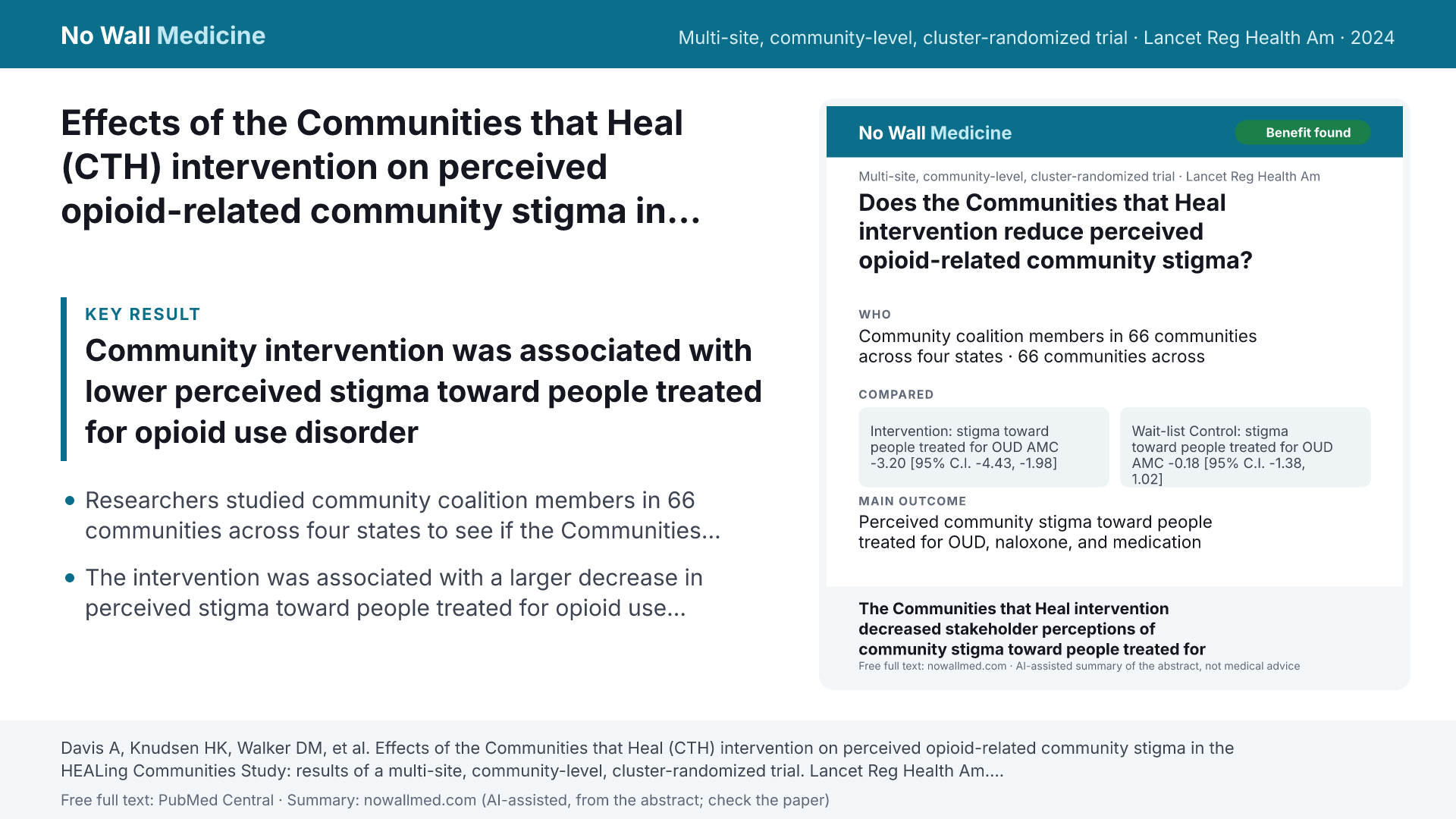
Community intervention was associated with lower perceived stigma toward people treated for opioid use disorder
Effects of the Communities that Heal (CTH) intervention on perceived opioid-related community stigma in the HEALing Communities Study: results of a multi-site, community-level, cluster-randomized trial
Multi-site, community-level, cluster-randomized trialBenefit found
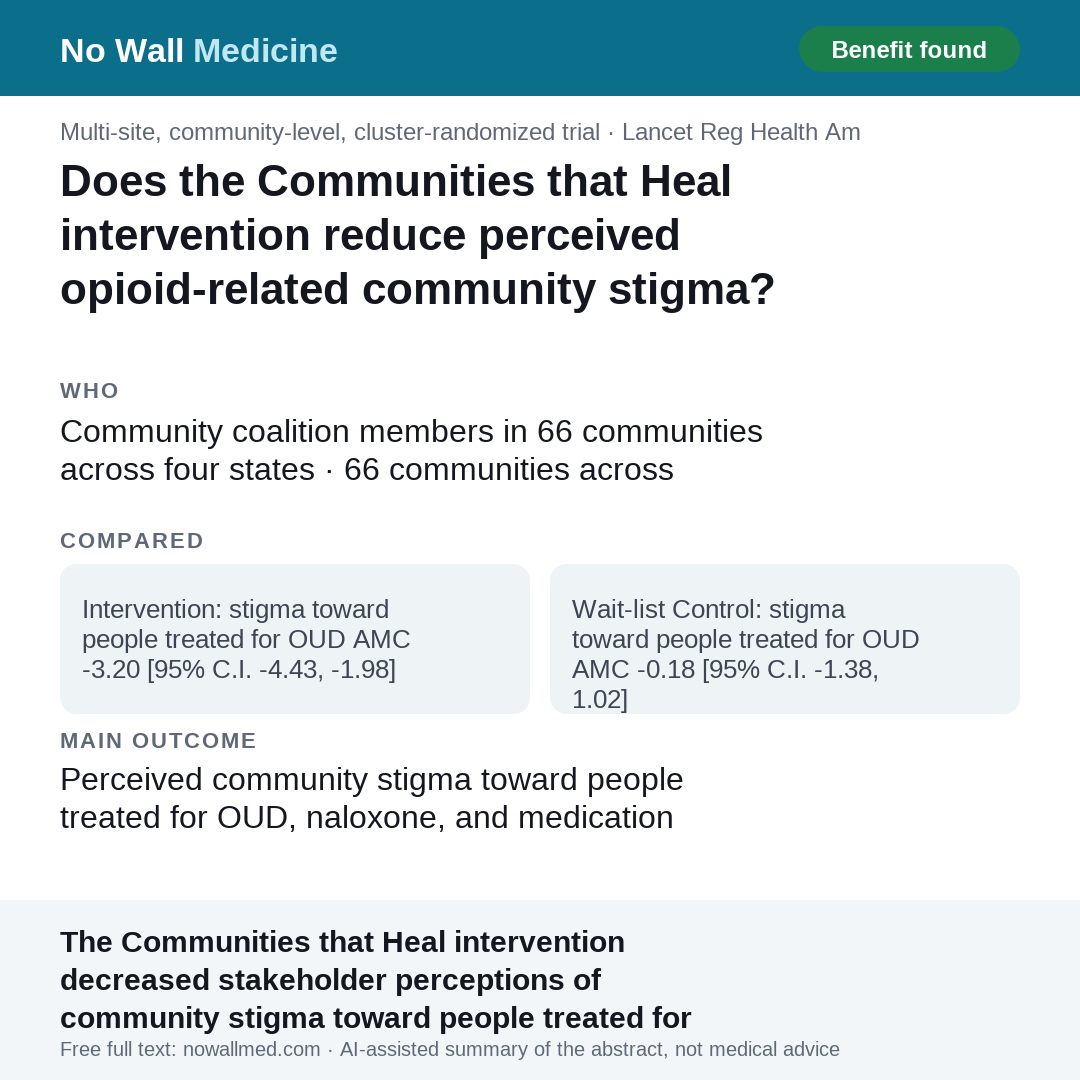
Does the Communities that Heal intervention reduce perceived opioid-related community stigma?
Who
Community coalition members in 66 communities across four states · 66 communities across four states
Compared
Intervention: stigma toward people treated for OUD AMC -3.20 [95% C.I. -4.43, -1.98]
Wait-list Control: stigma toward people treated for OUD AMC -0.18 [95% C.I. -1.38, 1.02]
Main outcome
Perceived community stigma toward people treated for OUD, naloxone, and medication
Result: AMC -3.20 [95% C.I. -4.43, -1.98] for OUD stigma
Bottom line: The Communities that Heal intervention decreased stakeholder perceptions of community stigma toward people treated for OUD and medication for opioid use disorder.
Funded by: US National Institute on Drug Abuse
Lancet Reg Health Am · 2024-03-12Download image
Clinical question: Does the Communities that Heal intervention reduce perceived opioid-related community stigma?
Why it matters: Community stigma toward people with opioid use disorder and toward medications used to treat it can worsen the opioid overdose crisis.
Key points
- Researchers studied community coalition members in 66 communities across four states to see if the Communities that Heal intervention changed perceptions of stigma.
- The intervention was associated with a larger decrease in perceived stigma toward people treated for opioid use disorder (AMC -3.20 [95% C.I. -4.43, -1.98]) and medication for opioid use disorder (AMC -0.33 [95% C.I. -0.56, -0.09]).
- The difference in perceived stigma toward naloxone, a medication used to reverse overdoses, between the intervention and control groups was not statistically significant (p = 0.18).
Headline and key points written with AI from the paper’s abstract, with every number checked against it. Read the paper before relying on them.
Was this summary helpful?
Cite this article
Davis A, Knudsen HK, Walker DM, et al. Effects of the Communities that Heal (CTH) intervention on perceived opioid-related community stigma in the HEALing Communities Study: results of a multi-site, community-level, cluster-randomized trial. Lancet Reg Health Am. 2024. doi:10.1016/j.lana.2024.100710
Spotted a mistake? Suggest a correction