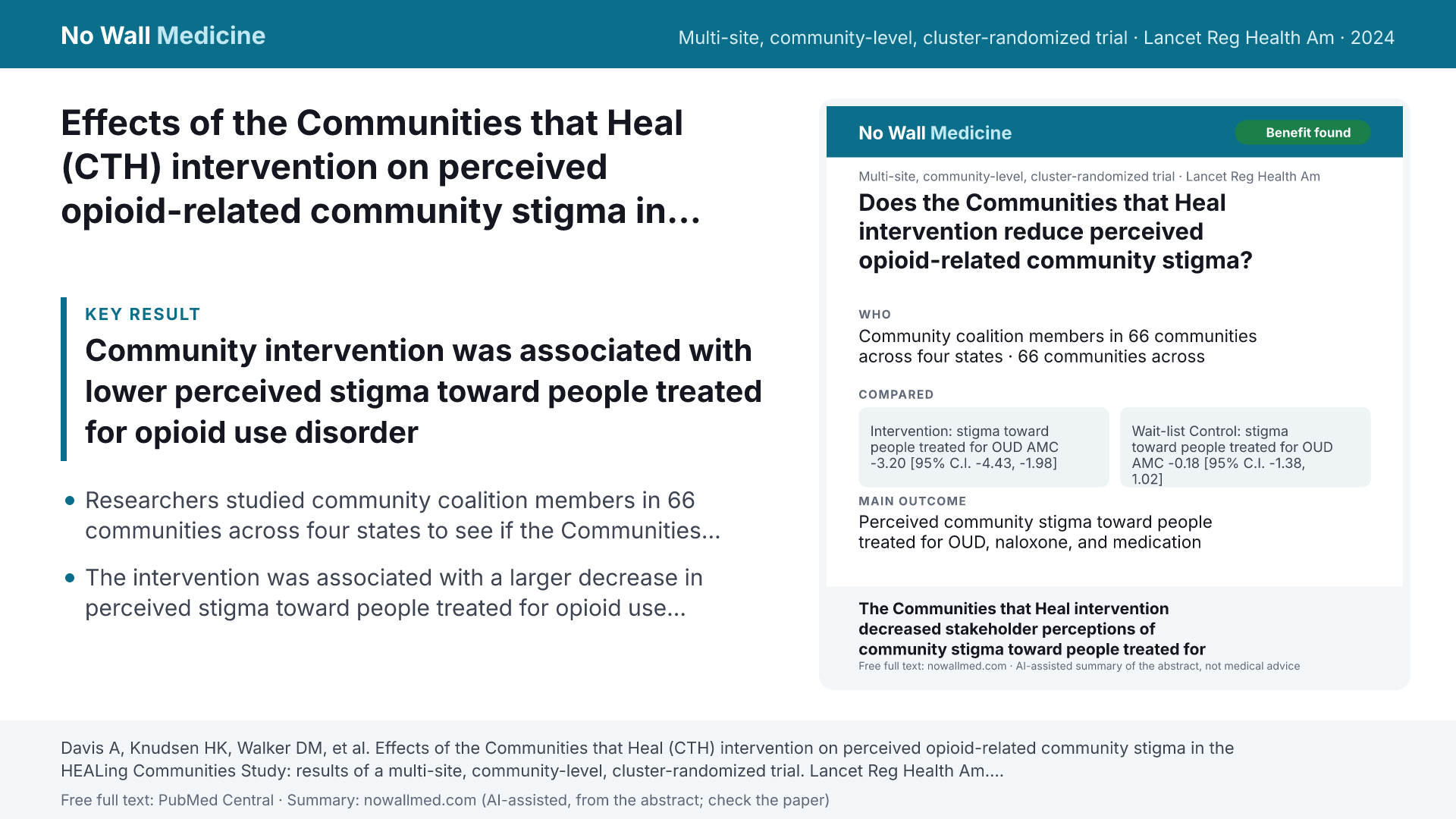
Effects of the Communities that Heal (CTH) intervention on perceived opioid-related community stigma in the HEALing Communities Study: results of a multi-site, community-level, cluster-randomized trial
Key result: Community intervention was associated with lower perceived stigma toward people treated for opioid use disorder
Key points
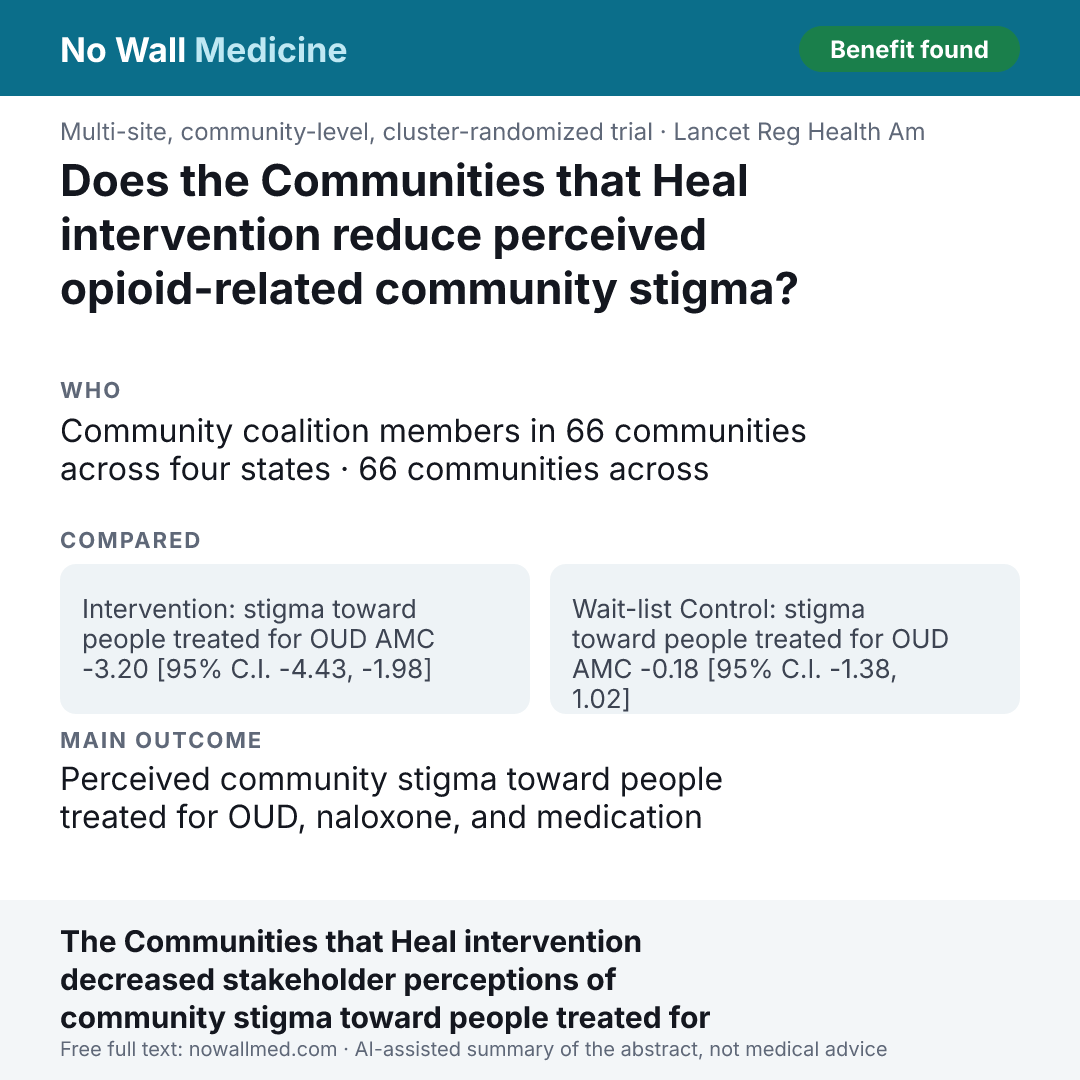
- Researchers studied community coalition members in 66 communities across four states to see if the Communities that Heal intervention changed perceptions of stigma.
- The intervention was associated with a larger decrease in perceived stigma toward people treated for opioid use disorder (AMC -3.20 [95% C.I. -4.43, -1.98]) and medication for opioid use disorder (AMC -0.33 [95% C.I. -0.56, -0.09]).
- The difference in perceived stigma toward naloxone, a medication used to reverse overdoses, between the intervention and control groups was not statistically significant (p = 0.18).
Why it matters: Community stigma toward people with opioid use disorder and toward medications used to treat it can worsen the opioid overdose crisis.
Discussion prompts
- Would these patients look like yours? Who was left out?
- Is the main outcome one that matters to patients?
- Is the difference large enough to change what you do?
Cite: Davis A, Knudsen HK, Walker DM, et al. Effects of the Communities that Heal (CTH) intervention on perceived opioid-related community stigma in the HEALing Communities Study: results of a multi-site, community-level, cluster-randomized trial. Lancet Reg Health Am. 2024;32:100710. doi:10.1016/j.lana.2024.100710
Free full text: PubMed Central · Summary and visual abstract: nowallmed.com/a/effects-of-the-communities-that-heal-cth-intervention-on-perceived-pwhy92/ (AI-assisted from the abstract; check the paper before relying on it).