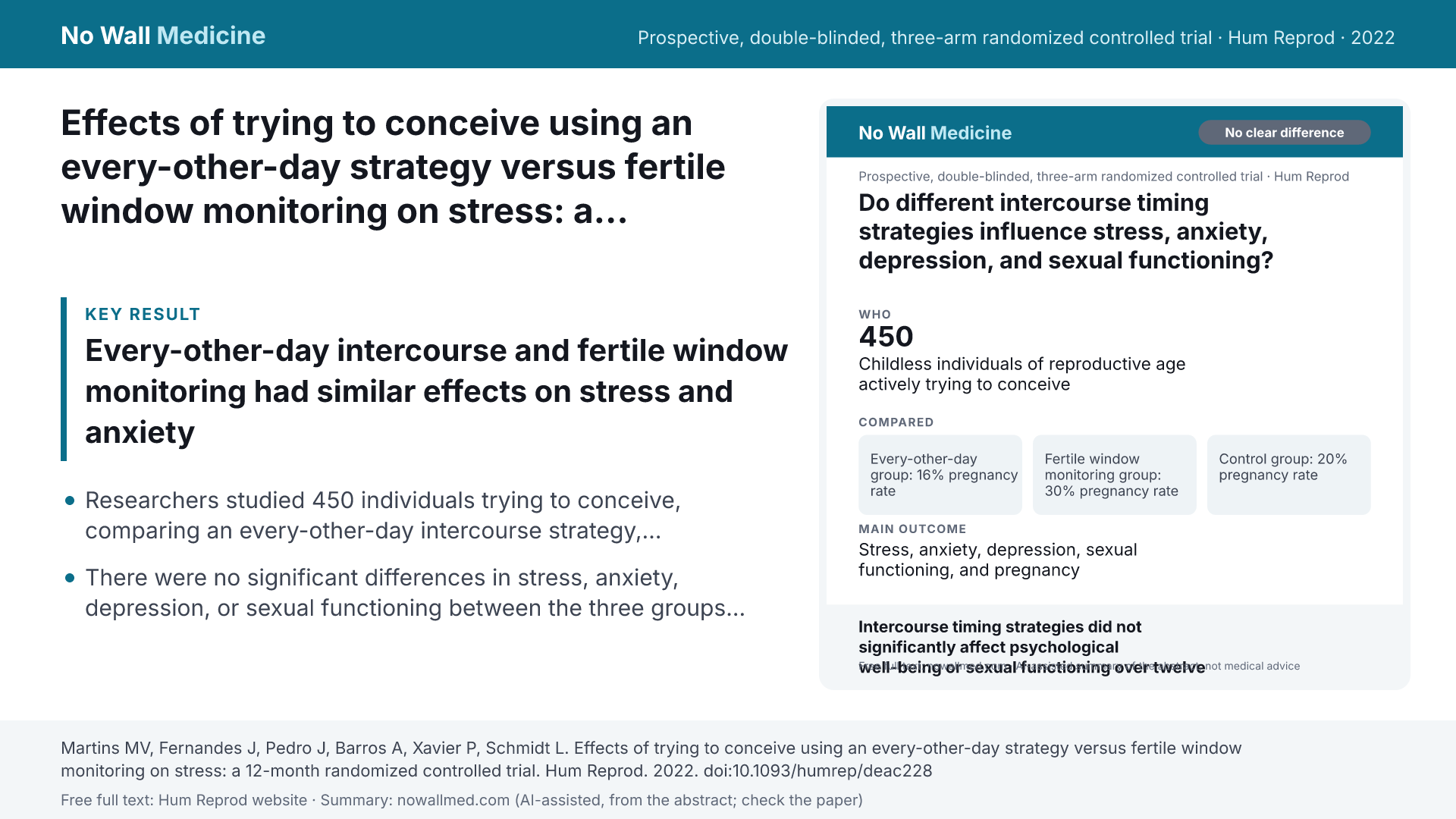
Every-other-day intercourse and fertile window monitoring had similar effects on stress and anxiety
Effects of trying to conceive using an every-other-day strategy versus fertile window monitoring on stress: a 12-month randomized controlled trial
Prospective, double-blinded, three-arm randomized controlled trialNo clear difference
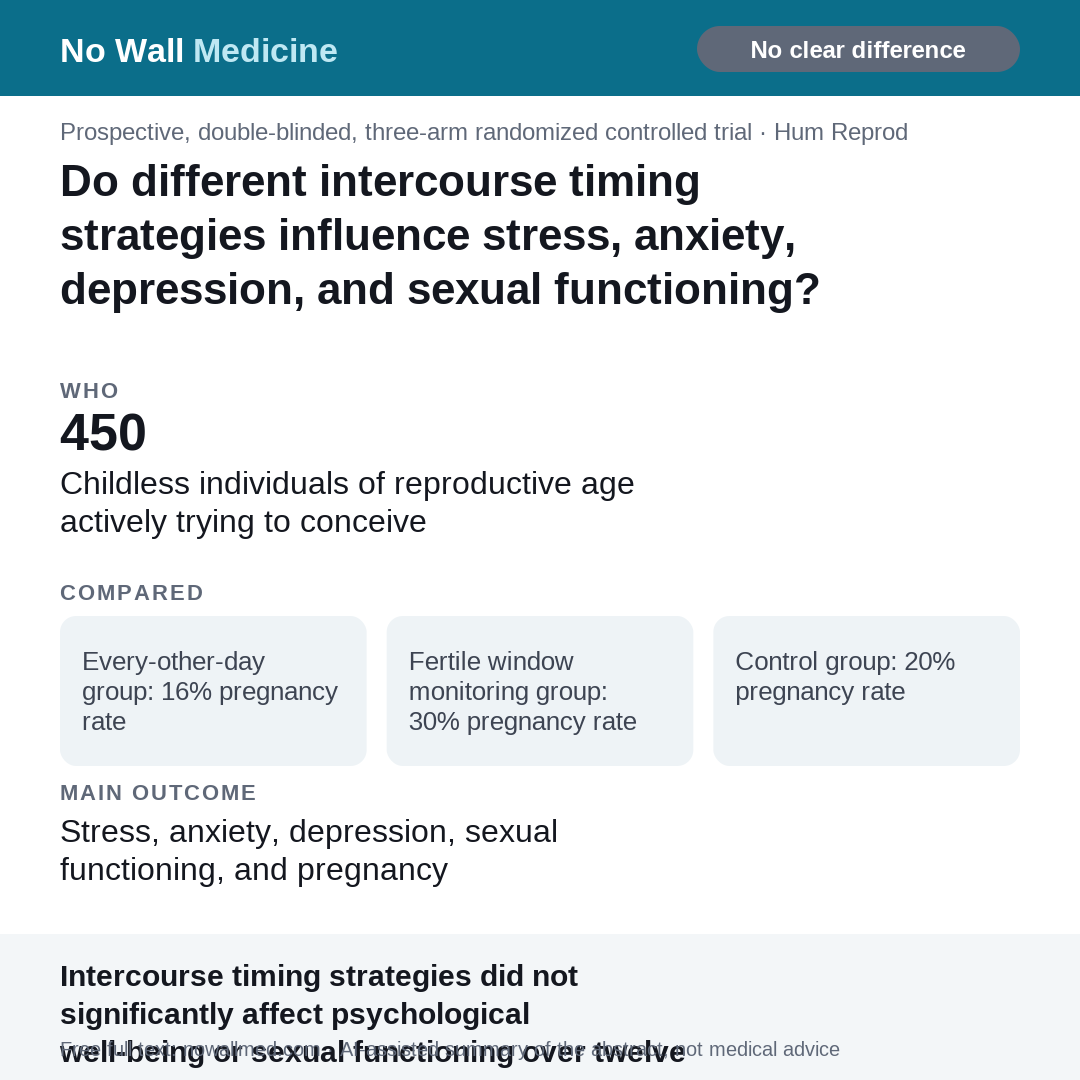
Do different intercourse timing strategies influence stress, anxiety, depression, and sexual functioning?
Who
450
Childless individuals of reproductive age actively trying to conceive
Compared
Every-other-day group: 16% pregnancy rate
Fertile window monitoring group: 30% pregnancy rate
Control group: 20% pregnancy rate
Main outcome
Stress, anxiety, depression, sexual functioning, and pregnancy
Bottom line: Intercourse timing strategies did not significantly affect psychological well-being or sexual functioning over twelve months.
Limitation: Potential bias as 30% met infertility criteria and other strategies might have been tried previously.
Hum Reprod · 2022-10-23Download image
Clinical question: Do different intercourse timing strategies influence stress, anxiety, depression, and sexual functioning?
Why it matters: It is unknown if different timing strategies for intercourse affect the psychological well-being and sexual functioning of individuals trying to conceive.
Key points
- Researchers studied 450 individuals trying to conceive, comparing an every-other-day intercourse strategy, fertile window monitoring, and a control group with no intervention.
- There were no significant differences in stress, anxiety, depression, or sexual functioning between the three groups over the 12-month period.
- Depression and sexual dysfunction significantly increased over time for all groups, while pregnancy rates were 16% for the every-other-day group, 30% for fertile window monitoring, and 20% for the control group.
Limitation the authors note: The study might be prone to bias because almost 30% of the sample met the chronological criteria for infertility and other reproductive strategies may have been used before recruitment.
Headline and key points written with AI from the paper’s abstract, with every number checked against it. Read the paper before relying on them.
Was this summary helpful?
Subject terms
Cite this article
Martins MV, Fernandes J, Pedro J, Barros A, Xavier P, Schmidt L. Effects of trying to conceive using an every-other-day strategy versus fertile window monitoring on stress: a 12-month randomized controlled trial. Hum Reprod. 2022. doi:10.1093/humrep/deac228
Spotted a mistake? Suggest a correction
Top studies every Monday
The week’s key trials and guidelines in your specialties, plus any topics you follow. By email, free.
Get the weekly digest