Virtual reality and robot-assisted therapies improve motor function and balance in children with cerebral palsy
Effects of virtual reality and robot-assisted therapy on rehabilitation outcomes in cerebral palsy: a systematic review and meta-analysis
Systematic review and meta-analysis of 17 randomized controlled trialsBenefit found
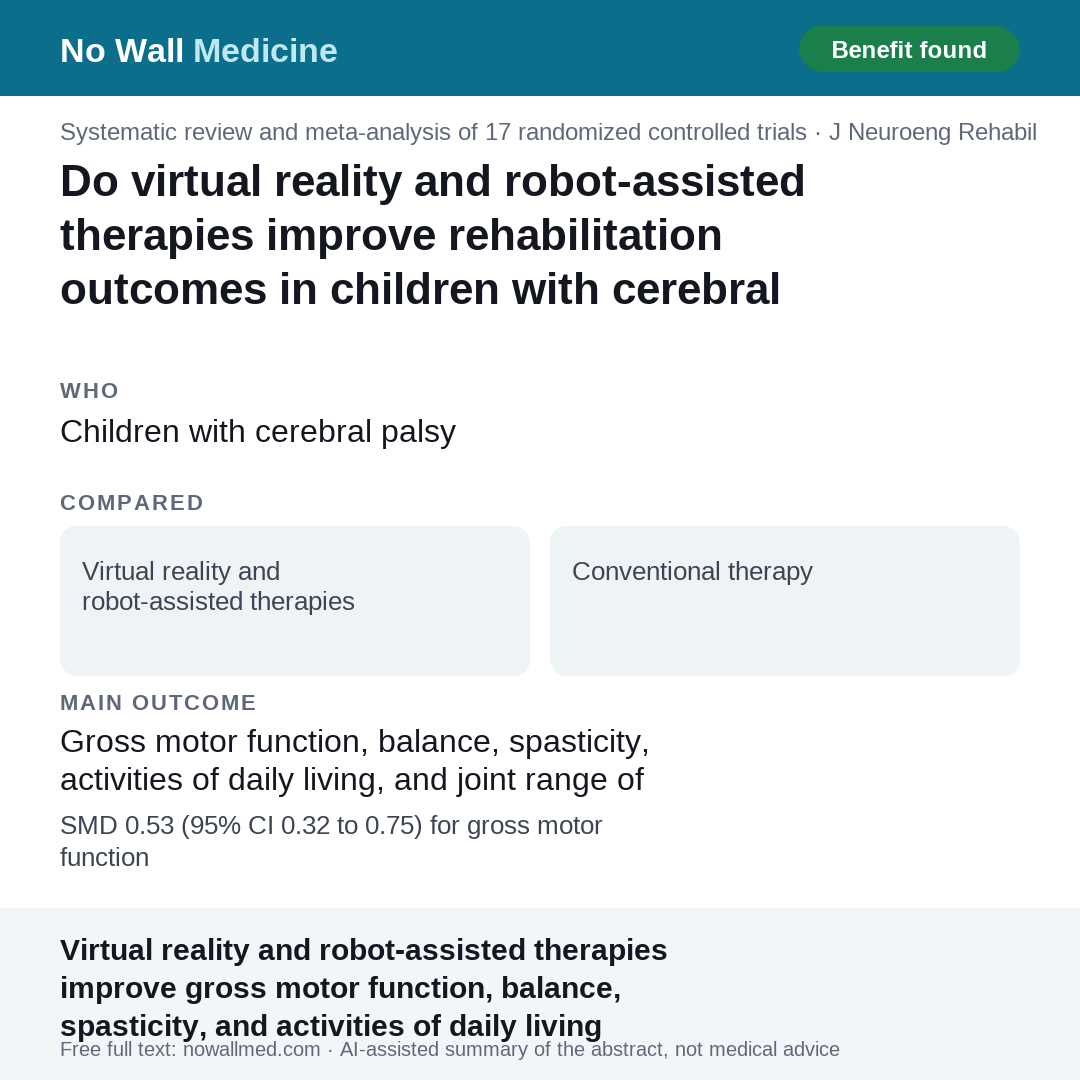
Do virtual reality and robot-assisted therapies improve rehabilitation outcomes in children with cerebral palsy?
Who
Children with cerebral palsy
Compared
Virtual reality and robot-assisted therapies
Conventional therapy
Main outcome
Gross motor function, balance, spasticity, activities of daily living, and joint range of motion
Result: SMD 0.53 (95% CI 0.32 to 0.75) for gross motor function
Bottom line: Virtual reality and robot-assisted therapies improve gross motor function, balance, spasticity, and activities of daily living in children with cerebral palsy.
Limitation: The findings were exploratory due to the limited number of included studies and certainty of evidence was very low to moderate.
J Neuroeng Rehabil · 2026-04-08Download image
Clinical question: Do virtual reality and robot-assisted therapies improve rehabilitation outcomes in children with cerebral palsy?
Why it matters: Existing research evidence on using virtual reality and robot-assisted technologies for cerebral palsy rehabilitation remains fragmented and lacks comprehensive subgroup analyses.
Key points
- Researchers analyzed 17 randomized controlled trials to compare virtual reality and robot-assisted therapies against conventional therapy for children with cerebral palsy.
- These technologies improved gross motor function (SMD = 0.53), balance (MD = 2.06), spasticity (MD = -0.49), and activities of daily living (MD = 0.51).
- The therapies showed no significant effect on joint range of motion, which is the measurement of how much a joint can move.
Limitation the authors note: The authors state that the findings were exploratory due to the limited number of included studies and the certainty of evidence ranged from very low to moderate.
Headline and key points written with AI from the paper’s abstract, with every number checked against it. Read the paper before relying on them.
Topics
Cite this article
Zhou H, Zhang Y, Nie M, Ge L. Effects of virtual reality and robot-assisted therapy on rehabilitation outcomes in cerebral palsy: a systematic review and meta-analysis. J Neuroeng Rehabil. 2026. doi:10.1186/s12984-026-01973-0
Spotted a mistake? Suggest a correction