Workplace interventions show varying effects on sitting time and step counts in working adults
Effects of workplace interventions on sedentary behaviour and physical activity: an umbrella review with meta-analyses and narrative synthesis
Umbrella review with meta-analyses and narrative synthesisMixed results
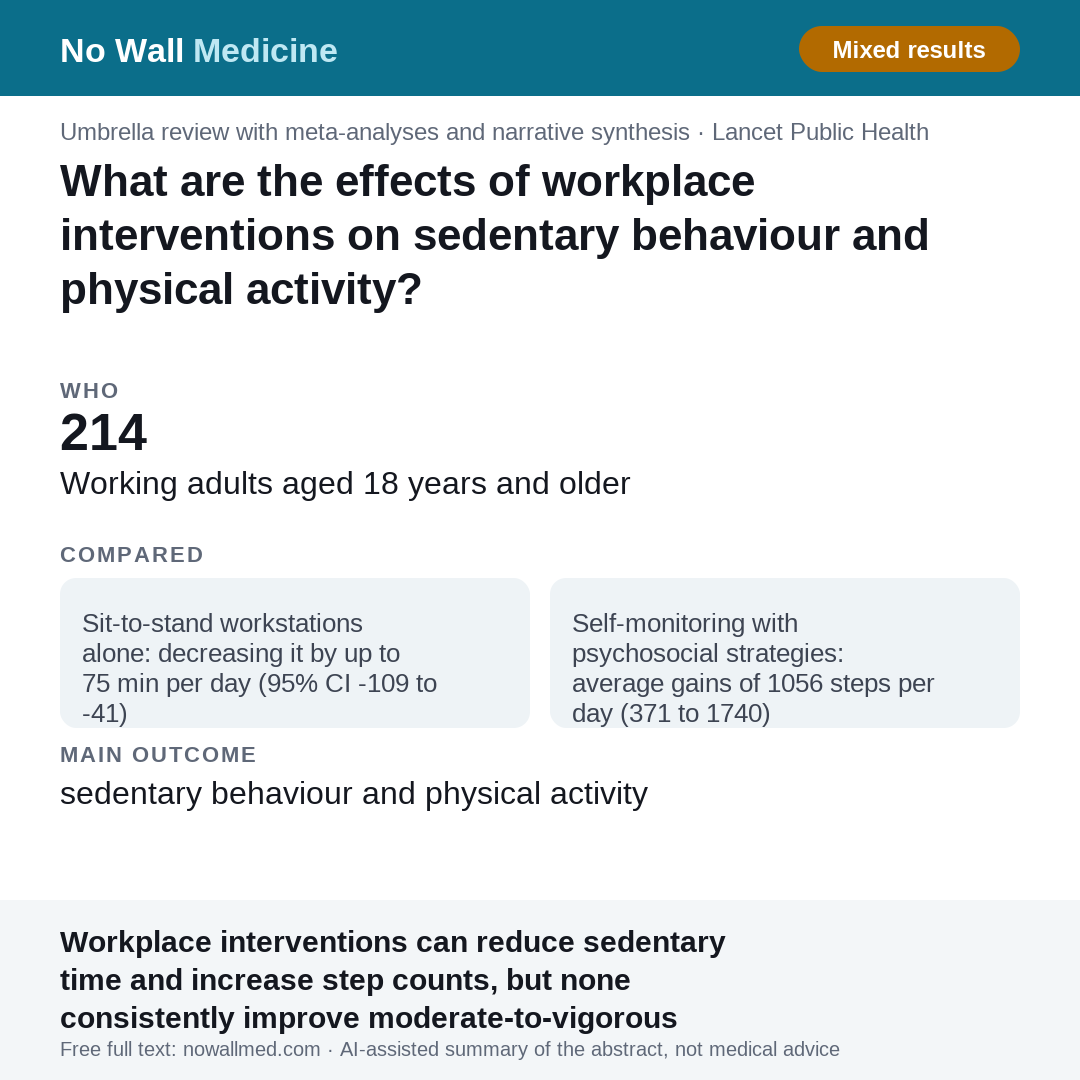
What are the effects of workplace interventions on sedentary behaviour and physical activity?
Who
214
Working adults aged 18 years and older
Compared
Sit-to-stand workstations alone: decreasing it by up to 75 min per day (95% CI -109 to -41)
Self-monitoring with psychosocial strategies: average gains of 1056 steps per day (371 to 1740)
Main outcome
sedentary behaviour and physical activity
Bottom line: Workplace interventions can reduce sedentary time and increase step counts, but none consistently improve moderate-to-vigorous physical activity.
Limitation: High heterogeneity (I2=84·80%) and potential publication bias in environmental-level interventions.
Lancet Public Health · 2025-04-03Download image
Clinical question: What are the effects of workplace interventions on sedentary behaviour and physical activity?
Why it matters: Synthesizing existing research is difficult because of the wide variety of workplace interventions and outcomes used to target physical inactivity.
Key points
- Researchers reviewed 36 systematic reviews and meta-analyses involving 214 primary studies to evaluate workplace programs for adults aged 18 years and older.
- Sit-to-stand workstations alone decreased sedentary time by up to 75 min per day, while combining them with psychosocial strategies increased this reduction by up to 33%.
- Self-monitoring paired with psychosocial strategies was associated with average gains of 1056 steps per day, but no strategy consistently increased moderate-to-vigorous physical activity.
Limitation the authors note: The authors noted high heterogeneity in the data, specifically an I2=84.80%.
Headline and key points written with AI from the paper’s abstract, with every number checked against it. Read the paper before relying on them.
Abstract
Background
Physical inactivity is rising globally, exacerbating the burden of preventable deaths and diseases. Despite extensive research on promoting physical activity in the workplace, synthesising the existing literature is challenging due to the wide variety of interventions and outcomes. This study aims to provide a comprehensive synthesis of intervention effects to inform health promotion initiatives and guide future research efforts. Methods
In this umbrella review, we conducted systematic searches of six databases (Cochrane, MEDLINE, Embase, CINAHL, Scopus, and Web of Science) for systematic reviews and meta-analyses published between Jan 1, 2000, and May 31, 2024, evaluating workplace interventions targeting sedentary behaviour or physical activity in working adults aged 18 years and older without specific health conditions or mobility impairments. Outcomes encompassed any behavioural changes related to sedentary behaviour or physical activity. Evidence for each relevant combination of intervention and outcome categories was summarised using either meta-analysis or narrative synthesis, with primary study data extracted as needed. This study is registered with PROSPERO, CRD42020171774. Findings
We included 36 systematic reviews and meta-analyses covering 214 unique primary studies. Despite considerable heterogeneity in the evidence, several effect trends emerged with moderate-to-high confidence. First, sit-to-stand workstations produced the largest reductions in sedentary time, decreasing it by up to 75 min per day (95% CI -109 to -41) when used alone, with reductions increasing by up to 33% when paired with psychosocial strategies. However, these interventions did not significantly increase physical activity at any intensity. Second, self-monitoring combined with psychosocial strategies yielded the largest increases in step count, with average gains of 1056 steps per day (371 to 1740). Third, no specific strategy consistently increased moderate-to-vigorous physical activity, although the available evidence remains sparse. Additional trends were observed but with lower confidence levels. Analysis of publication bias suggested an inflated effect of environmental-level interventions on occupational sedentary time. Adjusting for this bias using the trim-and-fill method only slightly reduced the effect size, but this result should be interpreted with caution due to high heterogeneity (I2=84·80%). Interpretation
Current evidence highlights the modest effect of existing workplace interventions on physical activity. Some strategies, such as sit-to-stand workstations and gamified interventions, effectively reduce sedentary behaviour and encourage lighter forms of physical activity, but none consistently improves moderate-to-vigorous physical activity, which provides the greatest health benefits. With many countries falling short of the WHO target to reduce physical inactivity prevalence by 15% from 2010 levels by 2030, intensified efforts are needed to address this gap, meet global goals, and alleviate the health burden of physical inactivity. Funding
None.
Abstract reproduced under the article’s CC BY licence.
Topics
Cite this article
Rouyard T, Yoda E, Akksilp K, Dieterich AV, Kc S, Dabak SV. Effects of workplace interventions on sedentary behaviour and physical activity: an umbrella review with meta-analyses and narrative synthesis. Lancet Public Health. 2025. doi:10.1016/S2468-2667(25)00038-6
Spotted a mistake? Suggest a correction
Top studies every Monday
The week’s key trials and guidelines in your specialties, by email. Free.
Get the weekly digest