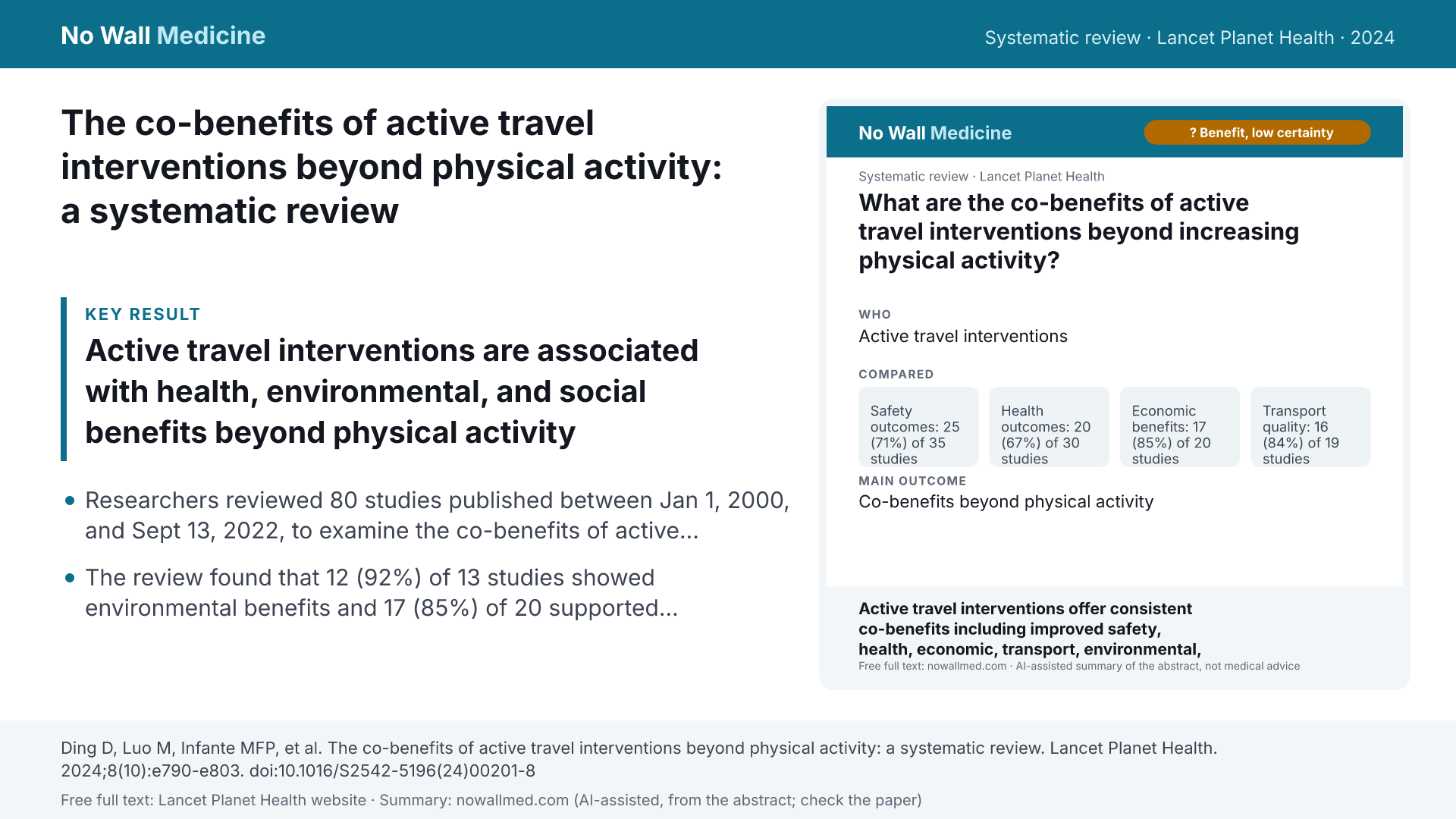
Active travel interventions are associated with health, environmental, and social benefits beyond physical activity
The co-benefits of active travel interventions beyond physical activity: a systematic review
Systematic reviewBenefit, low certainty
What are the co-benefits of active travel interventions beyond increasing physical activity?
Who
Active travel interventions
Compared
Safety outcomes: 25 (71%) of 35 studies
Health outcomes: 20 (67%) of 30 studies
Economic benefits: 17 (85%) of 20 studies
Transport quality: 16 (84%) of 19 studies
Main outcome
Co-benefits beyond physical activity
Bottom line: Active travel interventions offer consistent co-benefits including improved safety, health, economic, transport, environmental, and social outcomes.
Limitation: Overall low-certainty evidence, mostly limited by quasi-experimental and natural-experimental designs.
Lancet Planet Health · 2024-10-12 · Save PNG
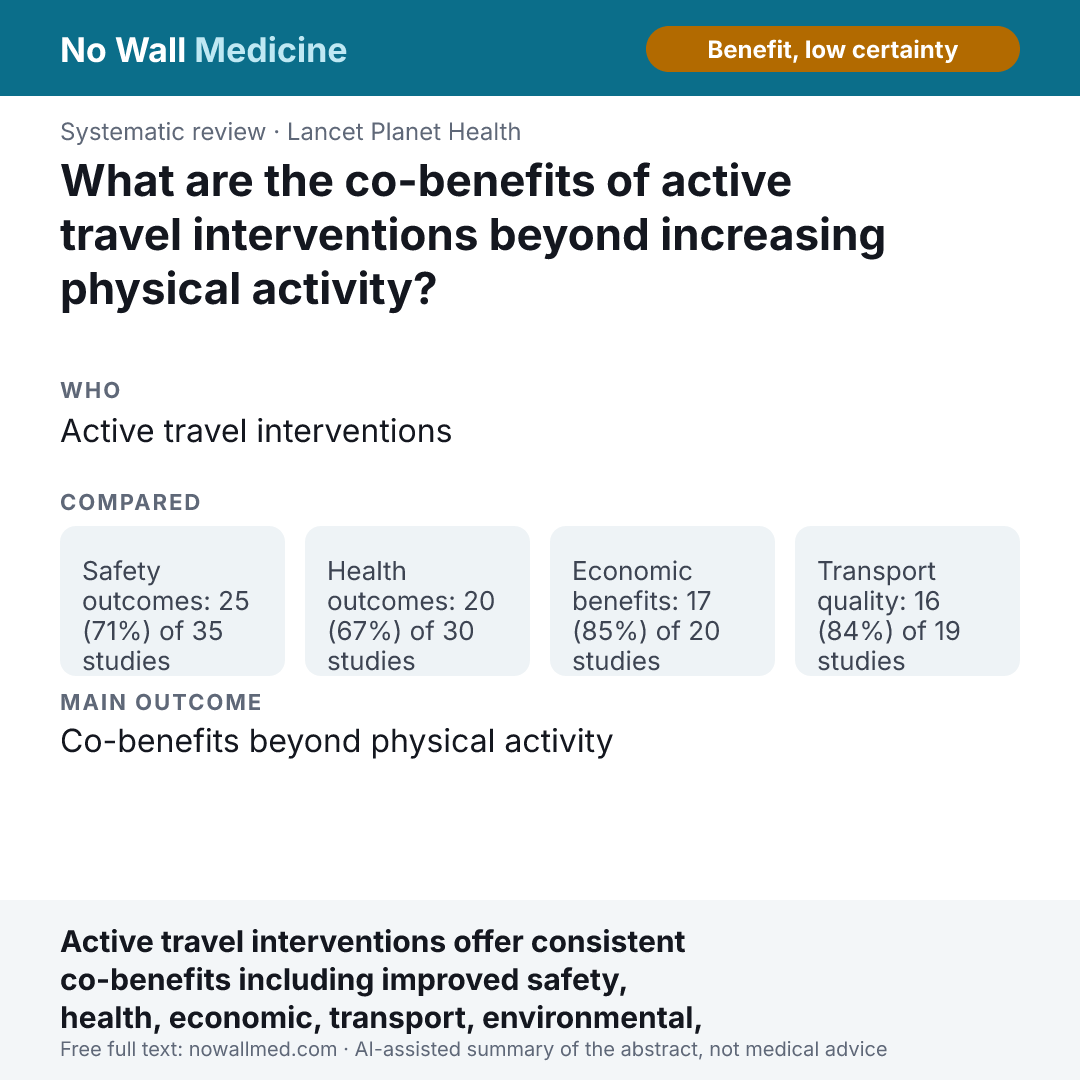
Clinical question: What are the co-benefits of active travel interventions beyond increasing physical activity?
Why it matters: The broader health, environmental, and social benefits of active travel interventions beyond increasing physical activity have rarely been synthesized.
Key points
- Researchers reviewed 80 studies published between Jan 1, 2000, and Sept 13, 2022, to examine the co-benefits of active travel interventions.
- The review found that 12 (92%) of 13 studies showed environmental benefits and 17 (85%) of 20 supported economic benefits.
- Other findings included 25 (71%) of 35 studies favoring improved safety outcomes and 20 (67%) of 30 showing improved health.
Limitation the authors note: The evidence was of overall low-certainty, mostly limited by the quasi-experimental design and natural-experimental design of many studies.
Headline and key points written with AI from the paper’s abstract, with every number checked against it. Read the paper before relying on them.
Was this summary helpful?
Abstract
Active travel is a widely recognised strategy for promoting active living but its co-benefits beyond increasing physical activity, such as broader health, environmental, and social benefits, have rarely been synthesised. We conducted a systematic review to examine the co-benefits of active travel interventions. Following a preregistered protocol (PROSPERO CRD42022359059), we identified 80 studies for the search period from Jan 1, 2000, to Sept 13, 2022. Across studies, there was consistent evidence that active travel interventions offered co-benefits beyond physical activity. Particularly, 25 (71%) of 35 studies favoured improved safety outcomes, 20 (67%) of 30 showed improved health, 17 (85%) of 20 supported economic benefits, 16 (84%) of 19 highlighted improved transport quality, 12 (92%) of 13 showed environmental benefits, and four (80%) of five documented social benefits. Despite the overall low-certainty evidence, mostly limited by the quasi-experimental design and natural-experimental design of many of the studies, active travel interventions offer unique opportunities to engage stakeholders across sectors to jointly address major societal issues, such as physical inactivity, traffic safety, and carbon emissions. This evidence can inform the design, implementation, and evaluation of active travel interventions.
Abstract reproduced under the article’s CC BY licence.
Subject terms
Headline, design, result, key points, caveat and citation as plain text.
Cite this article
Ding D, Luo M, Infante MFP, et al. The co-benefits of active travel interventions beyond physical activity: a systematic review. Lancet Planet Health. 2024;8(10):e790-e803. doi:10.1016/S2542-5196(24)00201-8
Spotted a mistake? Suggest a correction