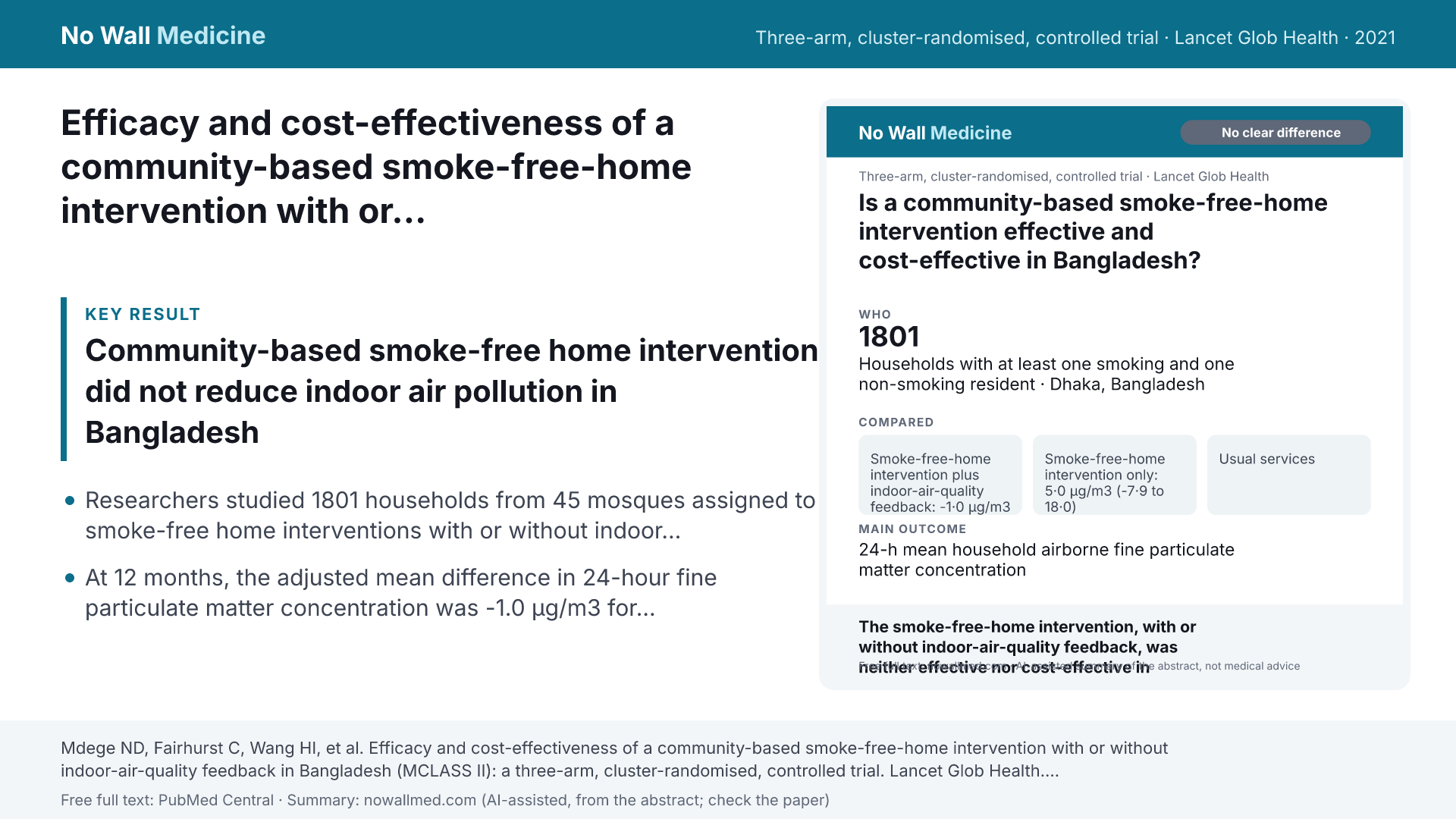
Community-based smoke-free home interventions did not reduce indoor air pollution in Bangladesh
Efficacy and cost-effectiveness of a community-based smoke-free-home intervention with or without indoor-air-quality feedback in Bangladesh (MCLASS II): a three-arm, cluster-randomised, controlled trial
Public & Global HealthAdult and pediatric
Three-arm, cluster-randomised, controlled trialNo clear difference
Is a community-based smoke-free-home intervention effective and cost-effective in Bangladesh?
Who
1801
Households with at least one smoking and one non-smoking resident · Dhaka, Bangladesh
Compared
Smoke-free-home intervention plus indoor-air-quality feedback: -1·0 μg/m3 (95% CI -12·8 to 10·9)
Smoke-free-home intervention only: 5·0 μg/m3 (-7·9 to 18·0)
Usual services
Main outcome
24-h mean household airborne fine particulate matter concentration
Result: -1·0 μg/m3 (95% CI -12·8 to 10·9)
Bottom line: The smoke-free-home intervention, with or without indoor-air-quality feedback, was neither effective nor cost-effective in reducing household second-hand-smoke exposure.
Funded by: Medical Research Council UK
Lancet Glob Health · 2021-04-18 · Save PNG
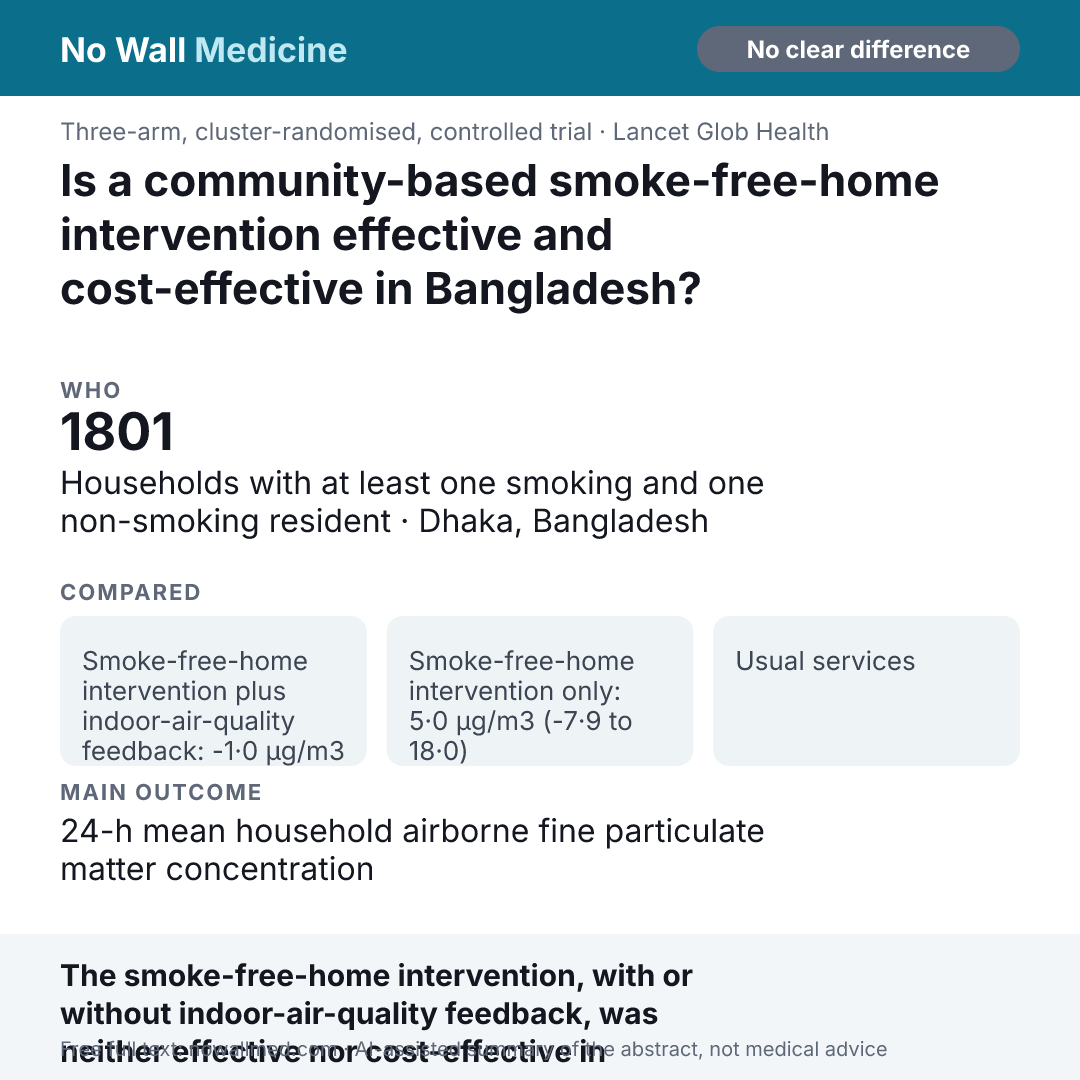
Clinical question: Is a community-based smoke-free-home intervention effective and cost-effective in Bangladesh?
Key points
- Researchers studied 1801 households from 45 mosques assigned to smoke-free home interventions with or without indoor air quality feedback or usual services.
- At 12 months, the adjusted mean difference in 24-hour fine particulate matter concentration was -1.0 μg/m3 for the combined intervention versus usual services (p=0.88).
- The intervention with air quality feedback was not cost-effective, costing US$653 per quality-adjusted life-year gained compared to the $427 threshold.
Headline and key points written with AI from the paper’s abstract, with every number checked against it. Read the paper before relying on them.
Was this summary helpful?
Abstract
Background
Exposure to second-hand smoke from tobacco is a major contributor to global morbidity and mortality. We aimed to evaluate the efficacy and cost-effectiveness of a community-based smoke-free-home intervention, with or without indoor-air-quality feedback, in reducing second-hand-smoke exposure in homes in Bangladesh. Methods
We did a three-arm, cluster-randomised, controlled trial in Dhaka, Bangladesh, and randomly assigned (1:1:1) mosques and consenting households from their congregations to a smoke-free-home intervention plus indoor-air-quality feedback, smoke-free-home intervention only, or usual services. Households were eligible if they had at least one resident attending one of the participating mosques, at least one adult resident (age 18 years or older) who smoked cigarettes or other forms of smoked tobacco (eg, bidi, waterpipe) regularly (on at least 25 days per month), and at least one non-smoking resident of any age. The smoke-free-home intervention consisted of weekly health messages delivered within an Islamic discourse by religious leaders at mosques over 12 weeks. Indoor-air-quality feedback comprised providing households with feedback on their indoor air quality measured over 24 h. Households in the usual services group received no intervention. Masking of participants and mosque leaders was not possible. The primary outcome was the 24-h mean household airborne fine particulate matter (<2·5 microns in diameter [PM2·5]) concentration (a marker of second-hand smoke) at 12 months after randomisation. Cost-effectiveness was estimated using incremental cost-effectiveness ratios (ICERs). This trial is registered with ISRCTN, 49975452. Findings
Between April 11 and Aug 2, 2018, we enrolled 1801 households from 45 mosques. 640 households (35·5%) were assigned to the smoke-free-home intervention plus indoor-air-quality feedback group, 560 (31·1%) to the smoke-free-home intervention only group, and 601 (33·4%) to the usual services group. At 12 months, the adjusted mean difference in household mean 24-h PM2·5 concentration was -1·0 μg/m3 (95% CI -12·8 to 10·9, p=0·88) for the smoke-free-home intervention plus indoor-air-quality feedback group versus the usual services group, 5·0 μg/m3 (-7·9 to 18·0, p=0·45) for the smoke-free-home intervention only group versus the usual services group, and -6·0 μg/m3 (-18·3 to 6·3, p=0·34) for the smoke-free-home intervention plus indoor-air-quality feedback group versus the smoke-free-home intervention only group. The ICER for the smoke-free-home intervention plus indoor-air-quality feedback versus usual services was US$653 per quality-adjusted life-year (QALY) gained, which was more than the upper limit of the Bangladesh willingness-to-pay threshold of $427 per QALY. Interpretation
The smoke-free-home intervention, with or without indoor-air-quality feedback, was neither effective nor cost-effective in reducing household second-hand-smoke exposure compared with usual services. These interventions are therefore not recommended for Bangladesh. Funding
Medical Research Council UK. Translation
For the Bengali translation of the abstract see Supplementary Materials section.
Abstract reproduced under the article’s CC BY licence.
Subject terms
Headline, design, result, key points, caveat and citation as plain text.
Cite this article
Mdege ND, Fairhurst C, Wang HI, et al. Efficacy and cost-effectiveness of a community-based smoke-free-home intervention with or without indoor-air-quality feedback in Bangladesh (MCLASS II): a three-arm, cluster-randomised, controlled trial. Lancet Glob Health. 2021;9(5):e639-e650. doi:10.1016/S2214-109X(21)00040-1
Spotted a mistake? Suggest a correction