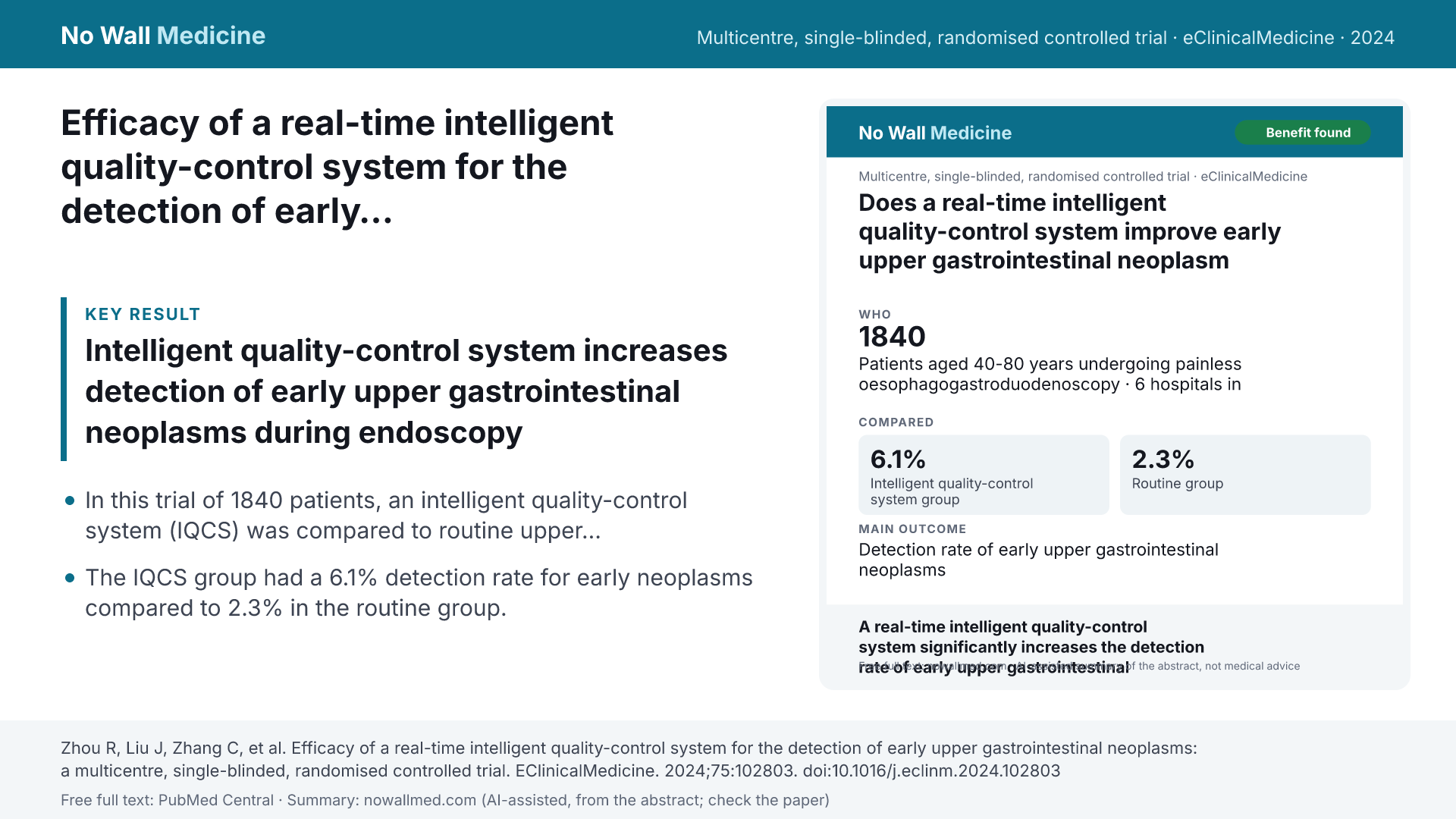
Intelligent quality-control system increases detection of early upper gastrointestinal neoplasms during endoscopy
Efficacy of a real-time intelligent quality-control system for the detection of early upper gastrointestinal neoplasms: a multicentre, single-blinded, randomised controlled trial
Multicentre, single-blinded, randomised controlled trialBenefit found
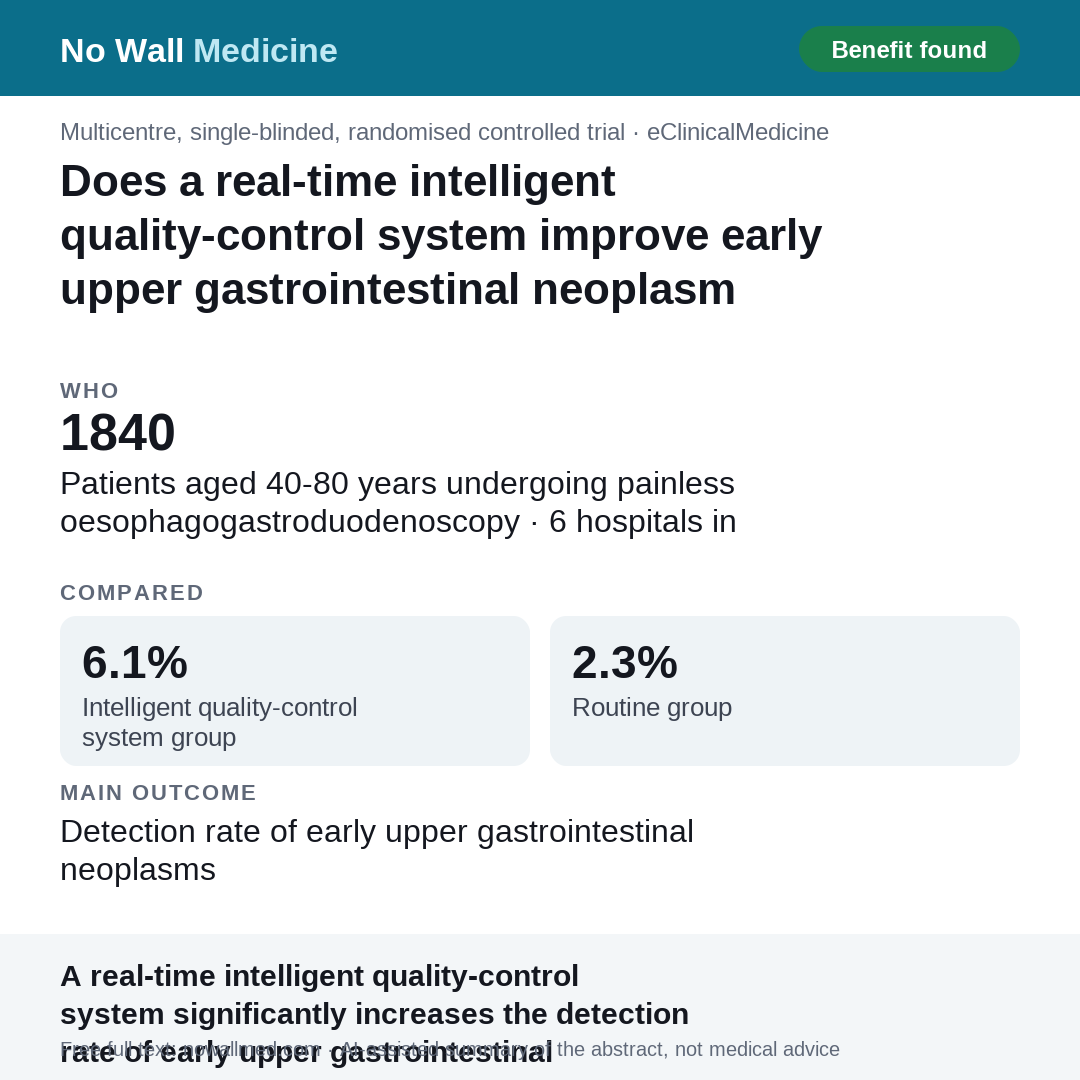
Does a real-time intelligent quality-control system improve early upper gastrointestinal neoplasm detection?
Who
1840
Patients aged 40-80 years undergoing painless oesophagogastroduodenoscopy · 6 hospitals in China
Compared
6.1%Intelligent quality-control system group (56/914)
2.3%Routine group (21/915)
Main outcome
Detection rate of early upper gastrointestinal neoplasms
Result: not explicitly provided as a single pooled ratio for the primary outcome
Bottom line: A real-time intelligent quality-control system significantly increases the detection rate of early upper gastrointestinal neoplasms.
Limitation: The effectiveness in real-world clinical settings needs a larger population validation.
Funded by: National Natural Science Foundation of China and others
eClinicalMedicine · 2024-08-30Download image
Clinical question: Does a real-time intelligent quality-control system improve early upper gastrointestinal neoplasm detection?
Why it matters: The optimal method for quality control during daily upper gastrointestinal endoscopy procedures is currently lacking.
In absolute numbers
Intelligent quality-control system group: 6.1% · Routine group: 2.3% → a difference of 3.8 percentage points, so about 27 people would need the treatment for 1 more to benefit (number needed to treat) over the trial’s follow-up.
Worked out by us from the two group results above, not reported by the authors. Check the paper for the exact outcome and timing.
Key points
- In this trial of 1840 patients, an intelligent quality-control system (IQCS) was compared to routine upper gastrointestinal endoscopy (OGD) procedures.
- The IQCS group had a 6.1% detection rate for early neoplasms compared to 2.3% in the routine group.
- The IQCS group showed fewer blind spots and higher stomach cleanliness scores across multiple regions compared to the routine group.
Headline and key points written with AI from the paper’s abstract, with every number checked against it. Read the paper before relying on them.
Was this summary helpful?
Cite this article
Zhou R, Liu J, Zhang C, et al. Efficacy of a real-time intelligent quality-control system for the detection of early upper gastrointestinal neoplasms: a multicentre, single-blinded, randomised controlled trial. eClinicalMedicine. 2024. doi:10.1016/j.eclinm.2024.102803
Spotted a mistake? Suggest a correction