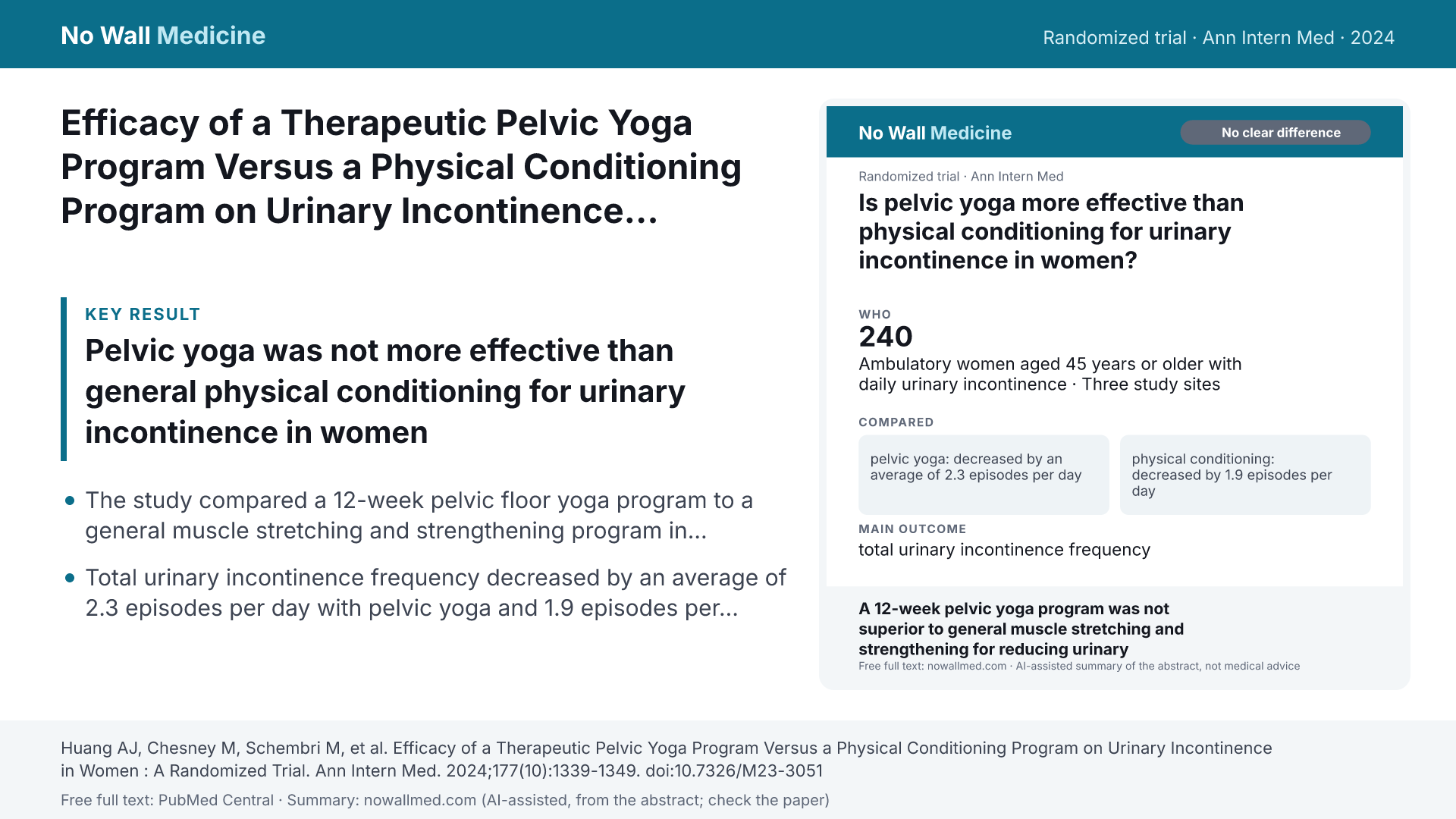
Pelvic yoga was not more effective than general physical conditioning for urinary incontinence in women
Efficacy of a Therapeutic Pelvic Yoga Program Versus a Physical Conditioning Program on Urinary Incontinence in Women : A Randomized Trial
Randomized trialNo clear difference
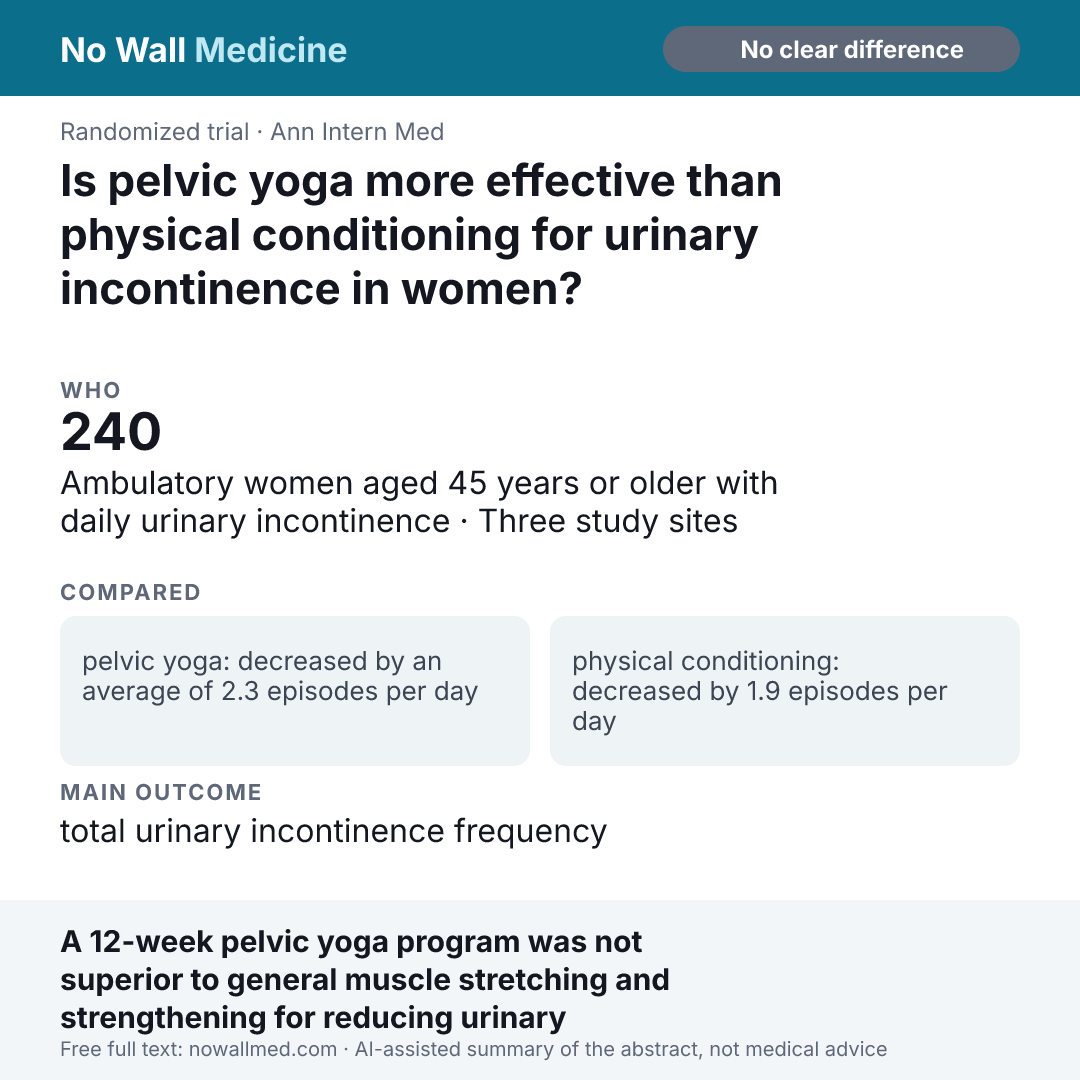
Is pelvic yoga more effective than physical conditioning for urinary incontinence in women?
Who
240
Ambulatory women aged 45 years or older with daily urinary incontinence · Three study sites in California, United States
Compared
pelvic yoga: decreased by an average of 2.3 episodes per day
physical conditioning: decreased by 1.9 episodes per day
Main outcome
total urinary incontinence frequency
Result: between-group difference of -0.3 episodes per day (95% CI, -0.7 to 0.0)
Bottom line: A 12-week pelvic yoga program was not superior to general muscle stretching and strengthening for reducing urinary incontinence.
Limitation: No comparison to no treatment or other clinical treatments; conversion to videoconference-based instruction during COVID-19.
Funded by: National Institutes of Health
Ann Intern Med · 2024-08-27 · Save PNG
Same trial (NCT03672461)
Papers we list that report this registered trial, oldest first. Read a secondary analysis alongside the main results.
- Main results No clear difference
This paper Ann Intern Med 2024-08 - Secondary analysis No clear difference
Hatha yoga did not improve sleep more than physical conditioning in women with urinary incontinence JAMA Netw Open 2025-12
Clinical question: Is pelvic yoga more effective than physical conditioning for urinary incontinence in women?
Key points
- The study compared a 12-week pelvic floor yoga program to a general muscle stretching and strengthening program in 240 women aged 45 to 90 years.
- Total urinary incontinence frequency decreased by an average of 2.3 episodes per day with pelvic yoga and 1.9 episodes per day with physical conditioning.
- Reductions in stress-type urinary incontinence, which is leakage during physical exertion, did not differ between the two groups by -0.1 episodes per day.
Limitation the authors note: The study did not compare the programs to no treatment or other clinical treatments and had to convert to videoconference-based instruction during the COVID-19 pandemic.
Headline and key points written with AI from the paper’s abstract, with every number checked against it. Read the paper before relying on them.
Was this summary helpful?
Subject terms
Headline, design, result, key points, caveat and citation as plain text.
Cite this article
Huang AJ, Chesney M, Schembri M, et al. Efficacy of a Therapeutic Pelvic Yoga Program Versus a Physical Conditioning Program on Urinary Incontinence in Women : A Randomized Trial. Ann Intern Med. 2024;177(10):1339-1349. doi:10.7326/M23-3051
Spotted a mistake? Suggest a correction