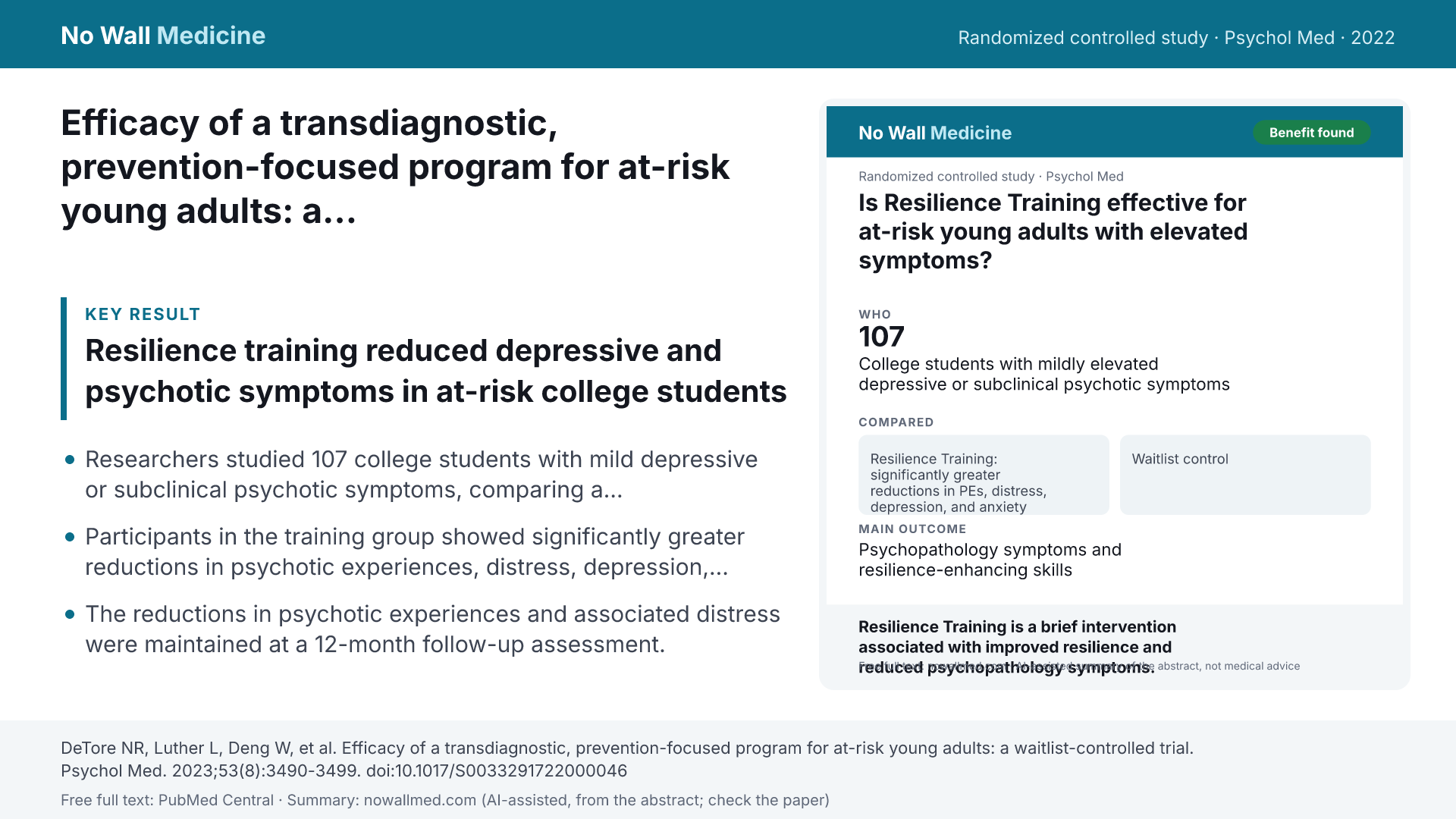
Resilience training reduced depressive and psychotic symptoms in at-risk college students
Efficacy of a transdiagnostic, prevention-focused program for at-risk young adults: a waitlist-controlled trial
Randomized controlled studyBenefit found
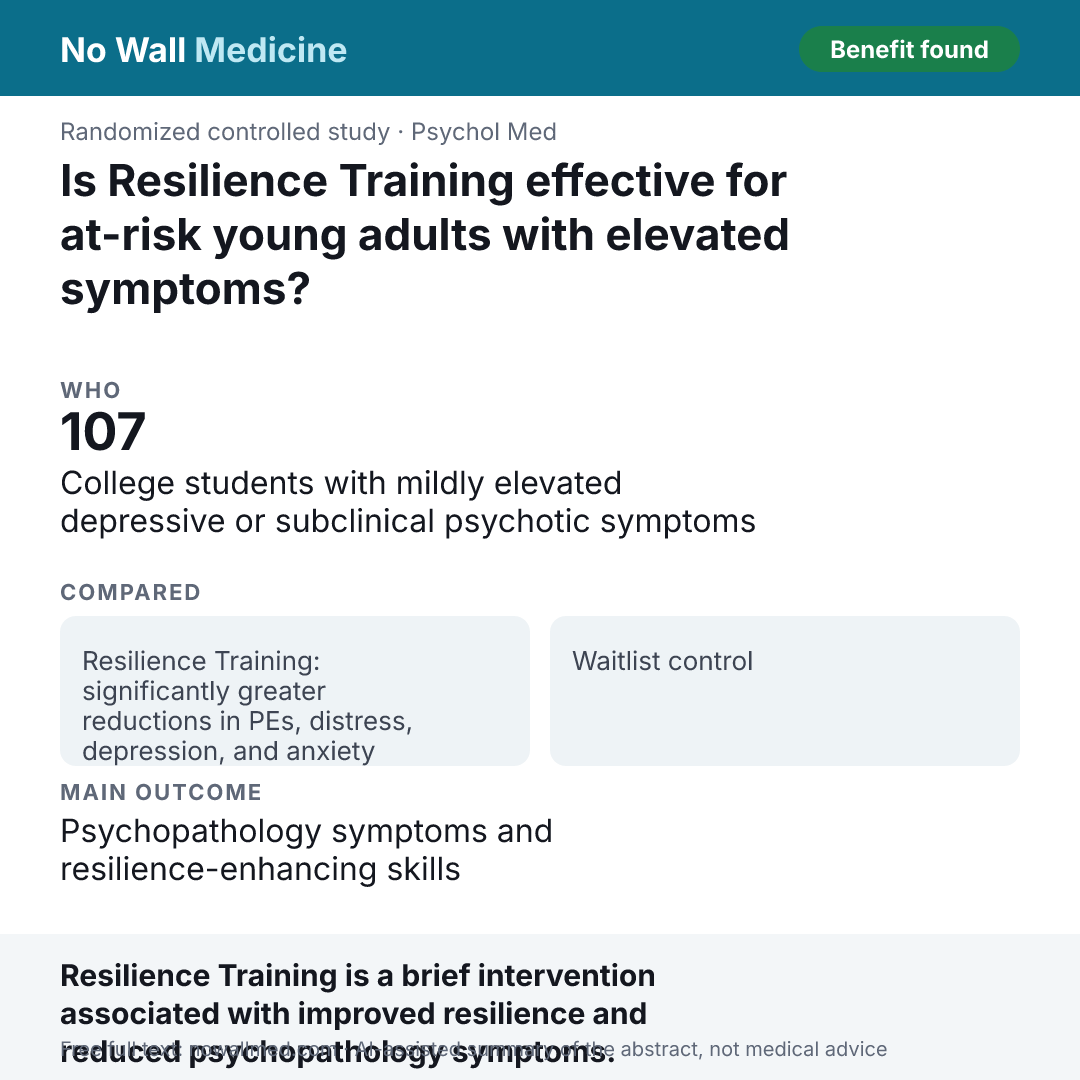
Is Resilience Training effective for at-risk young adults with elevated symptoms?
Who
107
College students with mildly elevated depressive or subclinical psychotic symptoms
Compared
Resilience Training: significantly greater reductions in PEs, distress, depression, and anxiety
Waitlist control
Main outcome
Psychopathology symptoms and resilience-enhancing skills
Bottom line: Resilience Training is a brief intervention associated with improved resilience and reduced psychopathology symptoms.
Psychol Med · 2022-03-01 · Save PNG
Clinical question: Is Resilience Training effective for at-risk young adults with elevated symptoms?
Key points
- Researchers studied 107 college students with mild depressive or subclinical psychotic symptoms, comparing a four-session Resilience Training program to a waitlist control group.
- Participants in the training group showed significantly greater reductions in psychotic experiences, distress, depression, and anxiety, as well as improvements in mindfulness and self-compassion (all p < 0.03).
- The reductions in psychotic experiences and associated distress were maintained at a 12-month follow-up assessment.
Headline and key points written with AI from the paper’s abstract, with every number checked against it. Read the paper before relying on them.
Was this summary helpful?
Subject terms
Headline, design, result, key points, caveat and citation as plain text.
Cite this article
DeTore NR, Luther L, Deng W, et al. Efficacy of a transdiagnostic, prevention-focused program for at-risk young adults: a waitlist-controlled trial. Psychol Med. 2022. doi:10.1017/S0033291722000046
Spotted a mistake? Suggest a correction