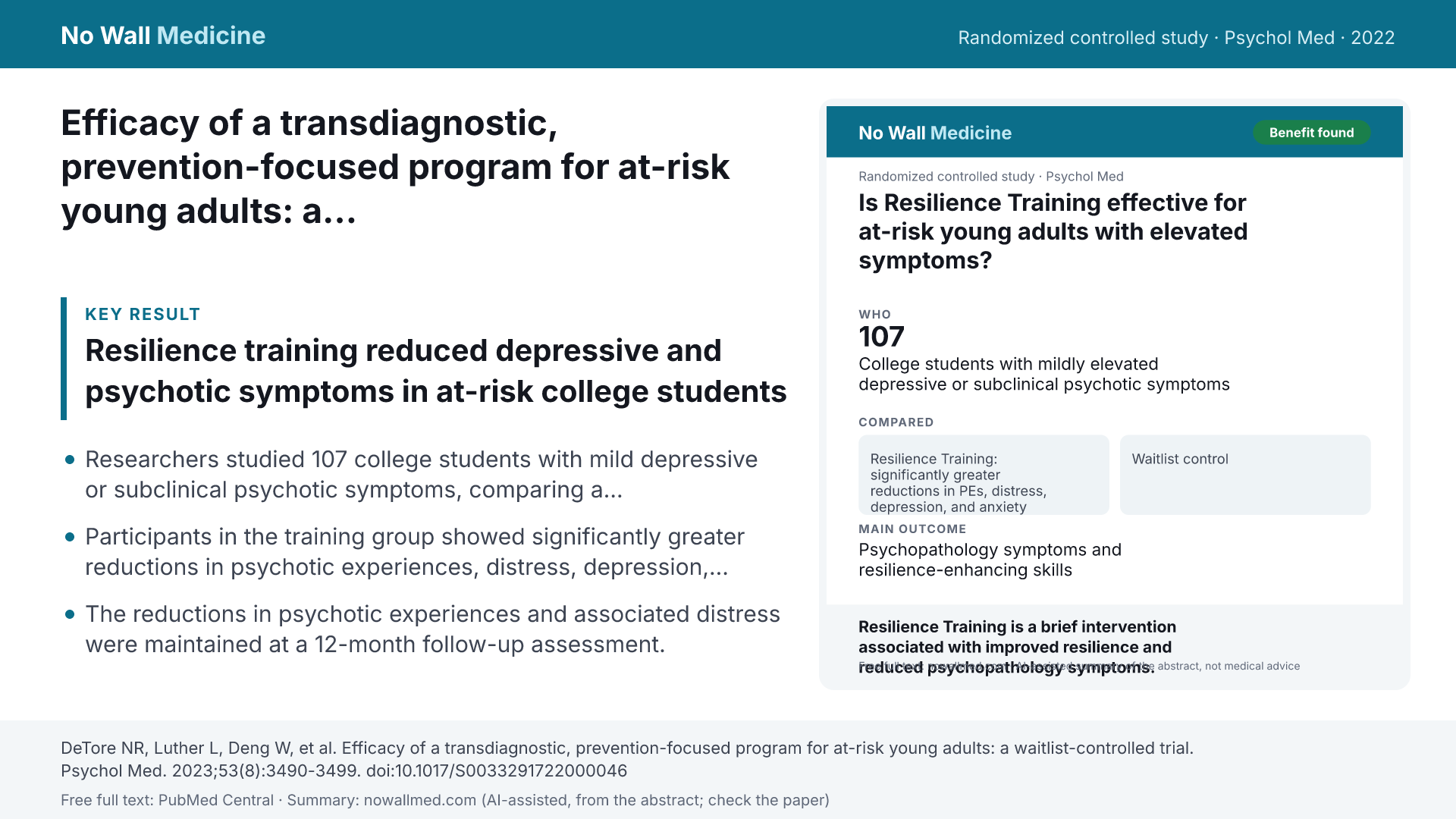
Efficacy of a transdiagnostic, prevention-focused program for at-risk young adults: a waitlist-controlled trial
Key result: Resilience training reduced depressive and psychotic symptoms in at-risk college students
Randomized controlled studyBenefit found
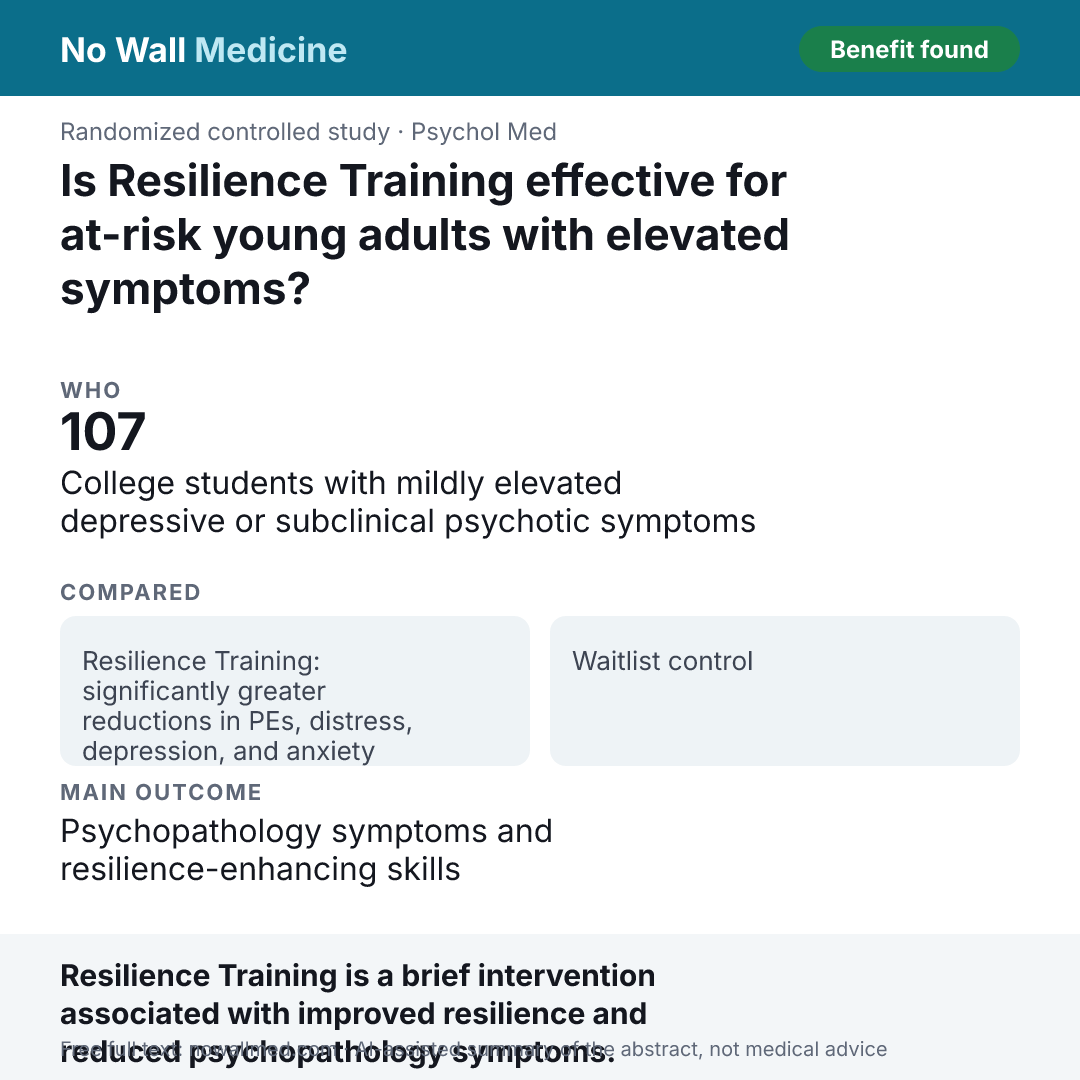
Is Resilience Training effective for at-risk young adults with elevated symptoms?
Who
107
College students with mildly elevated depressive or subclinical psychotic symptoms
Compared
Resilience Training: significantly greater reductions in PEs, distress, depression, and anxiety
Waitlist control
Main outcome
Psychopathology symptoms and resilience-enhancing skills
Bottom line: Resilience Training is a brief intervention associated with improved resilience and reduced psychopathology symptoms.
Psychol Med · 2022-03-01 · Save PNG
Key points
- Researchers studied 107 college students with mild depressive or subclinical psychotic symptoms, comparing a four-session Resilience Training program to a waitlist control group.
- Participants in the training group showed significantly greater reductions in psychotic experiences, distress, depression, and anxiety, as well as improvements in mindfulness and self-compassion (all p < 0.03).
- The reductions in psychotic experiences and associated distress were maintained at a 12-month follow-up assessment.
Discussion prompts
- Would these patients look like yours? Who was left out?
- Is the main outcome one that matters to patients?
- Is the difference large enough to change what you do?
Cite: DeTore NR, Luther L, Deng W, et al. Efficacy of a transdiagnostic, prevention-focused program for at-risk young adults: a waitlist-controlled trial. Psychol Med. 2022. doi:10.1017/S0033291722000046
Free full text: PubMed Central · Summary and visual abstract: nowallmed.com/a/efficacy-of-a-transdiagnostic-prevention-focused-program-for-at-risk-1y8l534/ (AI-assisted from the abstract; check the paper before relying on it).