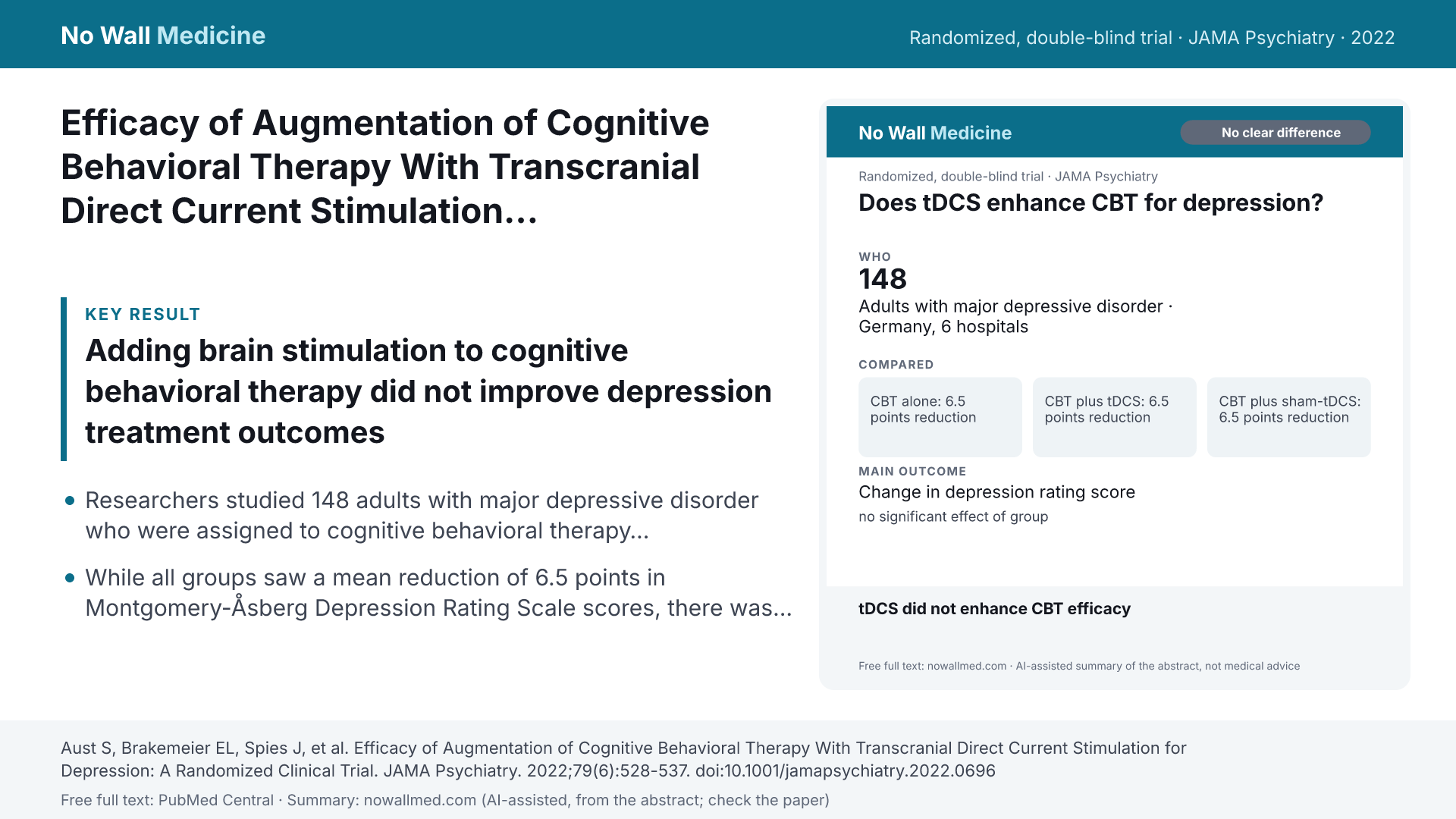
Adding brain stimulation to cognitive behavioral therapy did not improve depression treatment outcomes
Efficacy of Augmentation of Cognitive Behavioral Therapy With Transcranial Direct Current Stimulation for Depression: A Randomized Clinical Trial
Randomized, double-blind trialNo clear difference
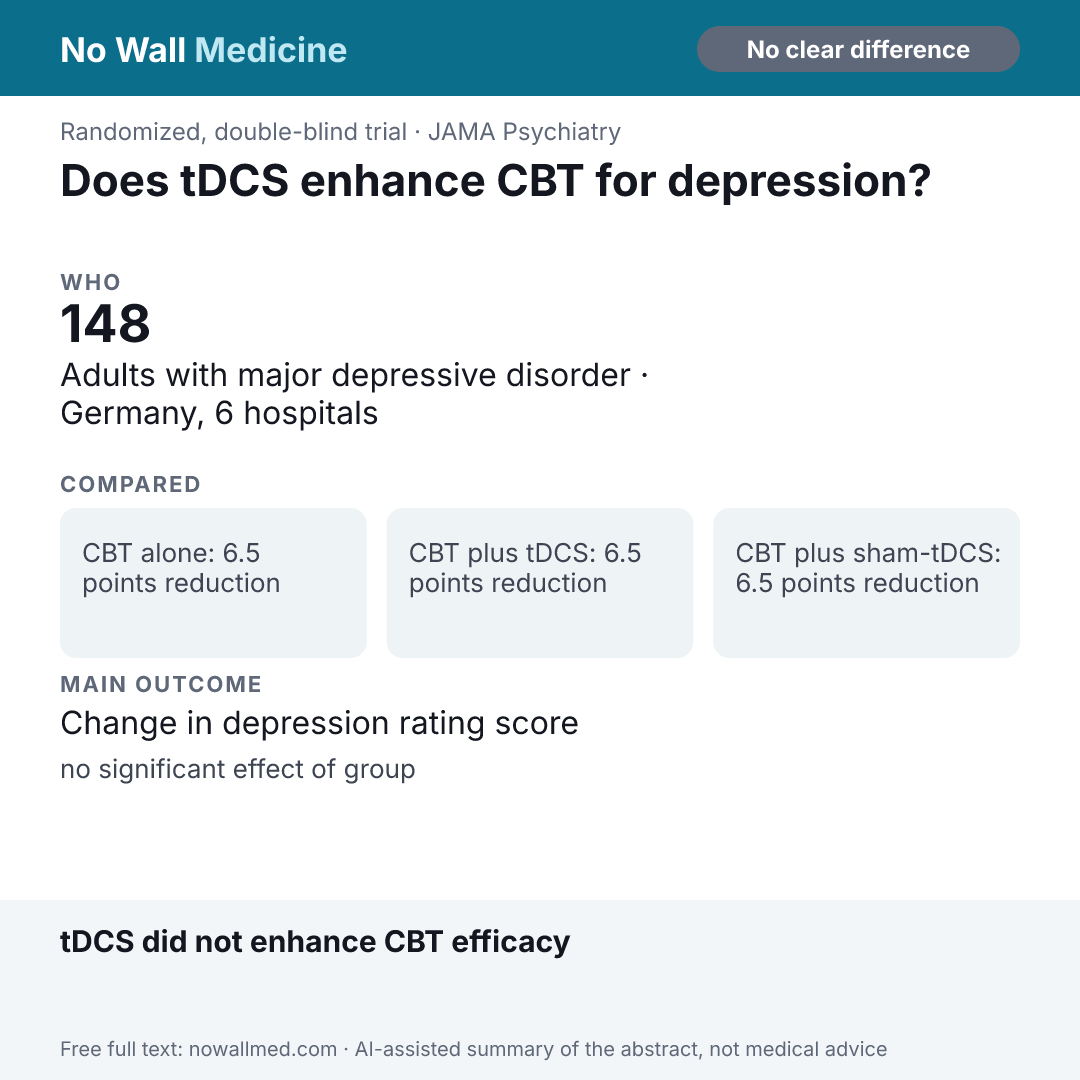
Does tDCS enhance CBT for depression?
Who
148
Adults with major depressive disorder · Germany, 6 hospitals
Compared
CBT alone: 6.5 points reduction
CBT plus tDCS: 6.5 points reduction
CBT plus sham-tDCS: 6.5 points reduction
Main outcome
Change in depression rating score
Result: no significant effect of group
Bottom line: tDCS did not enhance CBT efficacy
JAMA Psychiatry · 2022-04-21 · Save PNG
Clinical question: Does tDCS enhance CBT for depression?
Key points
- Researchers studied 148 adults with major depressive disorder who were assigned to cognitive behavioral therapy alone, cognitive behavioral therapy plus transcranial direct current stimulation, or cognitive behavioral therapy plus a sham stimulation.
- While all groups saw a mean reduction of 6.5 points in Montgomery-Åsberg Depression Rating Scale scores, there was no significant difference between the groups.
- The combination of cognitive behavioral therapy and transcranial direct current stimulation was found to be safe and feasible with no severe adverse events reported.
Headline and key points written with AI from the paper’s abstract, with every number checked against it. Read the paper before relying on them.
Was this summary helpful?
Subject terms
Headline, design, result, key points, caveat and citation as plain text.
Cite this article
Aust S, Brakemeier EL, Spies J, et al. Efficacy of Augmentation of Cognitive Behavioral Therapy With Transcranial Direct Current Stimulation for Depression: A Randomized Clinical Trial. JAMA Psychiatry. 2022;79(6):528-537. doi:10.1001/jamapsychiatry.2022.0696
Spotted a mistake? Suggest a correction