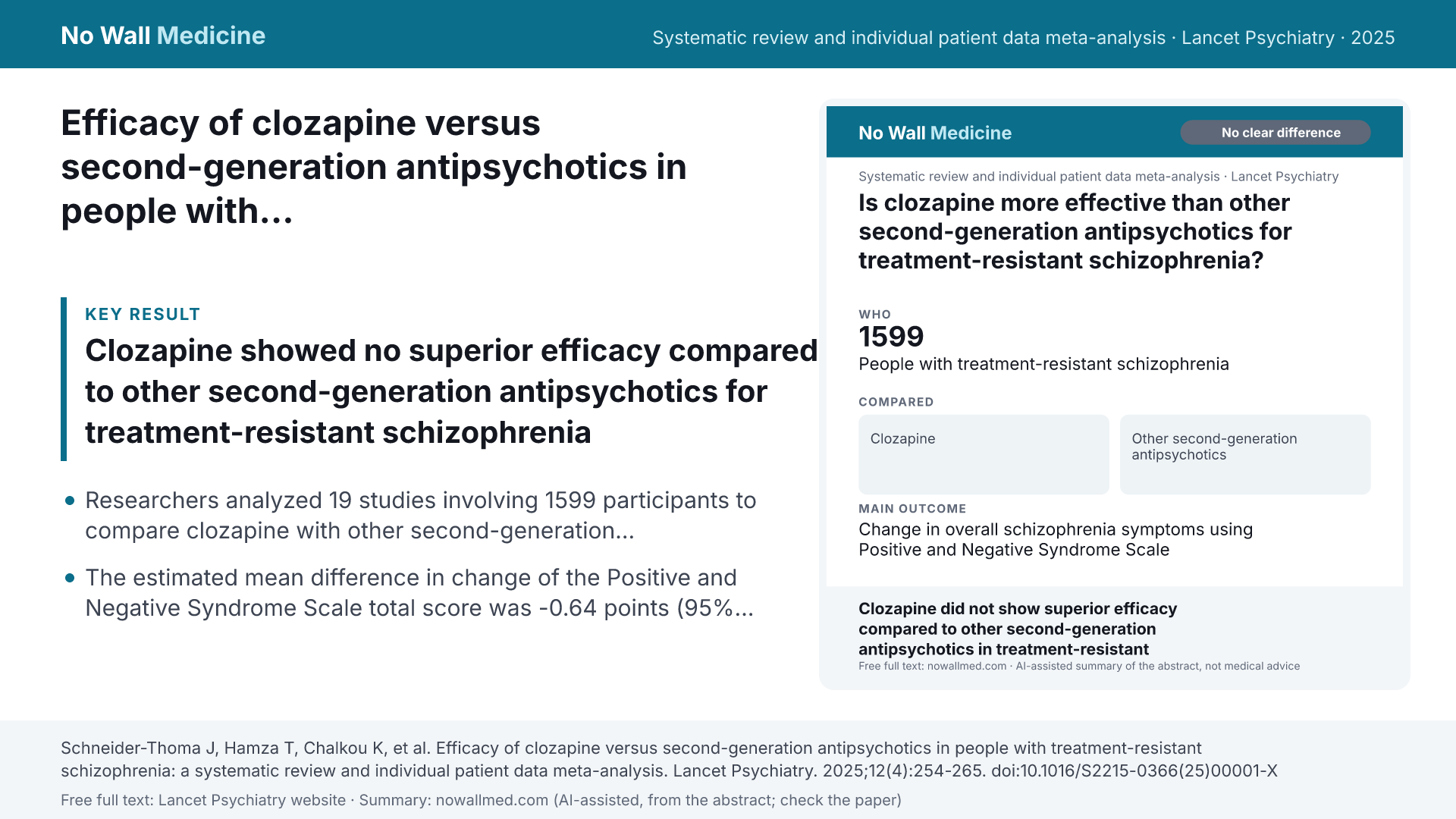
Clozapine showed no superior efficacy compared to other second-generation antipsychotics for treatment-resistant schizophrenia
Efficacy of clozapine versus second-generation antipsychotics in people with treatment-resistant schizophrenia: a systematic review and individual patient data meta-analysis
Systematic review and individual patient data meta-analysisNo clear difference
Is clozapine more effective than other second-generation antipsychotics for treatment-resistant schizophrenia?
Who
1599
People with treatment-resistant schizophrenia
Compared
Clozapine
Other second-generation antipsychotics
Main outcome
Change in overall schizophrenia symptoms using Positive and Negative Syndrome Scale
Result: mean difference -0·64 points (95% CrI -3·97 to 2·63)
Bottom line: Clozapine did not show superior efficacy compared to other second-generation antipsychotics in treatment-resistant schizophrenia.
Limitation: Unavailability of individual patient data for some studies and uncertainty due to premature study discontinuation.
Funded by: German Ministry of Education and Research
Lancet Psychiatry · 2025-02-26Download image
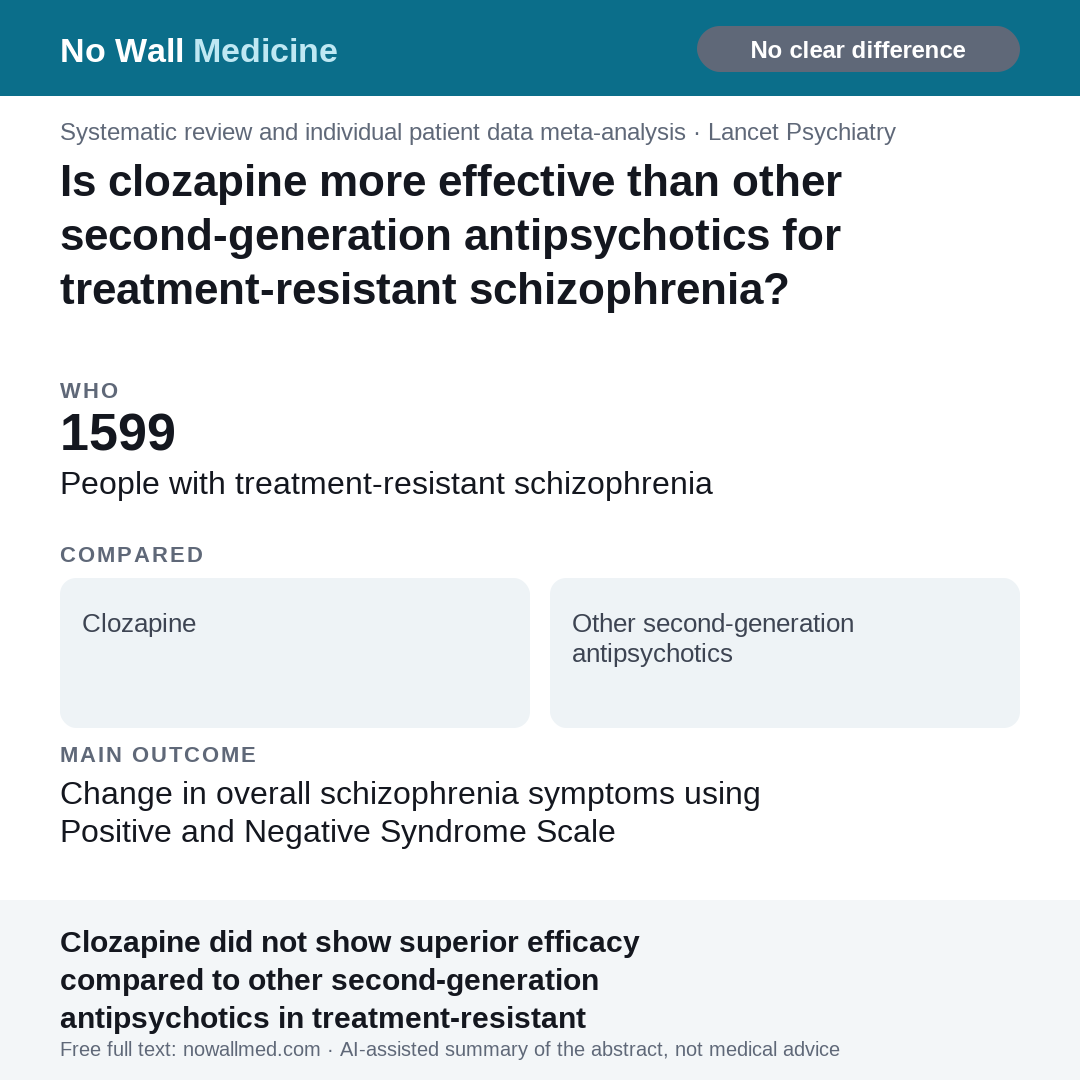
Clinical question: Is clozapine more effective than other second-generation antipsychotics for treatment-resistant schizophrenia?
Why it matters: Previous meta-analyses of randomized controlled trials showed no superior efficacy for clozapine and contained variability between original studies.
Key points
- Researchers analyzed 19 studies involving 1599 participants to compare clozapine with other second-generation antipsychotics in people with treatment-resistant schizophrenia.
- The estimated mean difference in change of the Positive and Negative Syndrome Scale total score was -0.64 points (95% CrI -3.97 to 2.63) in favor of other antipsychotics.
- Shorter duration of illness and higher baseline severity were associated with a larger reduction in symptoms, but sex did not modify the relative treatment effect.
Limitation the authors note: The study was limited by the unavailability of individual patient data for some studies, uncaptured sources of variance, and uncertainty due to premature study discontinuation.
Headline and key points written with AI from the paper’s abstract, with every number checked against it. Read the paper before relying on them.
Was this summary helpful?
Abstract
Background
Clozapine is recommended by national and international guidelines for people with treatment-resistant schizophrenia. However, available meta-analyses of randomised controlled trials have not shown superior efficacy of clozapine when compared with other second-generation antipsychotics, with heterogeneity identified between the original studies. We aimed to use individual patient data (IPD) to account for potential reasons of variability and to synthesise an adjusted estimate for the difference in efficacy between clozapine and other second-generation antipsychotics for treatment-resistant schizophrenia. Methods
In this systematic review and IPD meta-analysis, we searched the Cochrane Schizophrenia Group's Study-Based Register from inception to Jan 24, 2024, and previous reviews for blinded randomised controlled trials comparing clozapine with other second-generation antipsychotics in participants with treatment-resistant schizophrenia. Trials were eligible if they included patients with treatment-resistant schizophrenia and had a duration of at least 6 weeks. IPD were requested from trial investigators. The primary outcome was change in overall schizophrenia symptoms as measured by the Positive and Negative Syndrome Scale (PANSS) between clozapine and other second-generation antipsychotics after 6-8 weeks of treatment. The effect size measure for the primary outcome was mean difference with 95% credible interval (CrI). We fitted a Bayesian random-effects IPD meta-regression model that included duration of illness, baseline severity, and sex as potential prognostic factors or treatment effect modifiers. Confidence in the evidence was assessed using Grading of Recommendations, Assessment, Development, and Evaluation (GRADE). People with lived experience of mental illness were involved in this study. This study is registered with PROSPERO, CRD42021254986. Findings
We screened 13 876 references and included 19 studies with data for 1599 participants; IPD were available for 12 of 19 trials (n=1052; mean age 37·67 years [SD 11·24; range 10-66]; 348 [33·08%] women and 704 [66·92%] men). Data on ethnicity were not available. The estimated mean difference in change from baseline PANSS total score was -0·64 points (95% CrI -3·97 to 2·63; τ=2·68) in favour of other second-generation antipsychotics. Shorter duration of illness and higher baseline severity were prognostic factors associated with a larger reduction in symptoms, but neither those factors nor sex were found to modify the relative effect between clozapine and other second-generation antipsychotics. The confidence in the evidence was graded as very low. Interpretation
This IPD meta-analysis found a small and uncertain advantage of other second-generation antipsychotics, mainly olanzapine and risperidone, and so did not provide evidence for superior efficacy of clozapine compared with other second-generation antipsychotics in treatment-resistant schizophrenia. It is limited by unavailability of IPD for some studies, uncaptured sources of variance, and uncertainty due to premature study discontinuation. Given the side-effects of clozapine, the observed uncertainty regarding clozapine's superiority warrants prudent use and further research. Funding
German Ministry of Education and Research.
Abstract reproduced under the article’s CC BY licence.
Subject terms
Cite this article
Schneider-Thoma J, Hamza T, Chalkou K, Siafis S, Dong S, Bighelli I. Efficacy of clozapine versus second-generation antipsychotics in people with treatment-resistant schizophrenia: a systematic review and individual patient data meta-analysis. Lancet Psychiatry. 2025. doi:10.1016/S2215-0366(25)00001-X
Spotted a mistake? Suggest a correction
Top studies every Monday
The week’s key trials and guidelines in your specialties, plus any topics you follow. By email, free.
Get the weekly digest