Efficacy of Communication Bridge-2 for primary progressive aphasia: A randomized controlled trial of communication intervention
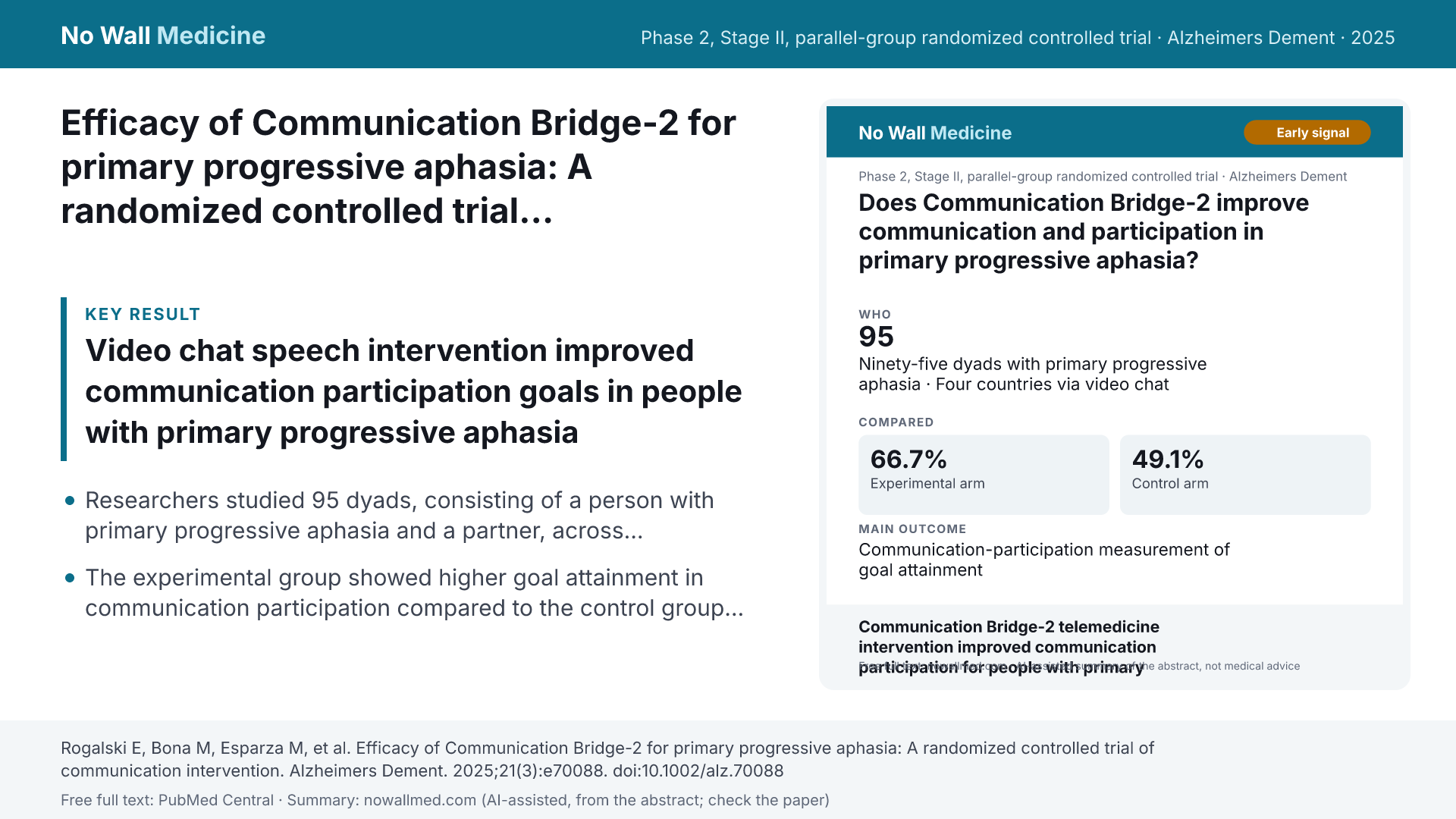
Key result: Video chat speech intervention improved communication participation goals in people with primary progressive aphasia
Phase 2, Stage II, parallel-group randomized controlled trialEarly signal
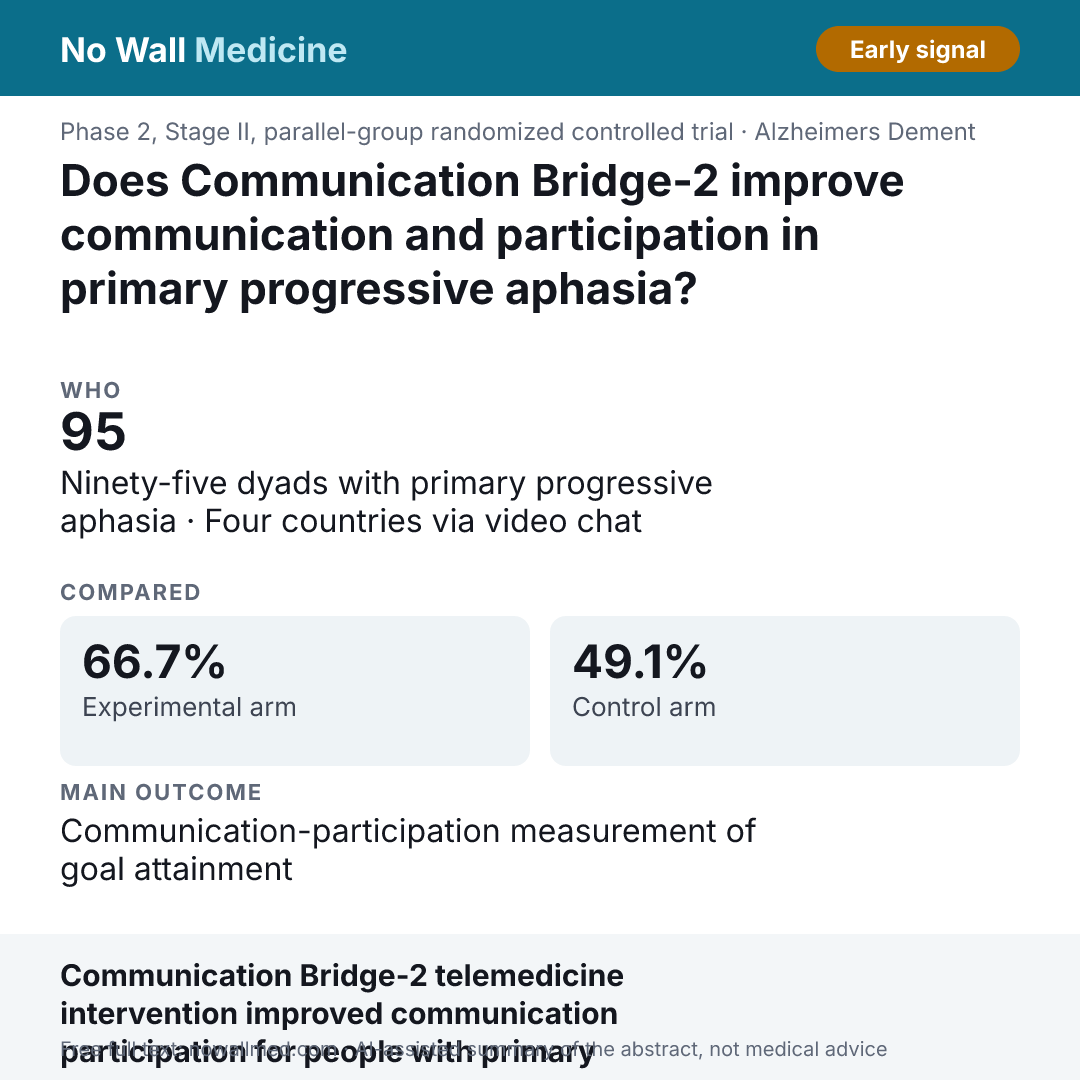
Does Communication Bridge-2 improve communication and participation in primary progressive aphasia?
Who
95
Ninety-five dyads with primary progressive aphasia · Four countries via video chat
Compared
66.7%Experimental arm
49.1%Control arm
Main outcome
Communication-participation measurement of goal attainment
Result: 66.7% vs 49.1% (p = 0.006)
Bottom line: Communication Bridge-2 telemedicine intervention improved communication participation for people with primary progressive aphasia.
Alzheimers Dement · 2025-03-27 · Save PNG
Key points
- Researchers studied 95 dyads, consisting of a person with primary progressive aphasia and a partner, across four countries using a video chat speech-language intervention.
- The experimental group showed higher goal attainment in communication participation compared to the control group at 66.7% vs 49.1% (p = 0.006).
- The results were supported by post-study interviews regarding the effectiveness of the person-centered telemedicine approach.
Discussion prompts
- Would these patients look like yours? Who was left out?
- Is the main outcome one that matters to patients?
- Is the difference large enough to change what you do?
Cite: Rogalski E, Bona M, Esparza M, et al. Efficacy of Communication Bridge-2 for primary progressive aphasia: A randomized controlled trial of communication intervention. Alzheimers Dement. 2025;21(3):e70088. doi:10.1002/alz.70088
Free full text: PubMed Central · Summary and visual abstract: nowallmed.com/a/efficacy-of-communication-bridge-2-for-primary-progressive-aphasia-a-372qag/ (AI-assisted from the abstract; check the paper before relying on it).