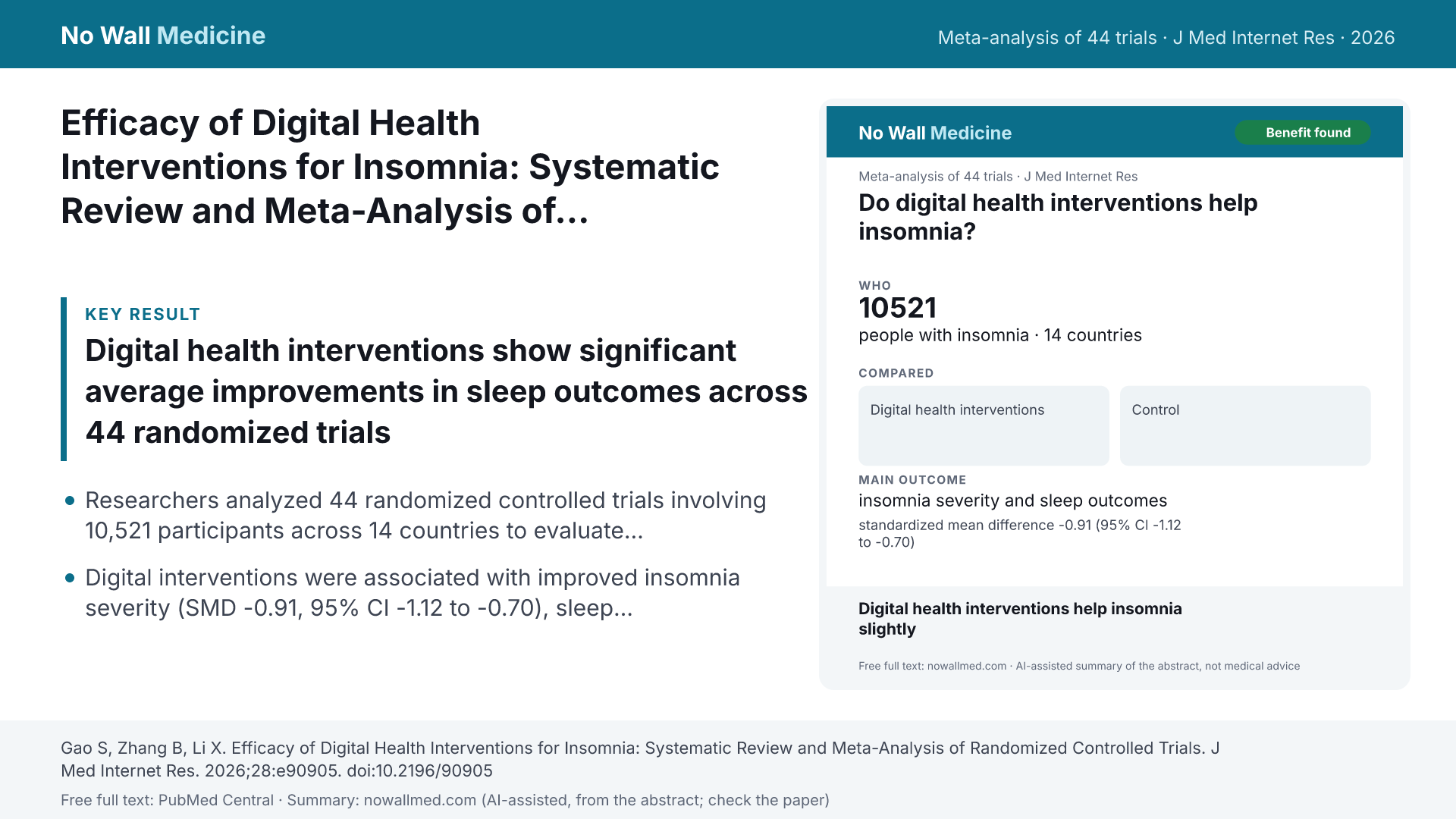
Efficacy of Digital Health Interventions for Insomnia: Systematic Review and Meta-Analysis of Randomized Controlled Trials
Key result: Digital health interventions show significant average improvements in sleep outcomes across 44 randomized trials
Key points
- Researchers analyzed 44 randomized controlled trials involving 10,521 participants across 14 countries to evaluate digital health interventions for insomnia.
- Digital interventions were associated with improved insomnia severity (SMD -0.91, 95% CI -1.12 to -0.70), sleep efficiency (SMD 0.59, 95% CI 0.45-0.72), and sleep quality (SMD -0.61, 95% CI -0.78 to -0.45).
- While statistically significant, 95% prediction intervals crossed the null for insomnia severity (-2.04 to 0.22) and total sleep time (-0.05 to 0.46).
Why it matters: Evidence comparing the effects of digital health interventions across multiple sleep outcomes was scarce.
Limitation the authors note: The authors noted that the evidence remains exploratory due to wide prediction intervals, effects approaching or below Minimum Clinically Important Difference thresholds, and very low-to-moderate certainty of evidence.
Discussion prompts
- Would these patients look like yours? Who was left out?
- Is the main outcome one that matters to patients?
- Is the difference large enough to change what you do?
Cite: Gao S, Zhang B, Li X. Efficacy of Digital Health Interventions for Insomnia: Systematic Review and Meta-Analysis of Randomized Controlled Trials. J Med Internet Res. 2026;28:e90905. doi:10.2196/90905
Free full text: PubMed Central · Summary and visual abstract: nowallmed.com/a/efficacy-of-digital-health-interventions-for-insomnia-systematic-j0u5d8/ (AI-assisted from the abstract; check the paper before relying on it).