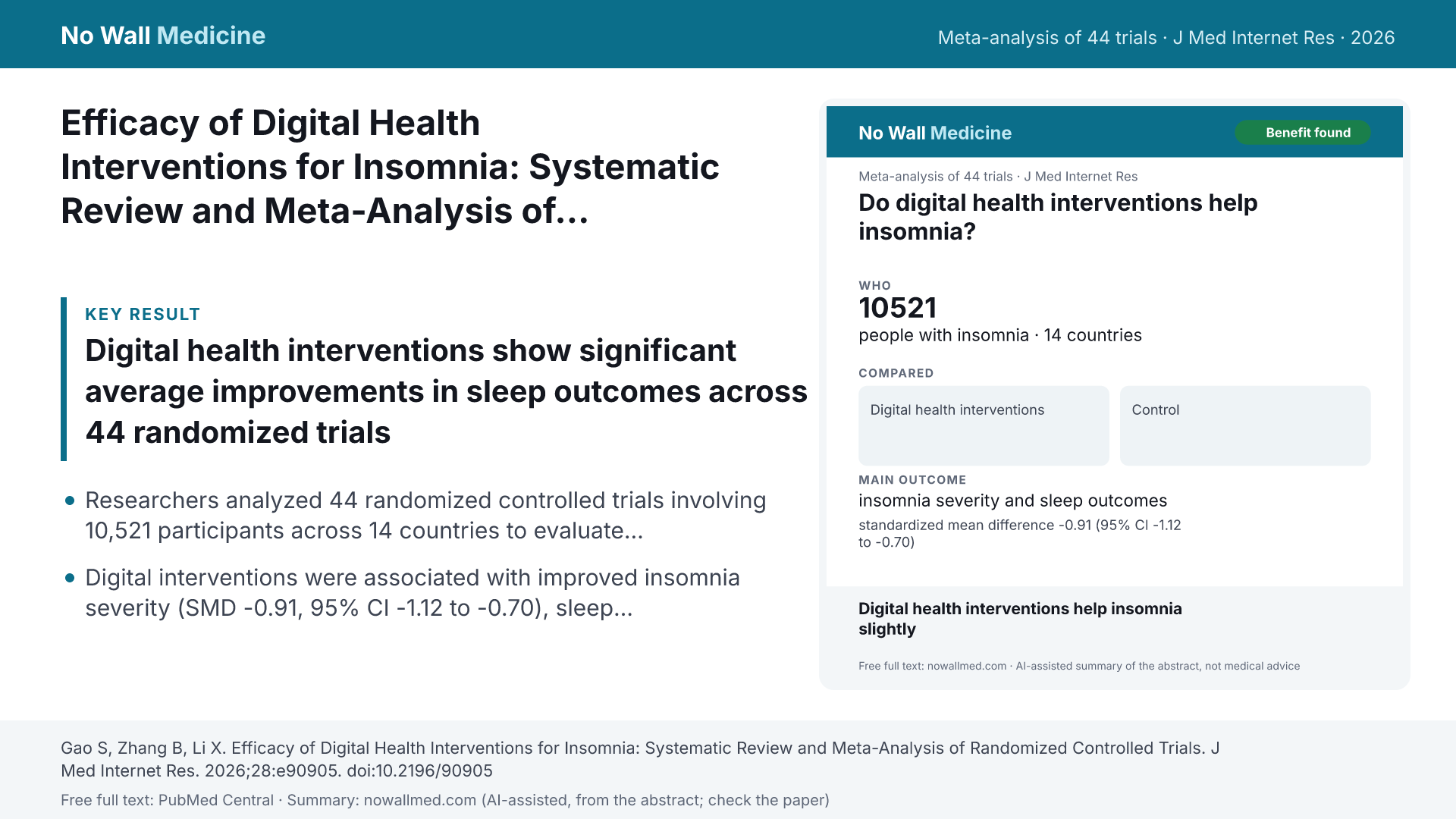
Digital health interventions show significant average improvements in sleep outcomes across 44 randomized trials
Efficacy of Digital Health Interventions for Insomnia: Systematic Review and Meta-Analysis of Randomized Controlled Trials
Meta-analysis of 44 trialsBenefit found
Do digital health interventions help insomnia?
Who
10521
people with insomnia · 14 countries
Compared
Digital health interventions
Control
Main outcome
insomnia severity and sleep outcomes
Result: standardized mean difference -0.91 (95% CI -1.12 to -0.70)
Bottom line: Digital health interventions help insomnia slightly
Limitation: very low to moderate certainty
J Med Internet Res · 2026-11-13Download image
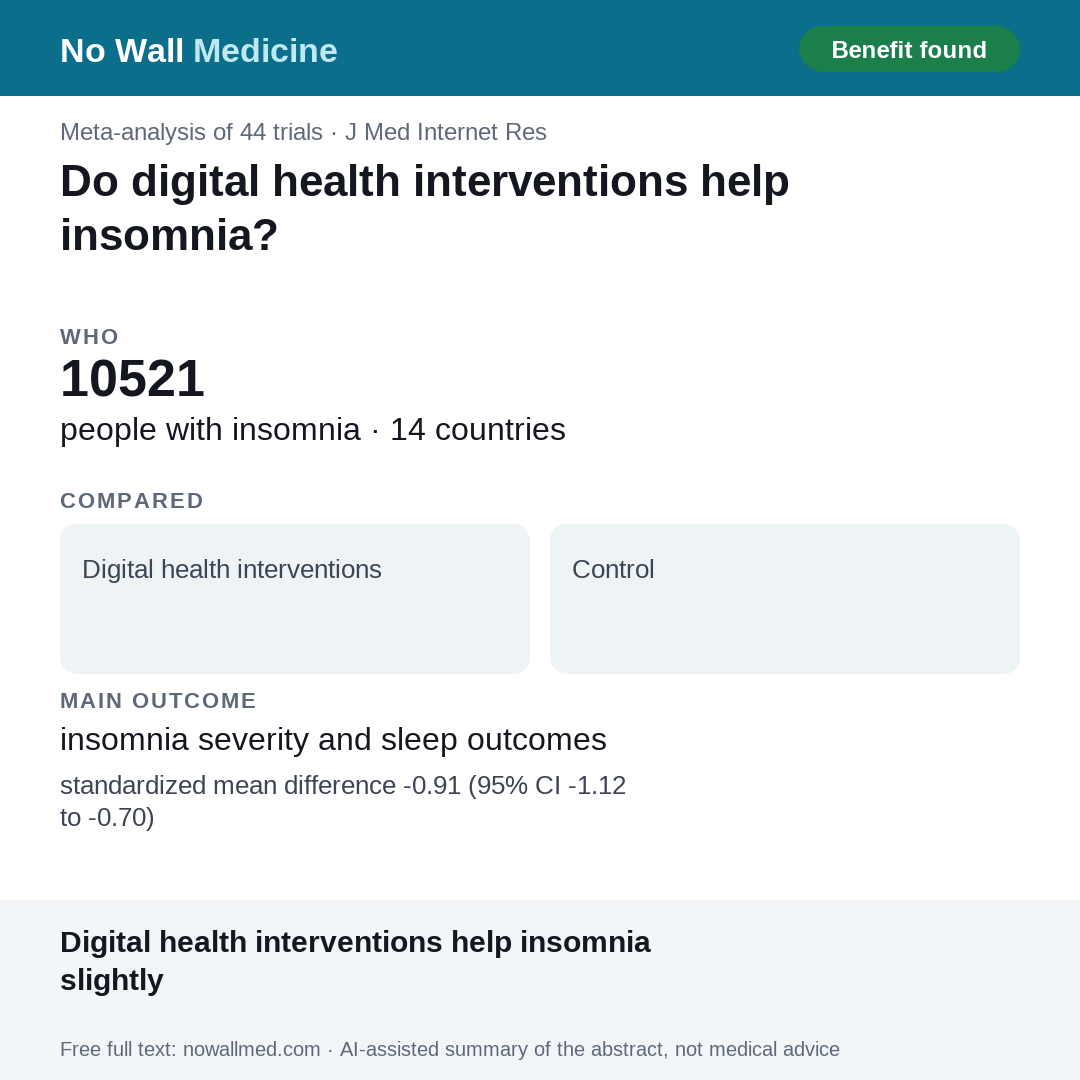
Clinical question: Do digital health interventions help insomnia?
Why it matters: Evidence comparing the effects of digital health interventions across multiple sleep outcomes was scarce.
Key points
- Researchers analyzed 44 randomized controlled trials involving 10,521 participants across 14 countries to evaluate digital health interventions for insomnia.
- Digital interventions were associated with improved insomnia severity (SMD -0.91, 95% CI -1.12 to -0.70), sleep efficiency (SMD 0.59, 95% CI 0.45-0.72), and sleep quality (SMD -0.61, 95% CI -0.78 to -0.45).
- While statistically significant, 95% prediction intervals crossed the null for insomnia severity (-2.04 to 0.22) and total sleep time (-0.05 to 0.46).
Limitation the authors note: The authors noted that the evidence remains exploratory due to wide prediction intervals, effects approaching or below Minimum Clinically Important Difference thresholds, and very low-to-moderate certainty of evidence.
Headline and key points written with AI from the paper’s abstract, with every number checked against it. Read the paper before relying on them.
Was this summary helpful?
Subject terms
Cite this article
Gao S, Zhang B, Li X. Efficacy of Digital Health Interventions for Insomnia: Systematic Review and Meta-Analysis of Randomized Controlled Trials. J Med Internet Res. 2026. doi:10.2196/90905
Spotted a mistake? Suggest a correction