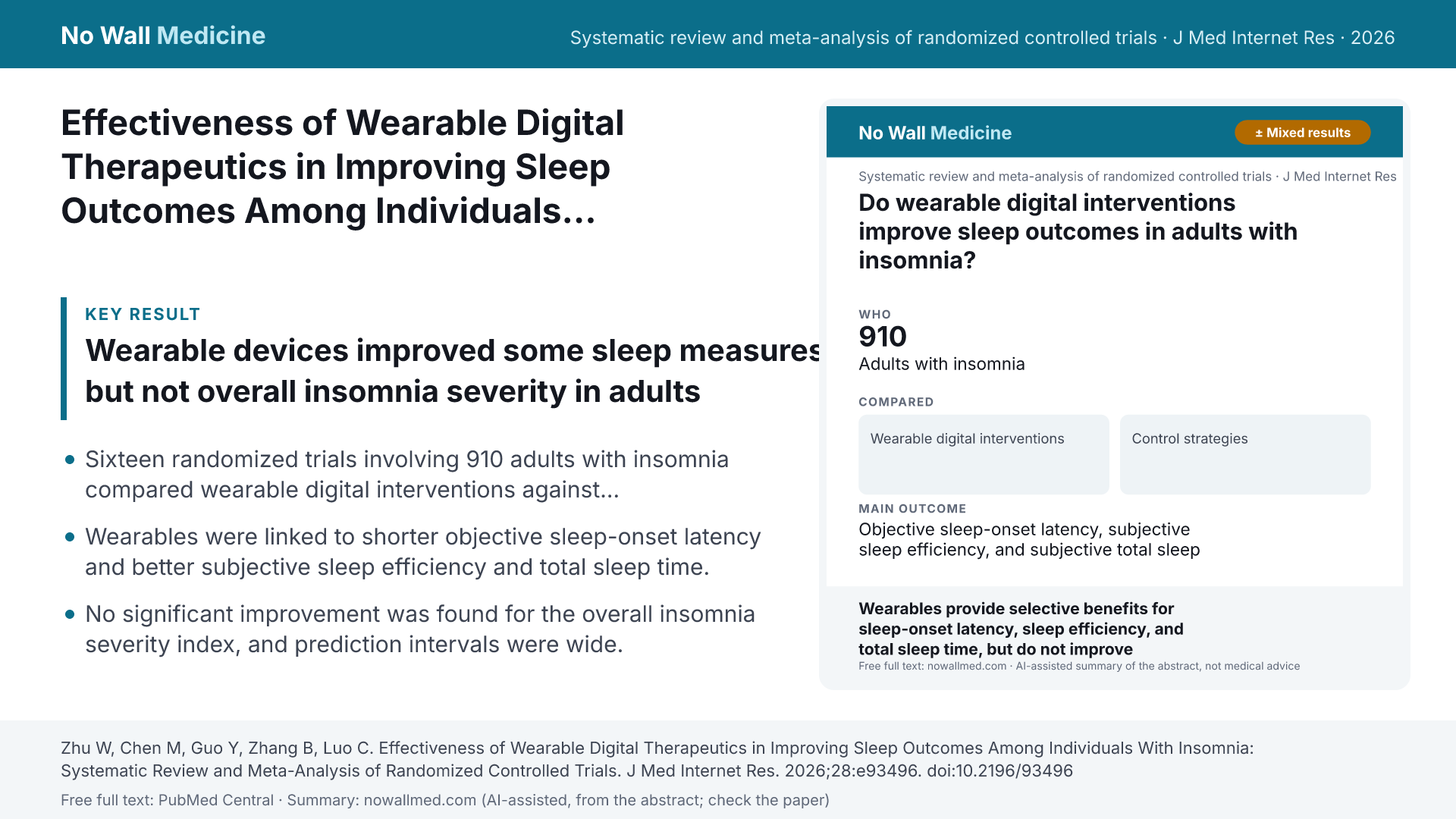
Wearable devices improved some sleep measures but not overall insomnia severity in adults
Effectiveness of Wearable Digital Therapeutics in Improving Sleep Outcomes Among Individuals With Insomnia: Systematic Review and Meta-Analysis of Randomized Controlled Trials
Systematic review and meta-analysis of randomized controlled trialsMixed results
Do wearable digital interventions improve sleep outcomes in adults with insomnia?
Who
910
Adults with insomnia
Compared
Wearable digital interventions
Control strategies
Main outcome
Objective sleep-onset latency, subjective sleep efficiency, and subjective total sleep time
Result: mean difference -4.52, 95% CI -8.38 to -0.67 for sleep-onset latency
Bottom line: Wearables provide selective benefits for sleep-onset latency, sleep efficiency, and total sleep time, but do not improve insomnia severity.
Limitation: Wide prediction intervals, substantial heterogeneity, and limited study numbers indicate preliminary, nonconclusive findings.
J Med Internet Res · 2026-09-11Download image
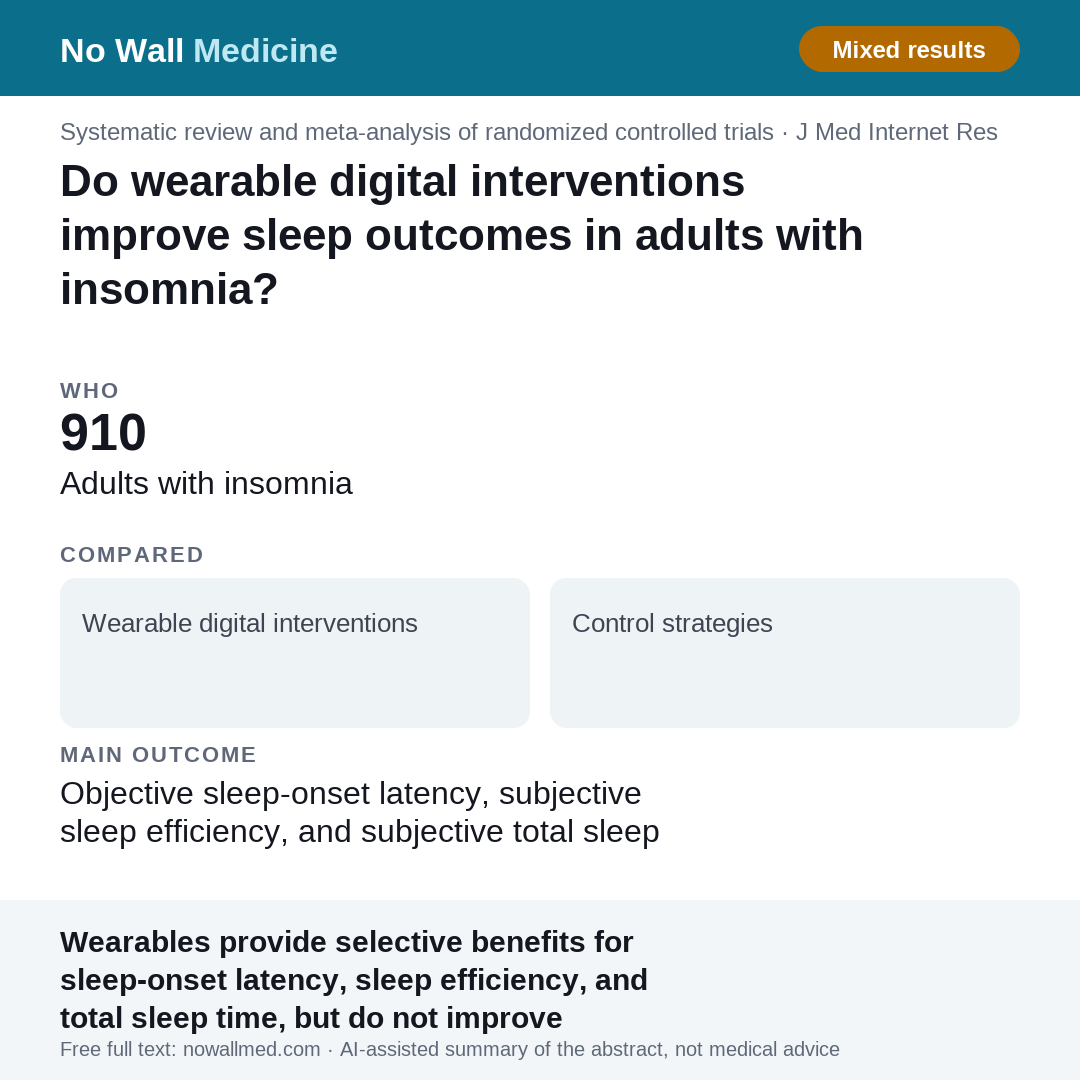
Clinical question: Do wearable digital interventions improve sleep outcomes in adults with insomnia?
Why it matters: Previous reviews rarely isolated stand-alone wearables or distinguished between objective and subjective sleep endpoints in adults with insomnia.
Key points
- Sixteen randomized trials involving 910 adults with insomnia compared wearable digital interventions against control strategies.
- Wearables were linked to shorter objective sleep-onset latency and better subjective sleep efficiency and total sleep time.
- No significant improvement was found for the overall insomnia severity index, and prediction intervals were wide.
Limitation the authors note: The authors note that wide prediction intervals, substantial heterogeneity, and limited study numbers indicate preliminary, nonconclusive findings.
Headline and key points written with AI from the paper’s abstract, with every number checked against it. Read the paper before relying on them.
Was this summary helpful?
Subject terms
Cite this article
Zhu W, Chen M, Guo Y, Zhang B, Luo C. Effectiveness of Wearable Digital Therapeutics in Improving Sleep Outcomes Among Individuals With Insomnia: Systematic Review and Meta-Analysis of Randomized Controlled Trials. J Med Internet Res. 2026. doi:10.2196/93496
Spotted a mistake? Suggest a correction