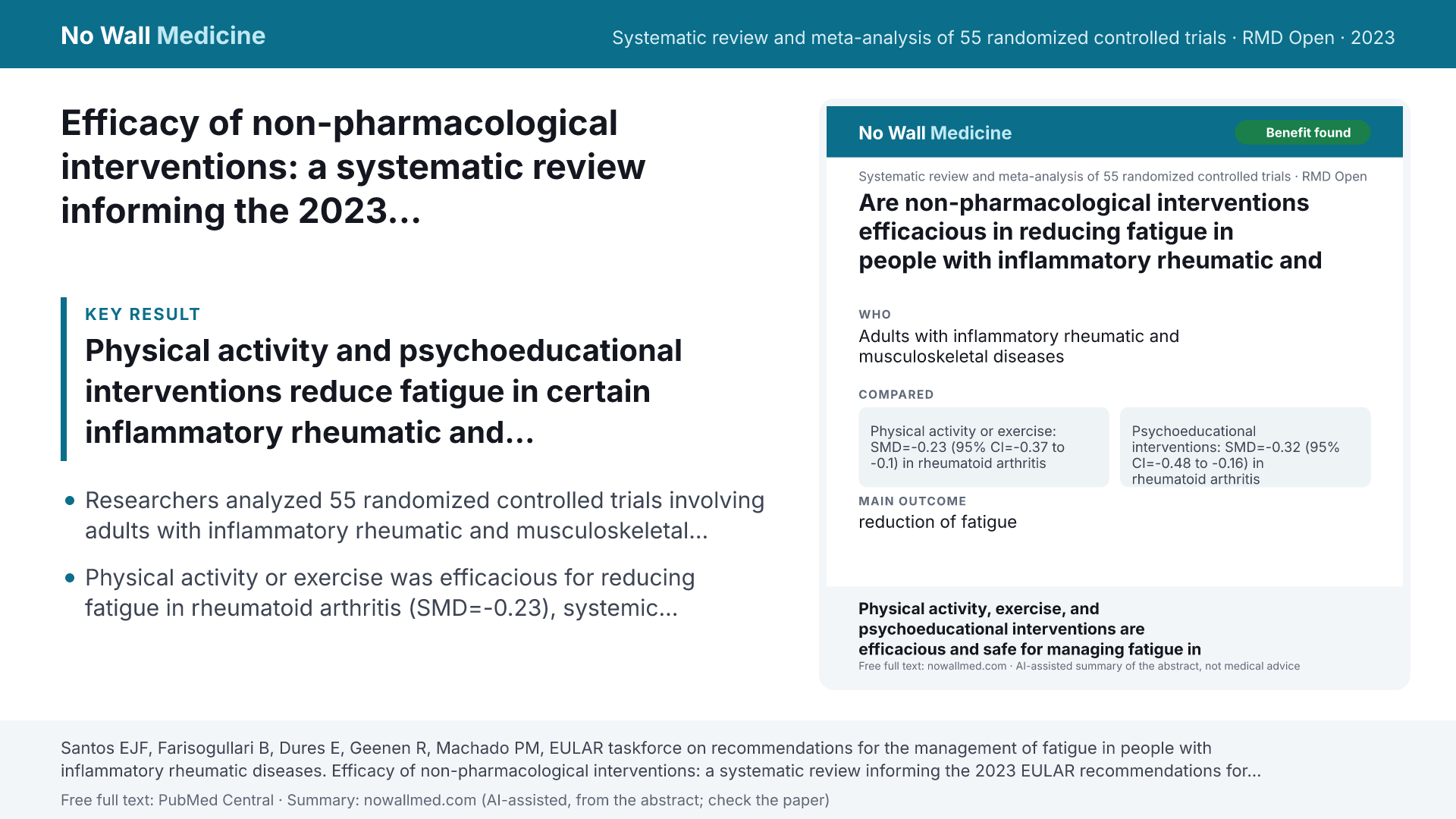
Physical activity and psychoeducational interventions reduce fatigue in certain inflammatory rheumatic and musculoskeletal diseases
Efficacy of non-pharmacological interventions: a systematic review informing the 2023 EULAR recommendations for the management of fatigue in people with inflammatory rheumatic and musculoskeletal diseases
Systematic review and meta-analysis of 55 randomized controlled trialsBenefit found
Are non-pharmacological interventions efficacious in reducing fatigue in people with inflammatory rheumatic and musculoskeletal diseases?
Who
Adults with inflammatory rheumatic and musculoskeletal diseases
Compared
Physical activity or exercise: SMD=-0.23 (95% CI=-0.37 to -0.1) in rheumatoid arthritis
Psychoeducational interventions: SMD=-0.32 (95% CI=-0.48 to -0.16) in rheumatoid arthritis
Main outcome
reduction of fatigue
Bottom line: Physical activity, exercise, and psychoeducational interventions are efficacious and safe for managing fatigue in people with inflammatory rheumatic and musculoskeletal diseases.
RMD Open · 2023-08-22Download image
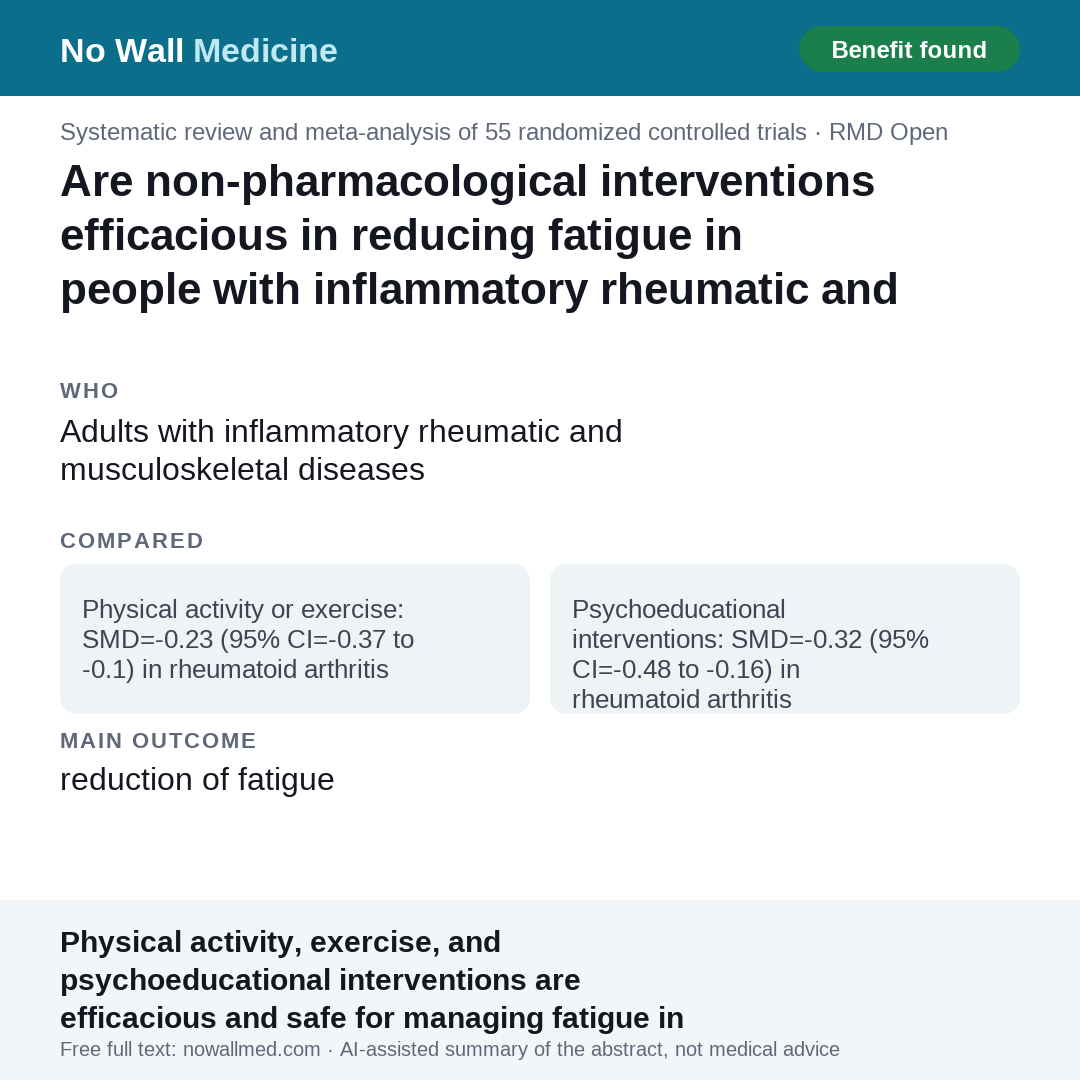
Clinical question: Are non-pharmacological interventions efficacious in reducing fatigue in people with inflammatory rheumatic and musculoskeletal diseases?
Why it matters: It was unknown which non-drug interventions are most effective and safe for managing fatigue in people with inflammatory rheumatic and musculoskeletal diseases.
Key points
- Researchers analyzed 55 randomized controlled trials involving adults with inflammatory rheumatic and musculoskeletal diseases to evaluate non-drug treatments for fatigue.
- Physical activity or exercise was efficacious for reducing fatigue in rheumatoid arthritis (SMD=-0.23), systemic lupus erythematosus (SMD=-0.54), and spondyloarthritis (SMD=-0.94).
- Psychoeducational interventions, which involve teaching patients about their condition, were efficacious for rheumatoid arthritis (SMD=-0.32) but not for systemic lupus erythematosus (SMD=-0.19).
Headline and key points written with AI from the paper’s abstract, with every number checked against it. Read the paper before relying on them.
Was this summary helpful?
Abstract
Objective
To identify the best evidence on the efficacy of non-pharmacological interventions in reducing fatigue in people with inflammatory rheumatic and musculoskeletal diseases (I-RMDs) and to summarise their safety in the identified studies to inform European Alliance of Associations for Rheumatology recommendations for the management of fatigue in people with I-RMDs. Methods
Systematic review of randomised controlled trials (RCTs) including adults with I-RMDs conducted according to the Cochrane Handbook. Search strategy ran in Medline, Embase, Cochrane Library, CINAHL Complete, PEDro, OTseeker and PsycINFO. Assessment of risk of bias, data extraction and synthesis were performed by two reviewers independently. Data were pooled in meta-analyses. Results
From a total of 4150 records, 454 were selected for full-text review, 82 fulfilled the inclusion criteria and 55 RCTs were included in meta-analyses. Physical activity or exercise was efficacious in reducing fatigue in rheumatoid arthritis (RA) (standardised mean differences (SMD)=-0.23, 95% CI=-0.37 to -0.1), systemic lupus erythematosus (SLE) (SMD=-0.54, 95% CI=-1.07 to -0.01) and spondyloarthritis (SMD=-0.94, 95% CI=-1.23 to -0.66); reduction of fatigue was not significant in Sjögren's syndrome (SMD=-0.83, 95% CI=-2.13 to 0.47) and systemic sclerosis (SMD=-0.66, 95% CI=-1.33 to 0.02). Psychoeducational interventions were efficacious in reducing fatigue in RA (SMD=-0.32, 95% CI=-0.48 to -0.16), but not in SLE (SMD=-0.19, 95% CI=-0.46 to 0.09). Follow-up models in consultations (SMD=-0.05, 95% CI=-0.29 to 0.20) and multicomponent interventions (SMD=-0.20, 95% CI=-0.53 to 0.14) did not show significant reductions of fatigue in RA. The results of RCTs not included in the meta-analysis suggest that several other non-pharmacological interventions may provide a reduction of fatigue, with reassuring safety results. Conclusions
Physica activity or exercise and psychoeducational interventions are efficacious and safe for managing fatigue in people with I-RMDs.
Abstract reproduced under the article’s CC BY NC licence.
Subject terms
Cite this article
Santos EJF, Farisogullari B, Dures E, Geenen R, Machado PM, EULAR taskforce on recommendations for the management of fatigue in people with inflammatory rheumatic diseases. Efficacy of non-pharmacological interventions: a systematic review informing the 2023 EULAR recommendations for the management of fatigue in people with inflammatory rheumatic and musculoskeletal diseases. RMD Open. 2023. doi:10.1136/rmdopen-2023-003350
Spotted a mistake? Suggest a correction