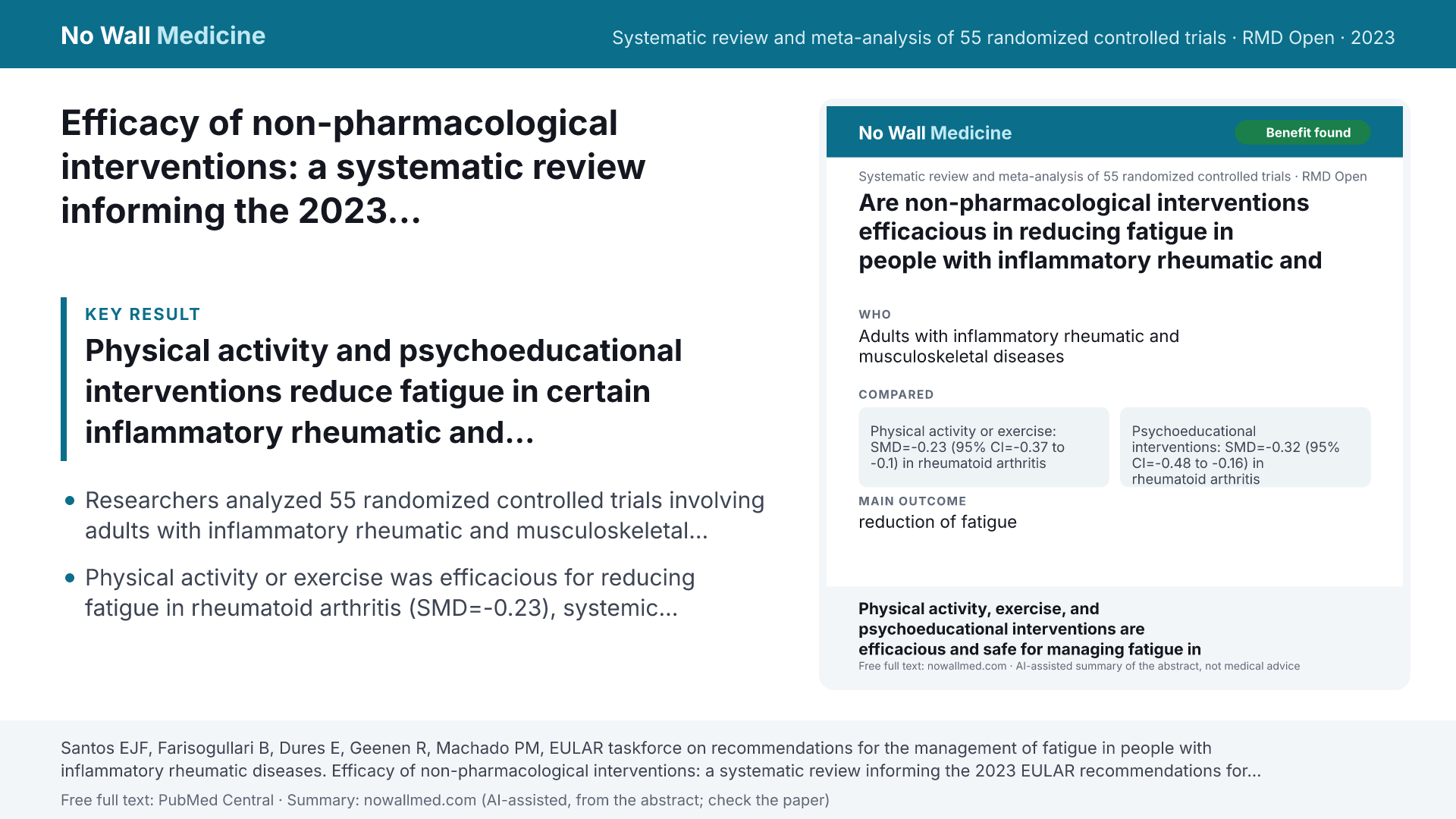
Efficacy of non-pharmacological interventions: a systematic review informing the 2023 EULAR recommendations for the management of fatigue in people with inflammatory rheumatic and musculoskeletal diseases
Key result: Physical activity and psychoeducational interventions reduce fatigue in certain inflammatory rheumatic and musculoskeletal diseases
Key points
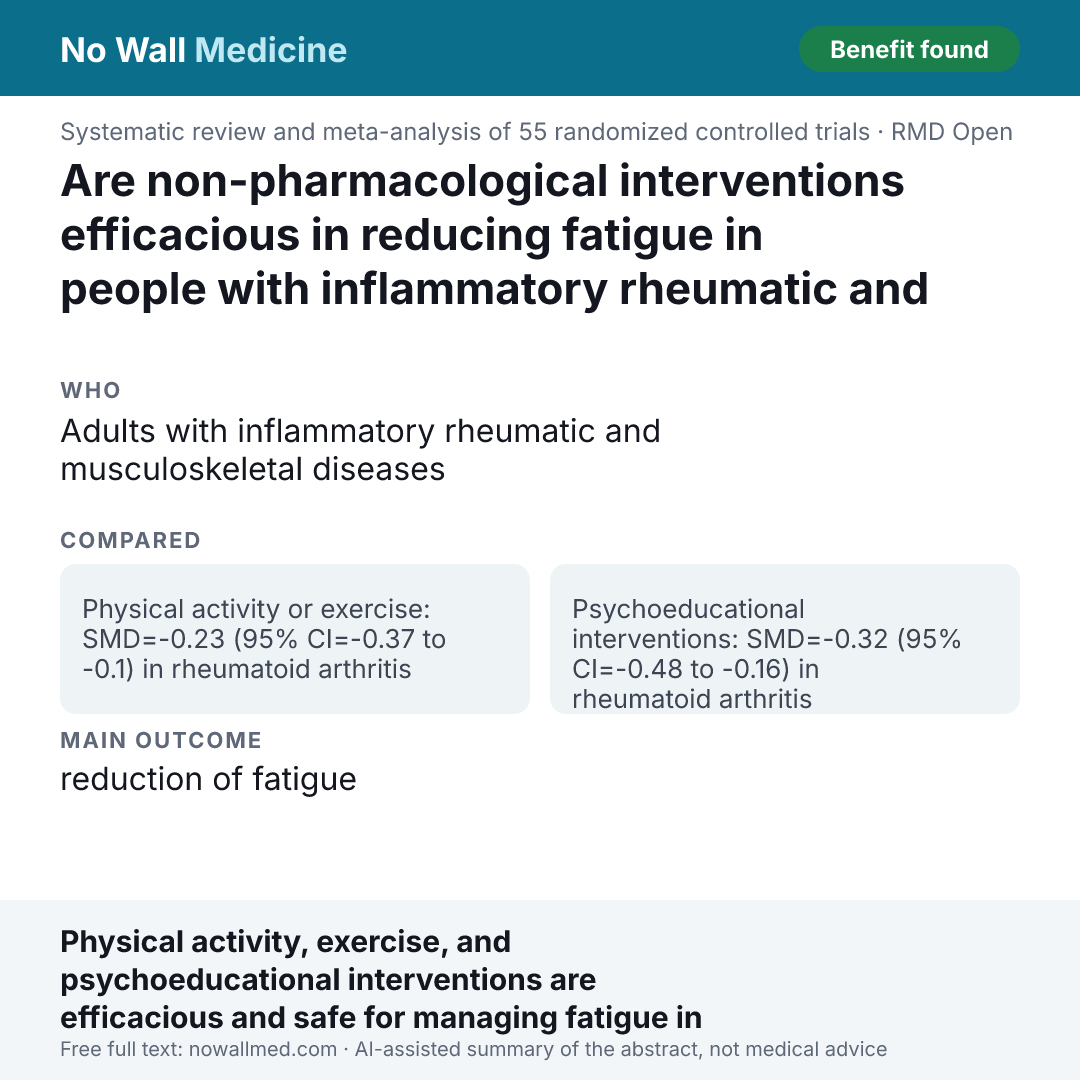
- Researchers analyzed 55 randomized controlled trials involving adults with inflammatory rheumatic and musculoskeletal diseases to evaluate non-drug treatments for fatigue.
- Physical activity or exercise was efficacious for reducing fatigue in rheumatoid arthritis (SMD=-0.23), systemic lupus erythematosus (SMD=-0.54), and spondyloarthritis (SMD=-0.94).
- Psychoeducational interventions, which involve teaching patients about their condition, were efficacious for rheumatoid arthritis (SMD=-0.32) but not for systemic lupus erythematosus (SMD=-0.19).
Discussion prompts
- Would these patients look like yours? Who was left out?
- Is the main outcome one that matters to patients?
- Is the difference large enough to change what you do?
Cite: Santos EJF, Farisogullari B, Dures E, Geenen R, Machado PM, EULAR taskforce on recommendations for the management of fatigue in people with inflammatory rheumatic diseases. Efficacy of non-pharmacological interventions: a systematic review informing the 2023 EULAR recommendations for the management of fatigue in people with inflammatory rheumatic and musculoskeletal diseases. RMD Open. 2023;9(3). doi:10.1136/rmdopen-2023-003350
Free full text: PubMed Central · Summary and visual abstract: nowallmed.com/a/efficacy-of-non-pharmacological-interventions-a-systematic-review-udxazz/ (AI-assisted from the abstract; check the paper before relying on it).