Efficacy of Postpartum Pharmacologic Thromboprophylaxis: A Systematic Review and Meta-analysis
Systematic review and meta-analysisUnclear result
Is pharmacologic venous thromboembolism prophylaxis effective in postpartum patients?
Who
11,944
Postpartum patients
Compared
Exposed to pharmacologic prophylaxis
Unexposed
Main outcome
venous thromboembolism events
Result: relative risk 1.02 (95% CI 0.29-3.51)
Bottom line: Insufficient sample size was available to conclude if postpartum pharmacologic prophylaxis changes venous thromboembolism rates.
Limitation: Insufficient sample size due to the rarity of venous thromboembolism events.
Obstet Gynecol · 2023-03-09Download image
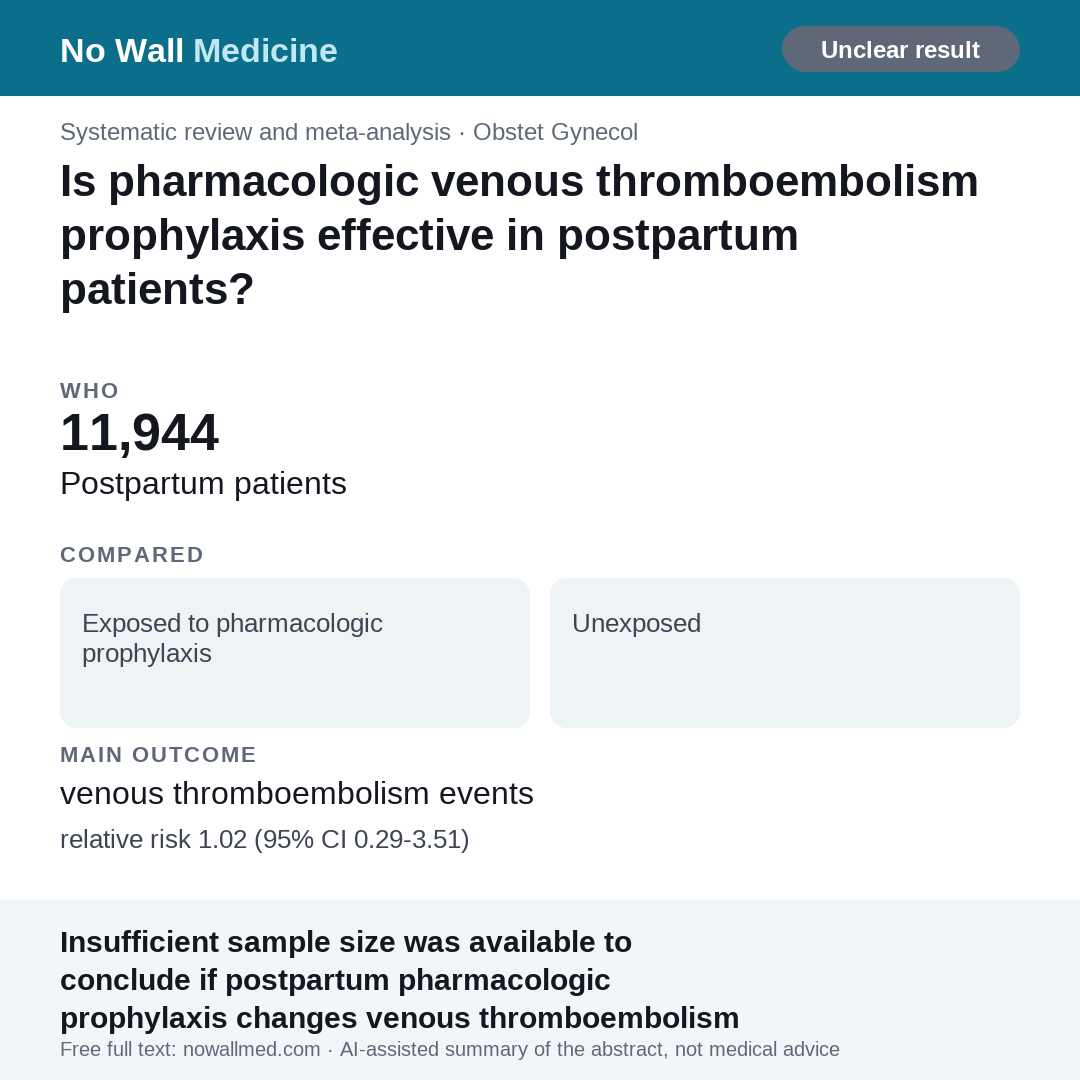
Clinical question: Is pharmacologic venous thromboembolism prophylaxis effective in postpartum patients?
Abstract
Objective
To evaluate the effectiveness of pharmacologic venous thromboembolism (VTE) prophylaxis in postpartum patients. Data sources
On February 21, 2022, a literature search was conducted on Embase.com , Ovid-Medline All, Cochrane Library, Scopus, and ClinicalTrials.gov using terms postpartum period AND thromboprophylaxis AND antithrombin medications including heparin and low molecular weight heparin. Methods of study selection
Studies that evaluated the outcome of VTE among postpartum patients exposed to pharmacologic VTE prophylaxis with or without a comparator group were eligible for inclusion. Studies of patients who received antepartum VTE prophylaxis, studies in which this prophylaxis could not be definitively ruled out, and studies of patients who received therapeutic dosing of anticoagulation for specific medical problems or treatment of VTE were excluded. Titles and abstracts were independently screened by two authors. Relevant full-text articles were retrieved and independently reviewed for inclusion or exclusion by two authors. Tabulation, integration, and results
A total of 944 studies were screened by title and abstract, and 54 full-text studies were retrieved for further evaluation after 890 studies were excluded. Fourteen studies including 11,944 patients were analyzed: eight randomized controlled trials (8,001 patients) and six observational studies (3,943 patients). Among the eight studies with a comparator group, there was no difference in the risk of VTE between patients who were exposed to postpartum pharmacologic VTE prophylaxis and those who were unexposed (pooled relative risk 1.02, 95% CI 0.29-3.51); however, six of eight studies had no events in either the exposed or unexposed group. Among the six studies without a comparator group, the pooled proportion of postpartum VTE events was 0.00, likely due to five of six studies having no events. Conclusion
The current literature provided an insufficient sample size to conclude whether postpartum VTE rates differ between those exposed to postpartum pharmacologic prophylaxis and those unexposed, given the rarity of VTE events. Systematic review registration
PROSPERO, CRD42022323841.
Subject terms
Cite this article
Oakes MC, Reese M, Colditz GA, Stoll CRT, Hardi A, Arnold LD. Efficacy of Postpartum Pharmacologic Thromboprophylaxis: A Systematic Review and Meta-analysis. Obstet Gynecol. 2023. doi:10.1097/AOG.0000000000005122
Spotted a mistake? Suggest a correction
Top studies every Monday
The week’s key trials and guidelines in your specialties, plus any topics you follow. By email, free.
Get the weekly digest