Remote ischemic conditioning improved blood flow regulation and reduced stroke risk after artery stenting
Efficacy of remote ischemic conditioning on cerebral blood flow regulation in patients with endovascular stenting: a randomized controlled trial
Randomized controlled trialBenefit found
Does remote ischemic conditioning improve cerebral blood flow regulation and reduce postoperative stroke?
Who
104
Patients with intracranial or extracranial cerebrovascular stenosis undergoing endovascular stenting
Compared
Remote ischemic conditioning: 0.00% 90-day stroke incidence
Sham-remote ischemic conditioning: 9.62% 90-day stroke incidence
Main outcome
Cerebral blood flow regulation and 90-day stroke incidence
Bottom line: Remote ischemic conditioning improved cerebral blood flow regulation and reduced 90-day stroke incidence after endovascular stenting.
BMC Med · 2026-07-04Download image
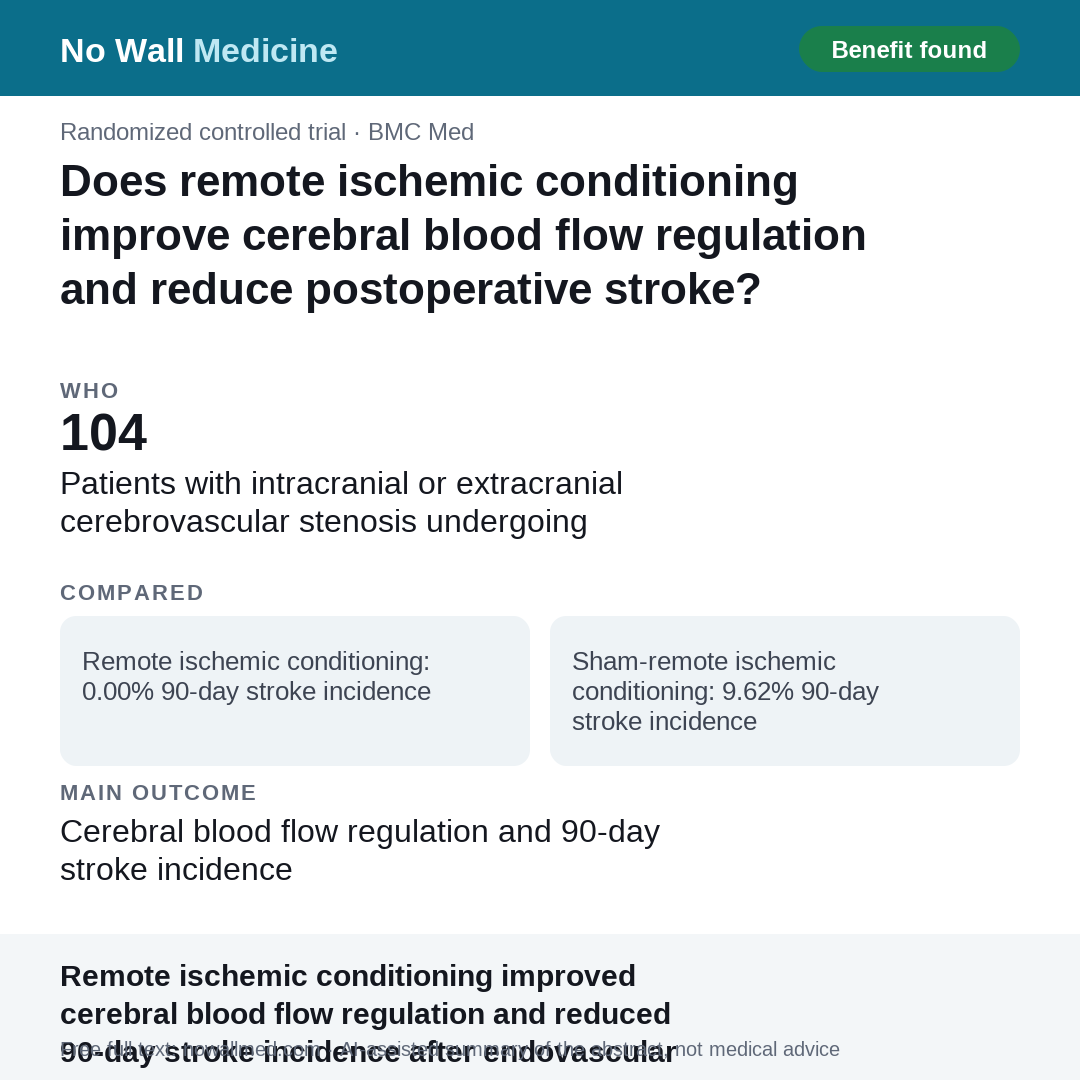
Clinical question: Does remote ischemic conditioning improve cerebral blood flow regulation and reduce postoperative stroke?
Why it matters: Postoperative stroke can undermine the benefits of endovascular stenting for patients with cerebrovascular stenosis.
Key points
- Researchers studied 104 patients with narrowing in their brain or neck arteries who were randomized to receive either remote ischemic conditioning or a sham treatment.
- Remote ischemic conditioning increased phase difference values on the affected side (40.67° vs. 20.51°) and the unaffected side (36.04° vs. 26.80°) compared to the sham group.
- The incidence of stroke at 90 days was 0.00% in the remote ischemic conditioning group compared to 9.62% in the sham group.
Headline and key points written with AI from the paper’s abstract, with every number checked against it. Read the paper before relying on them.
Topics
Cite this article
Hou YT, Xu BF, Zhang HM, Zhang P, He QY, Qu Y. Efficacy of remote ischemic conditioning on cerebral blood flow regulation in patients with endovascular stenting: a randomized controlled trial. BMC Med. 2026. doi:10.1186/s12916-026-05038-w
Spotted a mistake? Suggest a correction