Noninvasive positive pressure ventilation showed the best results for exercise capacity in severe COPD patients
Efficacy of respiratory support therapies during pulmonary rehabilitation exercise training in chronic obstructive pulmonary disease patients: a systematic review and network meta-analysis
Systematic review and network meta-analysisBenefit found
Which respiratory support therapy is most effective during pulmonary rehabilitation in COPD patients?
Who
1321
Stable chronic obstructive pulmonary disease patients at GOLD stage III or IV
Compared
Noninvasive positive pressure ventilation: superior in improving exercise capacity, dyspnea, and physiological change
Other respiratory support therapies
Main outcome
exercise capacity, dyspnea, and physiological change
Bottom line: Noninvasive positive pressure ventilation is most effective for assisting exercise in severe stable chronic obstructive pulmonary disease patients.
Limitation: Need for additional high-quality trials to assess consistency of evidence across various approaches.
BMC Med · 2024-09-12Download image
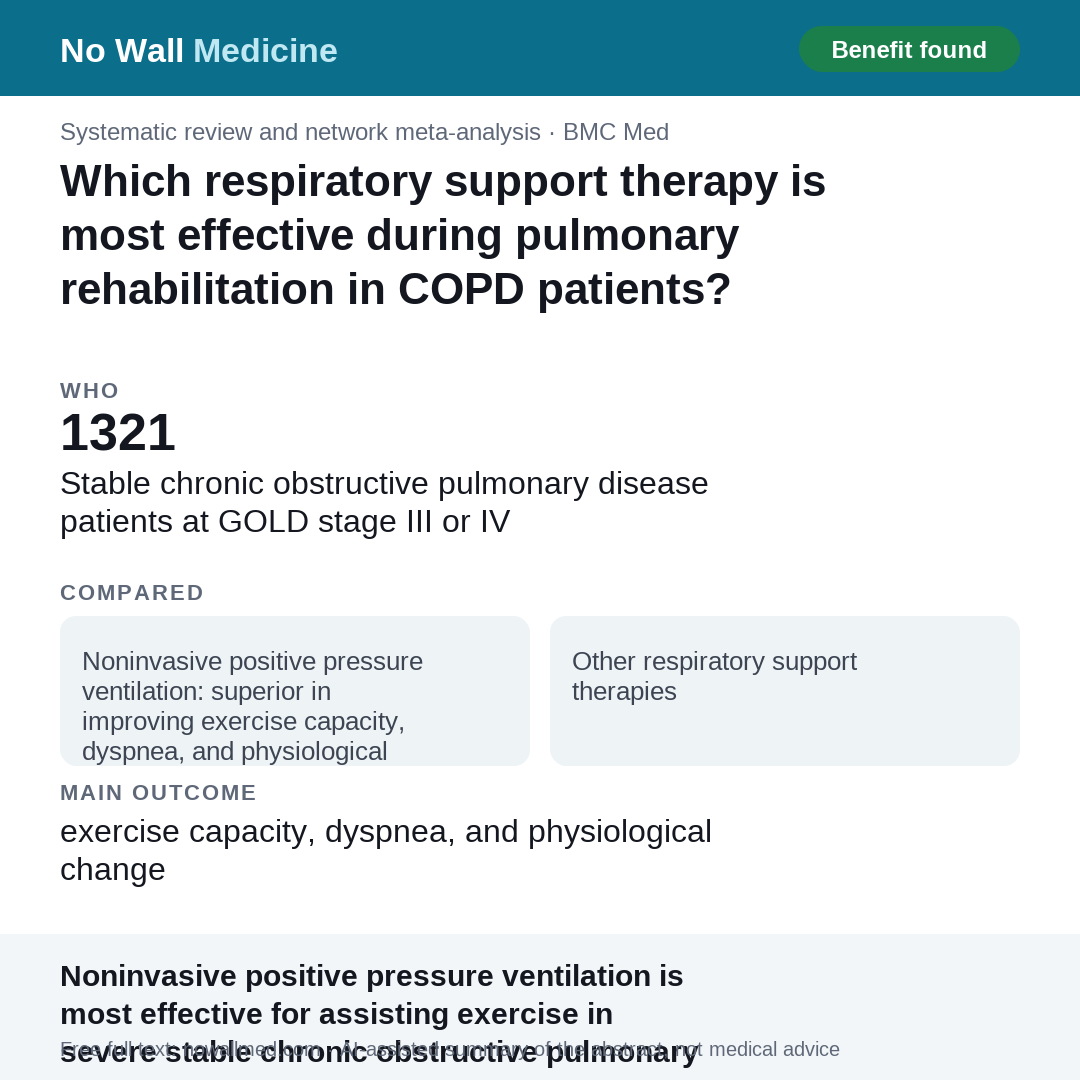
Clinical question: Which respiratory support therapy is most effective during pulmonary rehabilitation in COPD patients?
Why it matters: It was unknown which specific respiratory support therapy provides the most effective assistance for exercise capacity and physiological changes during pulmonary rehabilitation in patients with chronic obstructive pulmonary disease.
Key points
- Researchers analyzed 35 randomized controlled trials involving 1321 patients to compare different respiratory support therapies during pulmonary rehabilitation exercise training.
- Noninvasive positive pressure ventilation, a type of breathing support using a mask, was found to be superior for improving exercise capacity, shortness of breath, and physiological changes.
- The most effective improvements were seen in stable patients with GOLD stage III or IV chronic obstructive pulmonary disease.
Limitation the authors note: The authors noted a need for additional high-quality trials to assess the consistency of evidence across various respiratory support approaches.
Headline and key points written with AI from the paper’s abstract, with every number checked against it. Read the paper before relying on them.
Was this summary helpful?
Subject terms
Cite this article
Chen X, Xu L, Li S, Yang C, Wu X, Feng M. Efficacy of respiratory support therapies during pulmonary rehabilitation exercise training in chronic obstructive pulmonary disease patients: a systematic review and network meta-analysis. BMC Med. 2024. doi:10.1186/s12916-024-03605-7
Spotted a mistake? Suggest a correction
Top studies every Monday
The week’s key trials and guidelines in your specialties, plus any topics you follow. By email, free.
Get the weekly digest