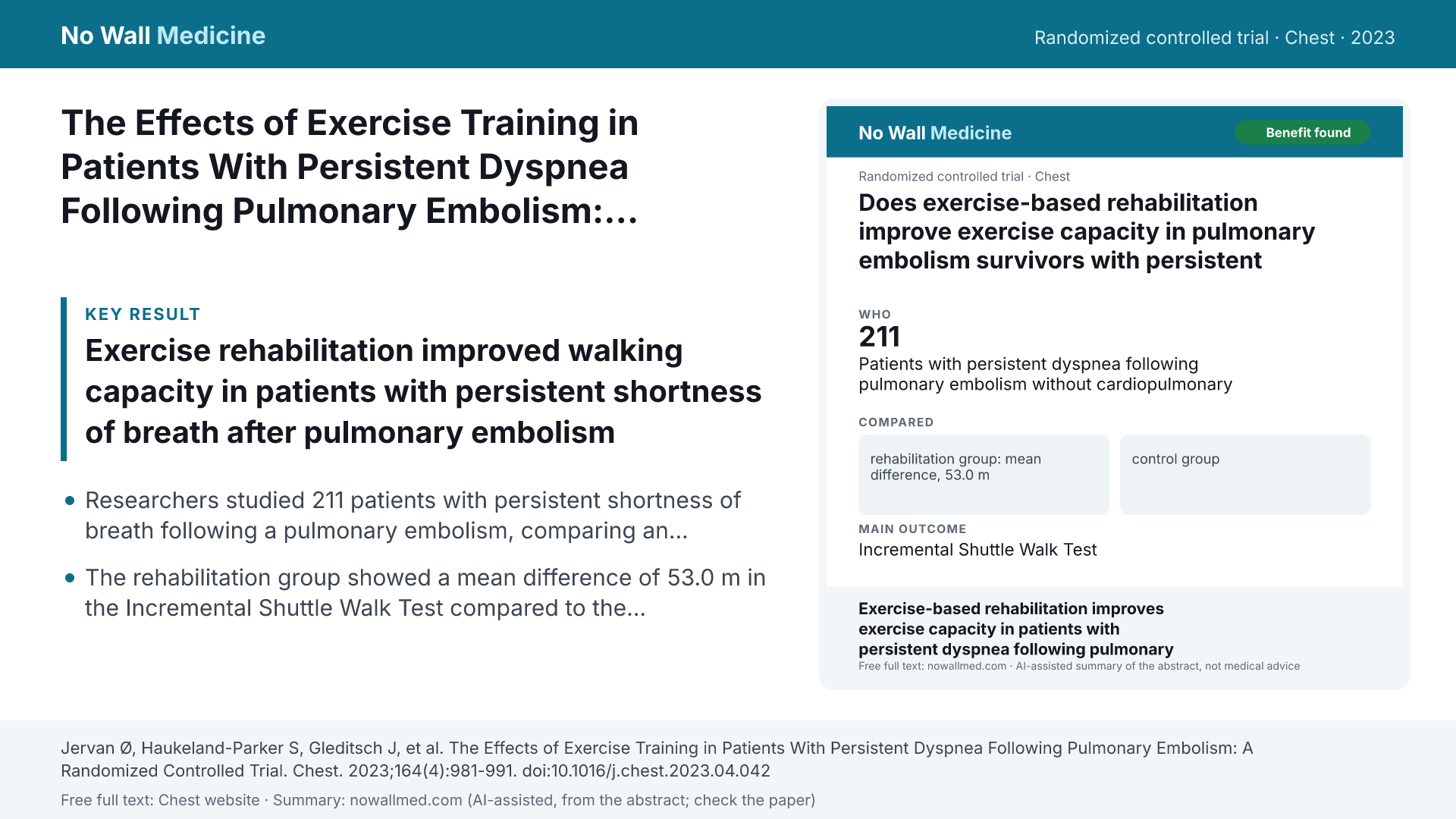
Exercise rehabilitation improved walking capacity in patients with persistent shortness of breath after pulmonary embolism
The Effects of Exercise Training in Patients With Persistent Dyspnea Following Pulmonary Embolism: A Randomized Controlled Trial
Randomized controlled trialBenefit found
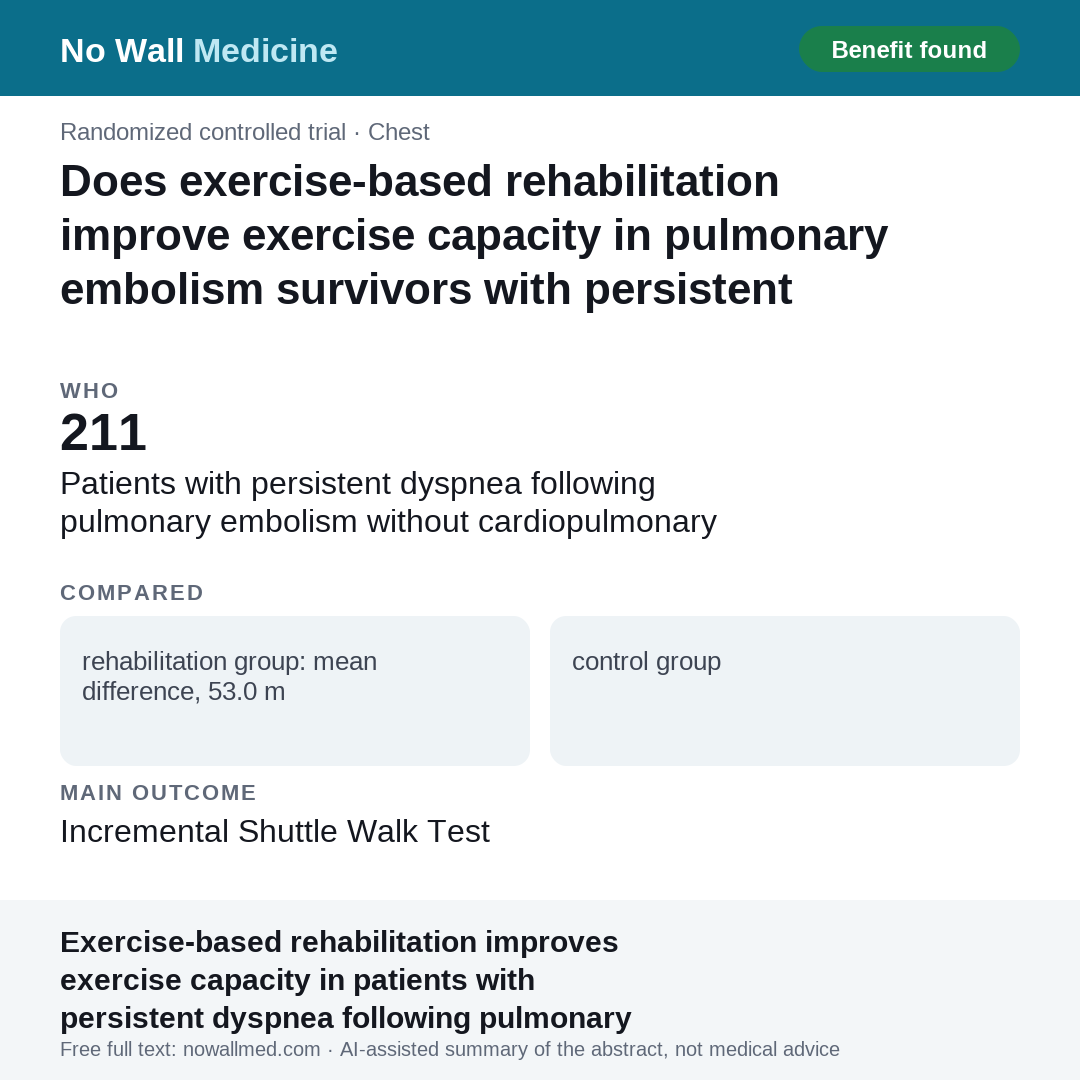
Does exercise-based rehabilitation improve exercise capacity in pulmonary embolism survivors with persistent dyspnea?
Who
211
Patients with persistent dyspnea following pulmonary embolism without cardiopulmonary comorbidities · Two hospitals
Compared
rehabilitation group: mean difference, 53.0 m
control group
Main outcome
Incremental Shuttle Walk Test
Result: mean difference, 53.0 m; 95% CI, 17.7-88.3
Bottom line: Exercise-based rehabilitation improves exercise capacity in patients with persistent dyspnea following pulmonary embolism.
Limitation: Further research is needed to assess optimal patient selection, timing, mode, and duration.
Chest · 2023-05-05Download image
Clinical question: Does exercise-based rehabilitation improve exercise capacity in pulmonary embolism survivors with persistent dyspnea?
Why it matters: It was unknown if an exercise-based rehabilitation program improves exercise capacity for survivors of pulmonary embolism who experience persistent shortness of breath.
Key points
- Researchers studied 211 patients with persistent shortness of breath following a pulmonary embolism, comparing an 8-week exercise program to usual care.
- The rehabilitation group showed a mean difference of 53.0 m in the Incremental Shuttle Walk Test compared to the control group.
- Participants in the exercise group also reported better scores on the Pulmonary Embolism-Quality of Life questionnaire with a mean difference of -4%.
Limitation the authors note: Further research is needed to assess the optimal patient selection, timing, mode, and duration of rehabilitation.
Headline and key points written with AI from the paper’s abstract, with every number checked against it. Read the paper before relying on them.
Was this summary helpful?
Subject terms
Cite this article
Jervan Ø, Haukeland-Parker S, Gleditsch J, Tavoly M, Klok FA, Steine K. The Effects of Exercise Training in Patients With Persistent Dyspnea Following Pulmonary Embolism: A Randomized Controlled Trial. Chest. 2023. doi:10.1016/j.chest.2023.04.042
Spotted a mistake? Suggest a correction
Top studies every Monday
The week’s key trials and guidelines in your specialties, plus any topics you follow. By email, free.
Get the weekly digest