The Effects of Exercise Training in Patients With Persistent Dyspnea Following Pulmonary Embolism: A Randomized Controlled Trial
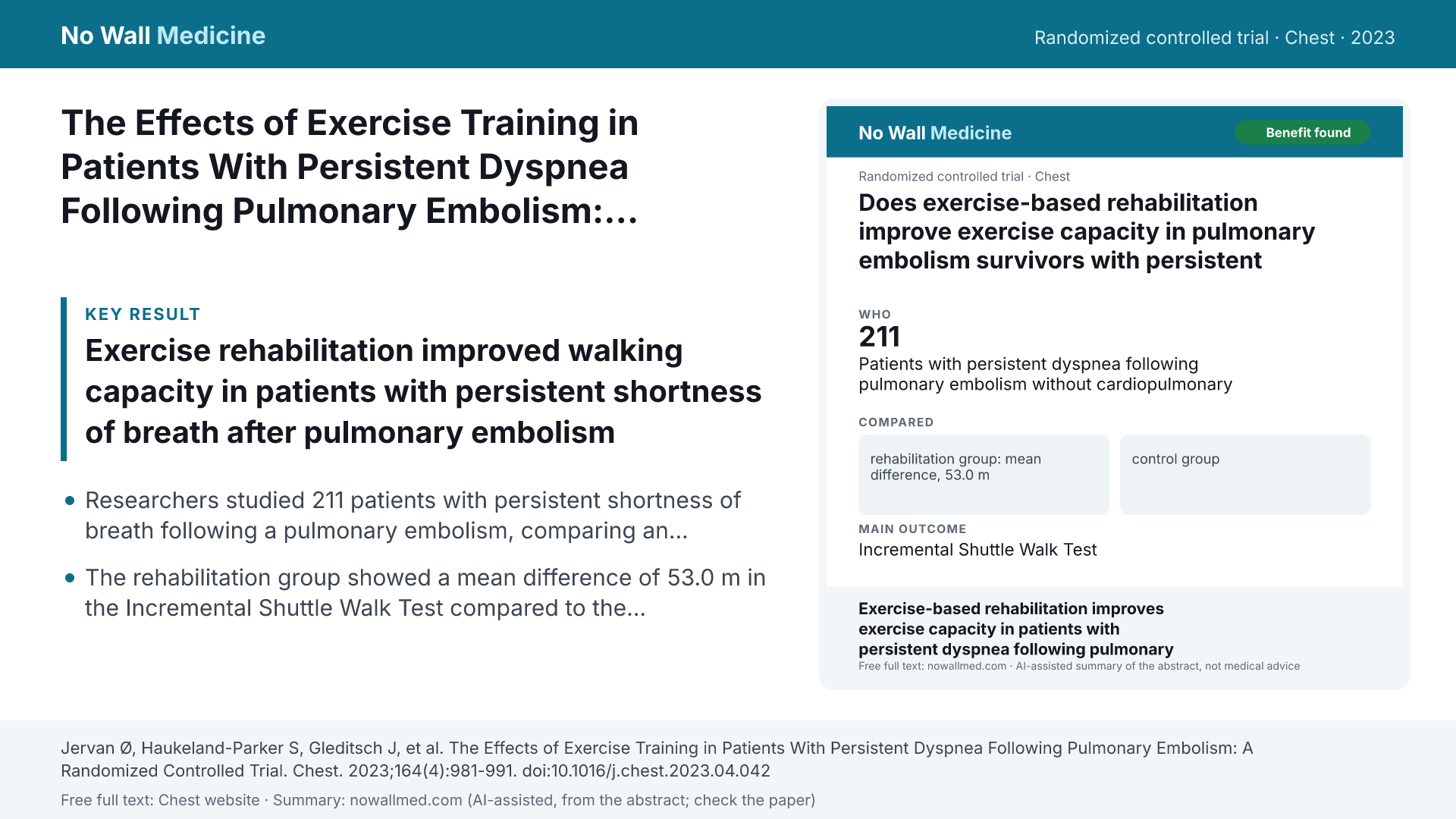
Key result: Exercise rehabilitation improved walking capacity in patients with persistent shortness of breath after pulmonary embolism
Randomized controlled trialBenefit found
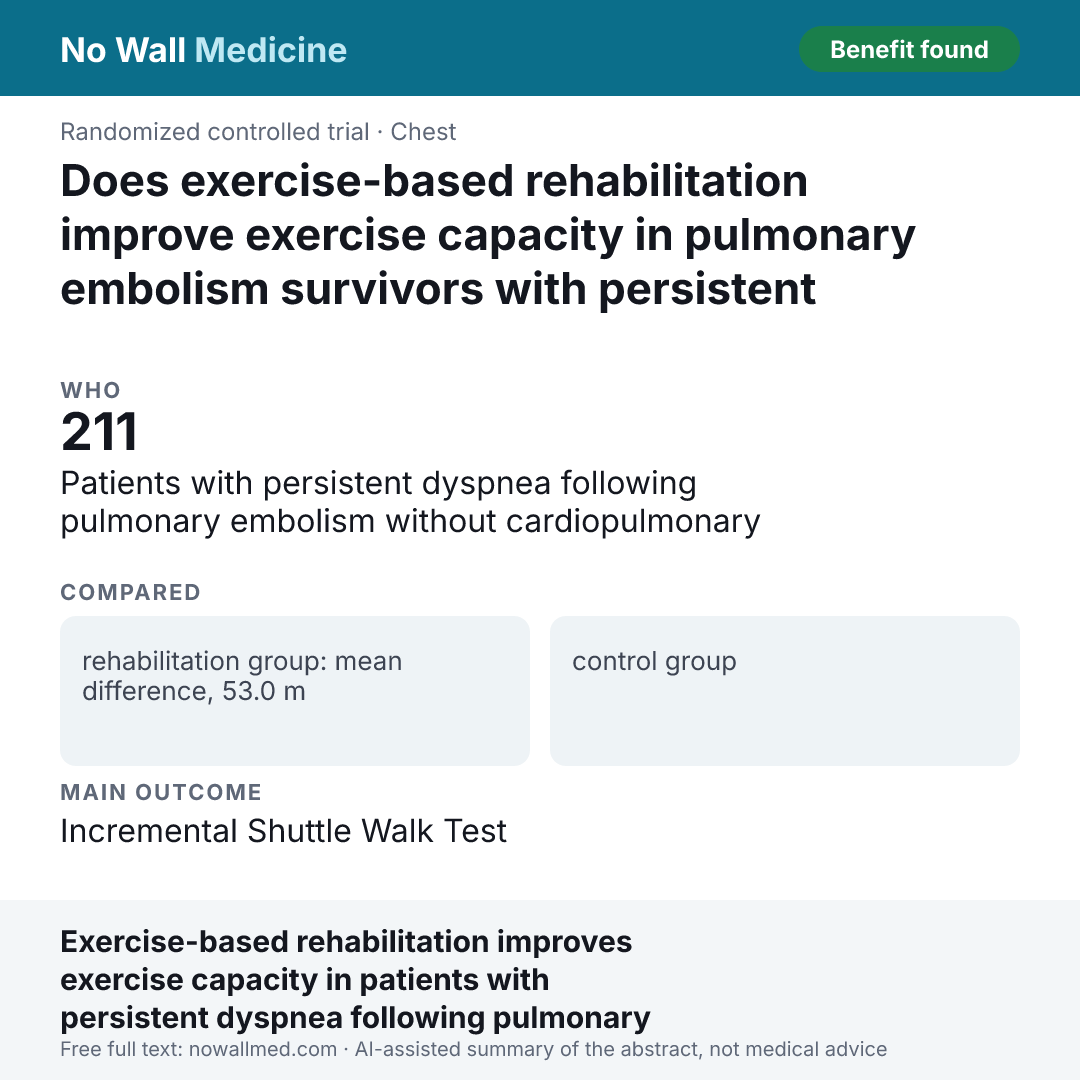
Does exercise-based rehabilitation improve exercise capacity in pulmonary embolism survivors with persistent dyspnea?
Who
211
Patients with persistent dyspnea following pulmonary embolism without cardiopulmonary comorbidities · Two hospitals
Compared
rehabilitation group: mean difference, 53.0 m
control group
Main outcome
Incremental Shuttle Walk Test
Result: mean difference, 53.0 m; 95% CI, 17.7-88.3
Bottom line: Exercise-based rehabilitation improves exercise capacity in patients with persistent dyspnea following pulmonary embolism.
Limitation: Further research is needed to assess optimal patient selection, timing, mode, and duration.
Chest · 2023-05-05 · Save PNG
Key points
- Researchers studied 211 patients with persistent shortness of breath following a pulmonary embolism, comparing an 8-week exercise program to usual care.
- The rehabilitation group showed a mean difference of 53.0 m in the Incremental Shuttle Walk Test compared to the control group.
- Participants in the exercise group also reported better scores on the Pulmonary Embolism-Quality of Life questionnaire with a mean difference of -4%.
Limitation the authors note: Further research is needed to assess the optimal patient selection, timing, mode, and duration of rehabilitation.
Discussion prompts
- Would these patients look like yours? Who was left out?
- Is the main outcome one that matters to patients?
- Is the difference large enough to change what you do?
Cite: Jervan Ø, Haukeland-Parker S, Gleditsch J, et al. The Effects of Exercise Training in Patients With Persistent Dyspnea Following Pulmonary Embolism: A Randomized Controlled Trial. Chest. 2023;164(4):981-991. doi:10.1016/j.chest.2023.04.042
Free full text: Chest website · Summary and visual abstract: nowallmed.com/a/the-effects-of-exercise-training-in-patients-with-persistent-dyspnea-10bqedl/ (AI-assisted from the abstract; check the paper before relying on it).