Efficacy of supraglottic airway devices in chest compression synchronized ventilation during continuous resuscitation: a prospective randomized cross-over cadaver study
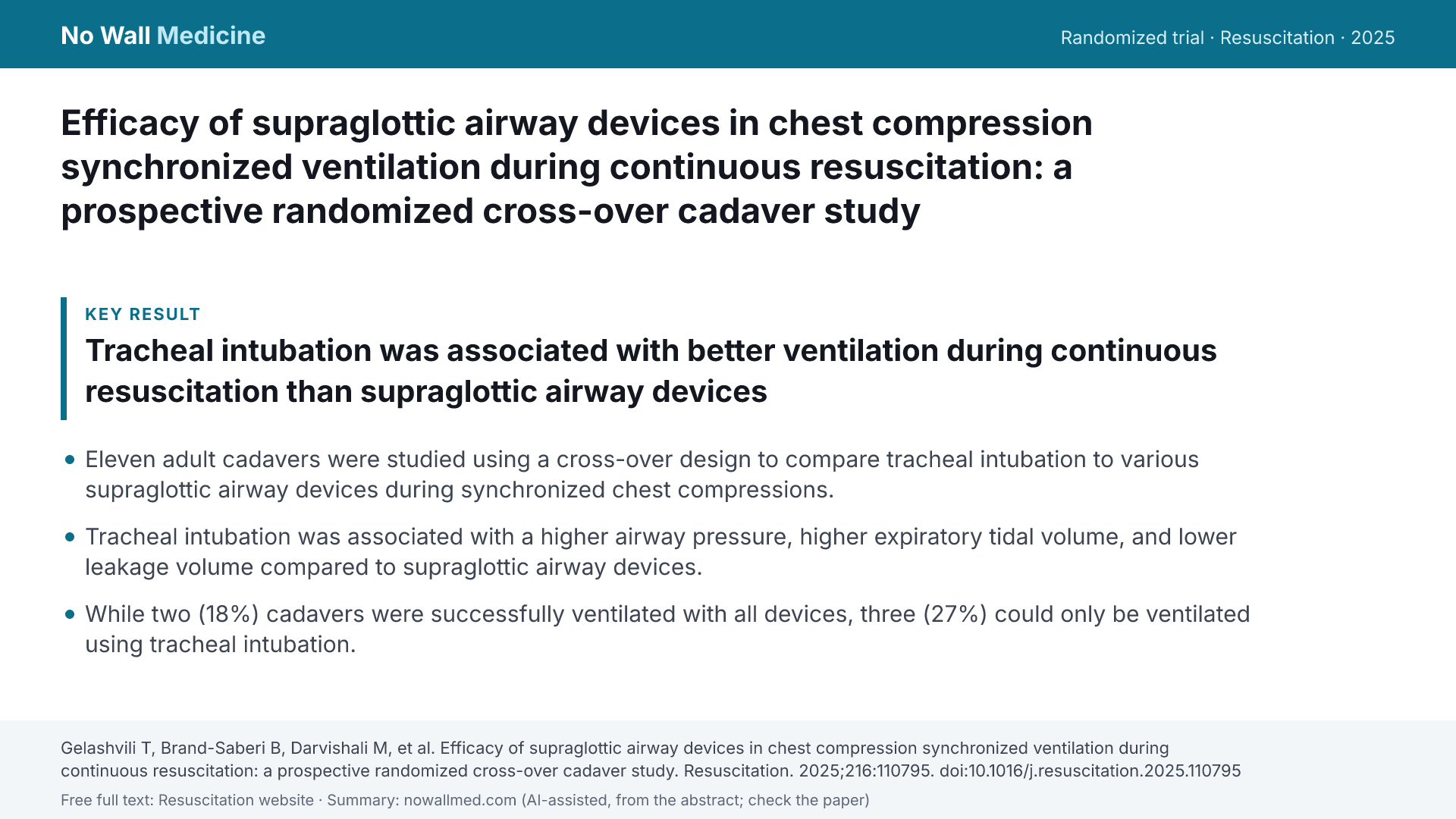
Key result: Tracheal intubation was associated with better ventilation during continuous resuscitation than supraglottic airway devices
Key points
- Eleven adult cadavers were studied using a cross-over design to compare tracheal intubation to various supraglottic airway devices during synchronized chest compressions.
- Tracheal intubation was associated with a higher airway pressure, higher expiratory tidal volume, and lower leakage volume compared to supraglottic airway devices.
- While two (18%) cadavers were successfully ventilated with all devices, three (27%) could only be ventilated using tracheal intubation.
Discussion prompts
- Would these patients look like yours? Who was left out?
- Is the main outcome one that matters to patients?
- Is the difference large enough to change what you do?
Cite: Gelashvili T, Brand-Saberi B, Darvishali M, et al. Efficacy of supraglottic airway devices in chest compression synchronized ventilation during continuous resuscitation: a prospective randomized cross-over cadaver study. Resuscitation. 2025;216:110795. doi:10.1016/j.resuscitation.2025.110795
Free full text: Resuscitation website · Summary and visual abstract: nowallmed.com/a/efficacy-of-supraglottic-airway-devices-in-chest-compression-c92scc/ (AI-assisted from the abstract; check the paper before relying on it).