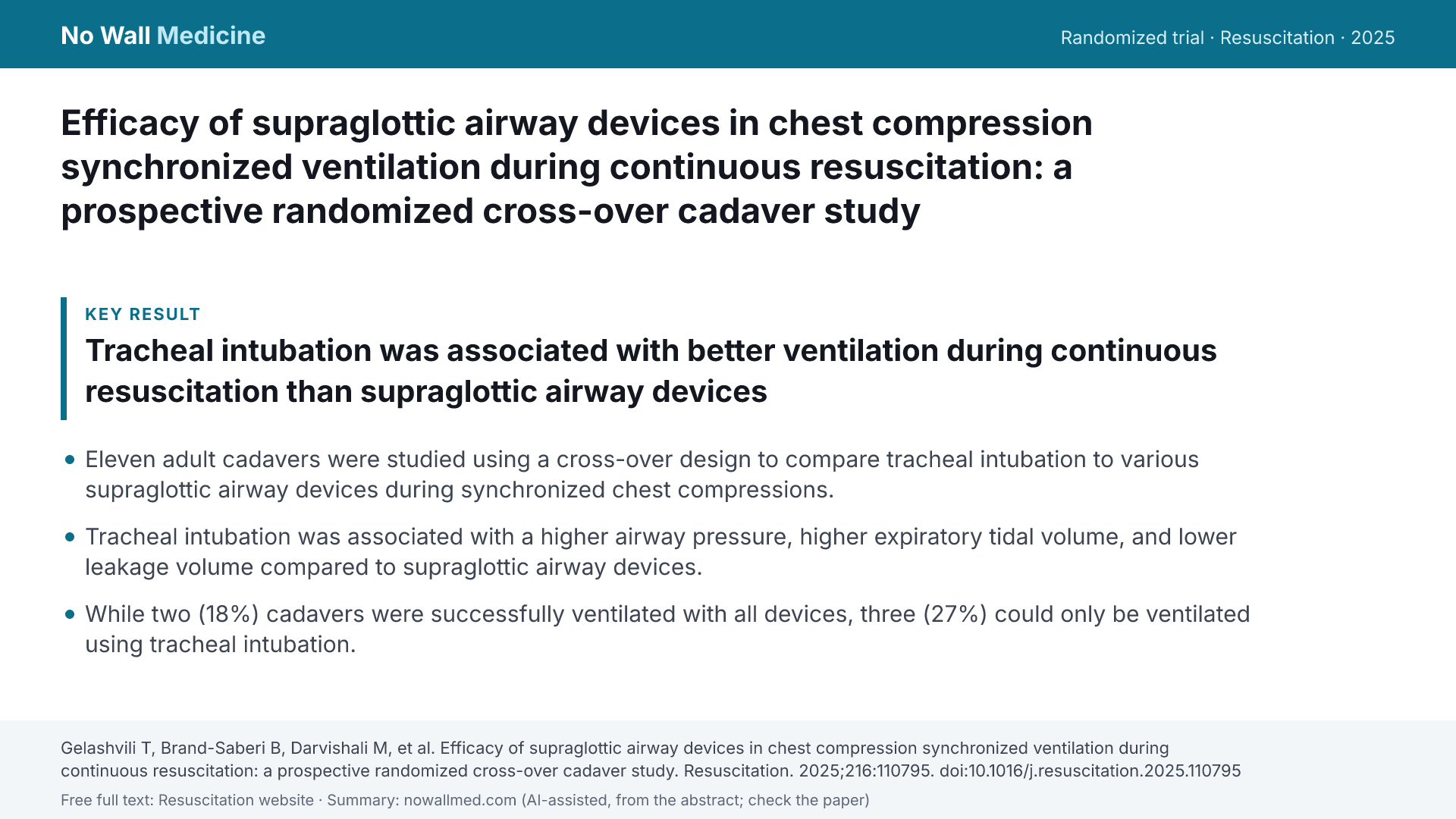
Tracheal intubation was associated with better ventilation during continuous resuscitation than supraglottic airway devices
Efficacy of supraglottic airway devices in chest compression synchronized ventilation during continuous resuscitation: a prospective randomized cross-over cadaver study
Why it matters: It is unknown how different airway devices perform when providing chest-compression-synchronized ventilation during continuous resuscitation.
Key points
- Eleven adult cadavers were studied using a cross-over design to compare tracheal intubation to various supraglottic airway devices during synchronized chest compressions.
- Tracheal intubation was associated with a higher airway pressure, higher expiratory tidal volume, and lower leakage volume compared to supraglottic airway devices.
- While two (18%) cadavers were successfully ventilated with all devices, three (27%) could only be ventilated using tracheal intubation.
Headline and key points written with AI from the paper’s abstract, with every number checked against it. Read the paper before relying on them.
Was this summary helpful?
Subject terms
Cite this article
Gelashvili T, Brand-Saberi B, Darvishali M, Hoyer A, Kolaparambil Varghese LJ, Kuehn V. Efficacy of supraglottic airway devices in chest compression synchronized ventilation during continuous resuscitation: a prospective randomized cross-over cadaver study. Resuscitation. 2025. doi:10.1016/j.resuscitation.2025.110795
Spotted a mistake? Suggest a correction
Top studies every Monday
The week’s key trials and guidelines in your specialties, plus any topics you follow. By email, free.
Get the weekly digest