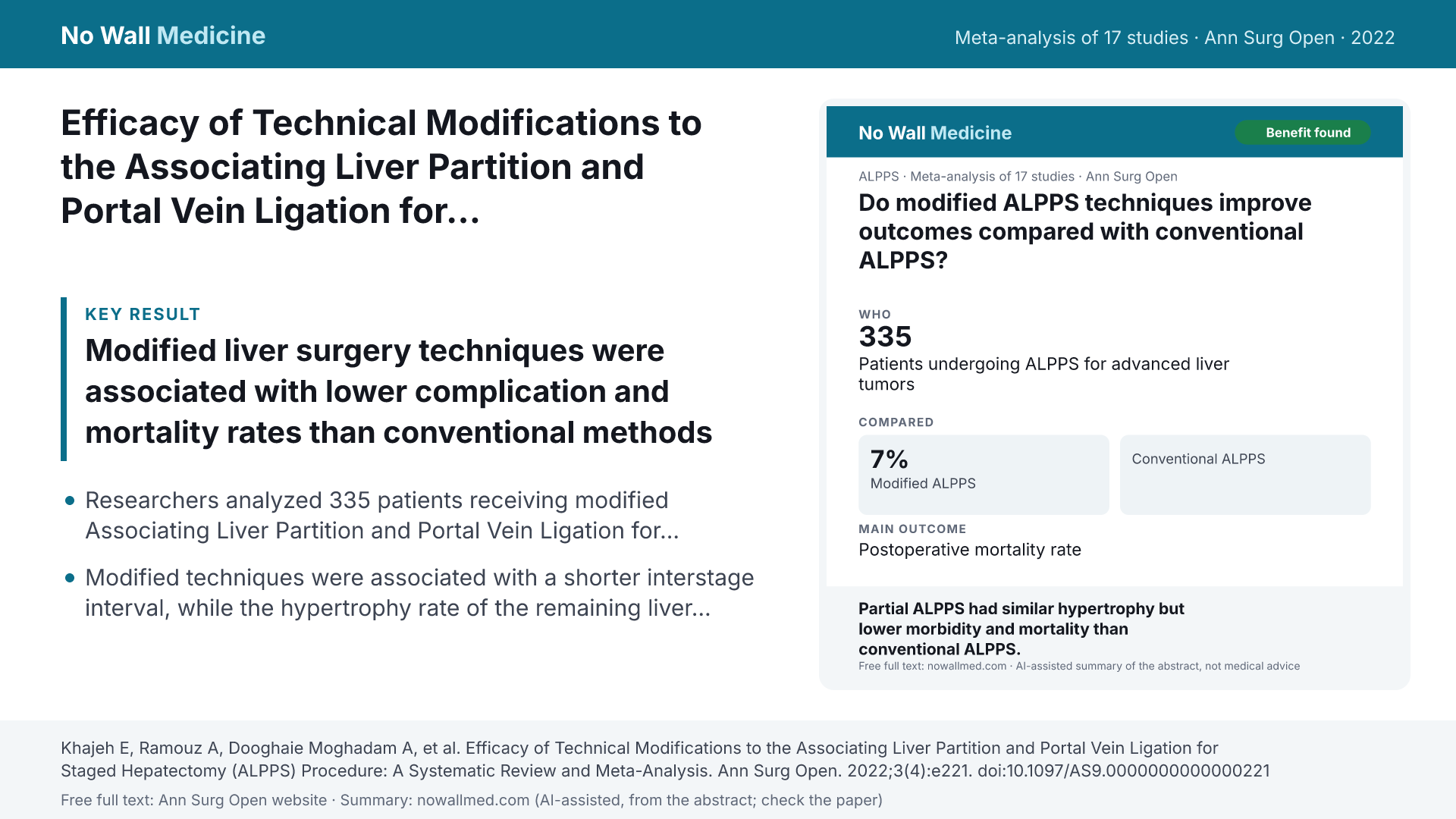
Modified liver surgery techniques were associated with lower complication and mortality rates than conventional methods
Efficacy of Technical Modifications to the Associating Liver Partition and Portal Vein Ligation for Staged Hepatectomy (ALPPS) Procedure: A Systematic Review and Meta-Analysis
Why it matters: It is unknown whether modifying the first stage of the Associating Liver Partition and Portal Vein Ligation for Staged Hepatectomy procedure affects liver growth or patient outcomes.
Key points
- Researchers analyzed 335 patients receiving modified Associating Liver Partition and Portal Vein Ligation for Staged Hepatectomy and 215 patients in a comparative analysis.
- Modified techniques were associated with a shorter interstage interval, while the hypertrophy rate of the remaining liver was not different between the two methods.
- The conventional method was associated with a higher overall complication rate and a higher mortality rate compared to the modified approach.
Headline and key points written with AI from the paper’s abstract, with every number checked against it. Read the paper before relying on them.
Was this summary helpful?
Abstract
To compare the outcomes of modified-Associating Liver Partition and Portal vein Ligation for Staged hepatectomy (ALPPS) techniques with those of conventional-ALPPS.Background
ALPPS is an established technique for treating advanced liver tumors.Methods
PubMed, Web of Science, and Cochrane databases were searched. The outcomes were assessed by single-arm and 2-arm analyses.Results
Seventeen studies containing 335 modified-ALPPS patients were included in single-arm meta-analysis. The estimated blood loss was 267 ± 29 mL (95% confidence interval [CI], 210-324 mL) during the first and 662 ± 51 mL (95% CI, 562-762 mL) during the second stage. The operation time was 166 ± 18 minutes (95% CI, 131-202 minutes) during the first and 225 ± 19 minutes (95% CI, 188-263 minutes) during the second stage. The major morbidity rate was 14% (95% CI, 9%-22%) after the first stage. The future liver remnant hypertrophy rate was 65.2% ± 5% (95% CI, 55%-75%) and the interstage interval was 16 ± 1 days (95% CI, 14-17 days). The dropout rate was 9% (95% CI, 5%-15%). The overall complication rate was 46% (95% CI, 37%-56%) and the major complication rate was 20% (95% CI, 14%-26%). The postoperative mortality rate was 7% (95% CI, 4%-11%). Seven studies containing 215 patients were included in comparative analysis. The hypertrophy rate was not different between 2 methods (mean difference [MD], -5.01; 95% CI, -19.16 to 9.14; P = 0.49). The interstage interval was shorter for partial-ALPPS (MD, 9.43; 95% CI, 3.29-15.58; P = 0.003). The overall complication rate (odds ratio [OR], 10.10; 95% CI, 2.11-48.35; P = 0.004) and mortality rate (OR, 3.74; 95% CI, 1.36-10.26; P = 0.01) were higher in the conventional-ALPPS.Conclusions
The hypertrophy rate in partial-ALPPS was similar to conventional-ALPPS. This shows that minimizing the first stage of the operation does not affect hypertrophy. Moreover, the postoperative overall morbidity and mortality rates were lower following partial-ALPPS.
Abstract reproduced under the article’s CC BY-NC-ND licence.
Cite this article
Khajeh E, Ramouz A, Dooghaie Moghadam A, Aminizadeh E, Ghamarnejad O, Ali-Hassan-Al-Saegh S. Efficacy of Technical Modifications to the Associating Liver Partition and Portal Vein Ligation for Staged Hepatectomy (ALPPS) Procedure: A Systematic Review and Meta-Analysis. Ann Surg Open. 2022. doi:10.1097/AS9.0000000000000221
Spotted a mistake? Suggest a correction
Top studies every Monday
The week’s key trials and guidelines in your specialties, plus any topics you follow. By email, free.
Get the weekly digest