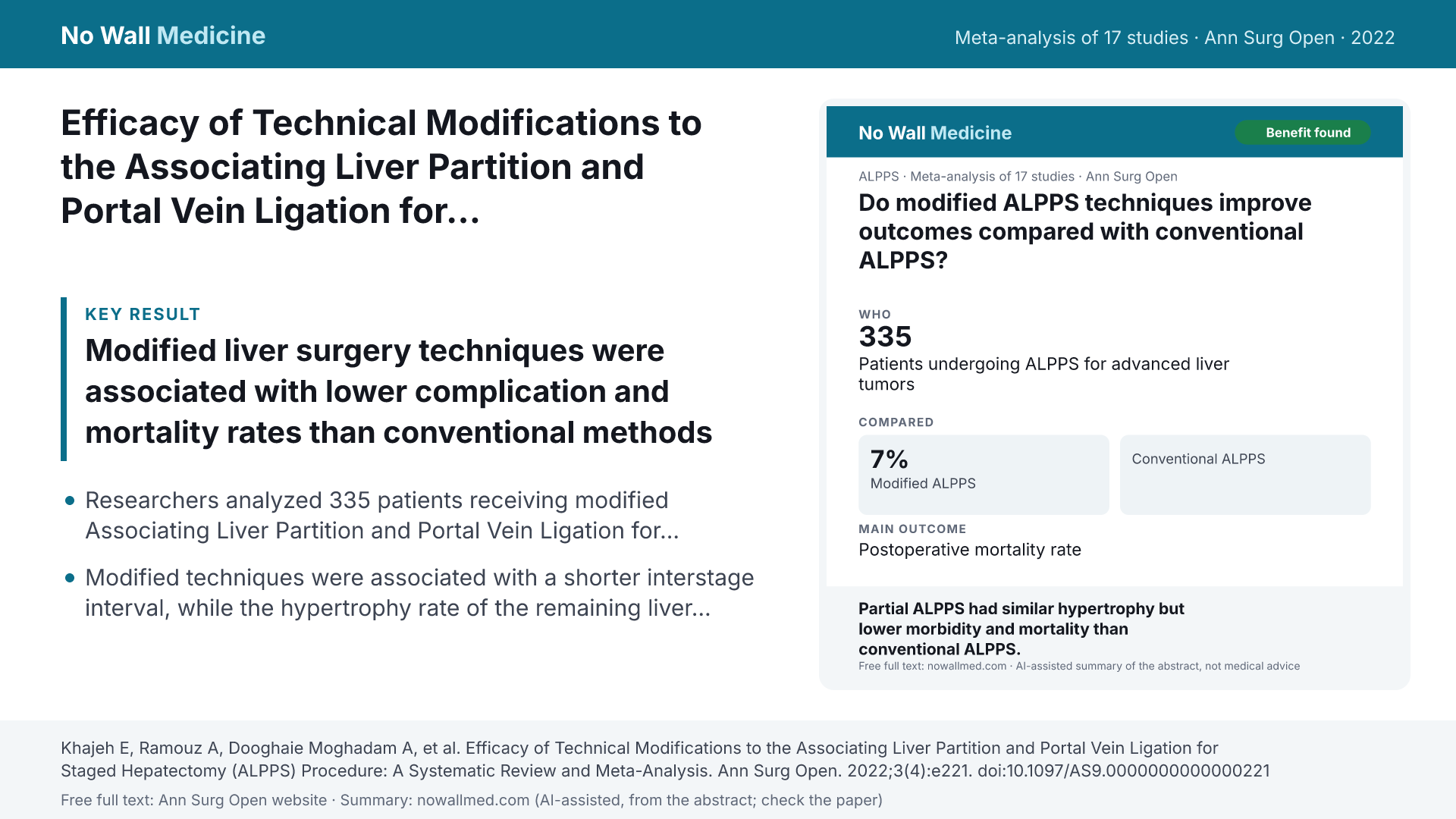
Efficacy of Technical Modifications to the Associating Liver Partition and Portal Vein Ligation for Staged Hepatectomy (ALPPS) Procedure: A Systematic Review and Meta-Analysis
Key result: Modified liver surgery techniques were associated with lower complication and mortality rates than conventional methods
Key points
- Researchers analyzed 335 patients receiving modified Associating Liver Partition and Portal Vein Ligation for Staged Hepatectomy and 215 patients in a comparative analysis.
- Modified techniques were associated with a shorter interstage interval, while the hypertrophy rate of the remaining liver was not different between the two methods.
- The conventional method was associated with a higher overall complication rate and a higher mortality rate compared to the modified approach.
Why it matters: It is unknown whether modifying the first stage of the Associating Liver Partition and Portal Vein Ligation for Staged Hepatectomy procedure affects liver growth or patient outcomes.
Discussion prompts
- Would these patients look like yours? Who was left out?
- Is the main outcome one that matters to patients?
- Is the difference large enough to change what you do?
Cite: Khajeh E, Ramouz A, Dooghaie Moghadam A, et al. Efficacy of Technical Modifications to the Associating Liver Partition and Portal Vein Ligation for Staged Hepatectomy (ALPPS) Procedure: A Systematic Review and Meta-Analysis. Ann Surg Open. 2022. doi:10.1097/AS9.0000000000000221
Free full text: Ann Surg Open website · Summary and visual abstract: nowallmed.com/a/efficacy-of-technical-modifications-to-the-associating-liver-1caa0zg/ (AI-assisted from the abstract; check the paper before relying on it).