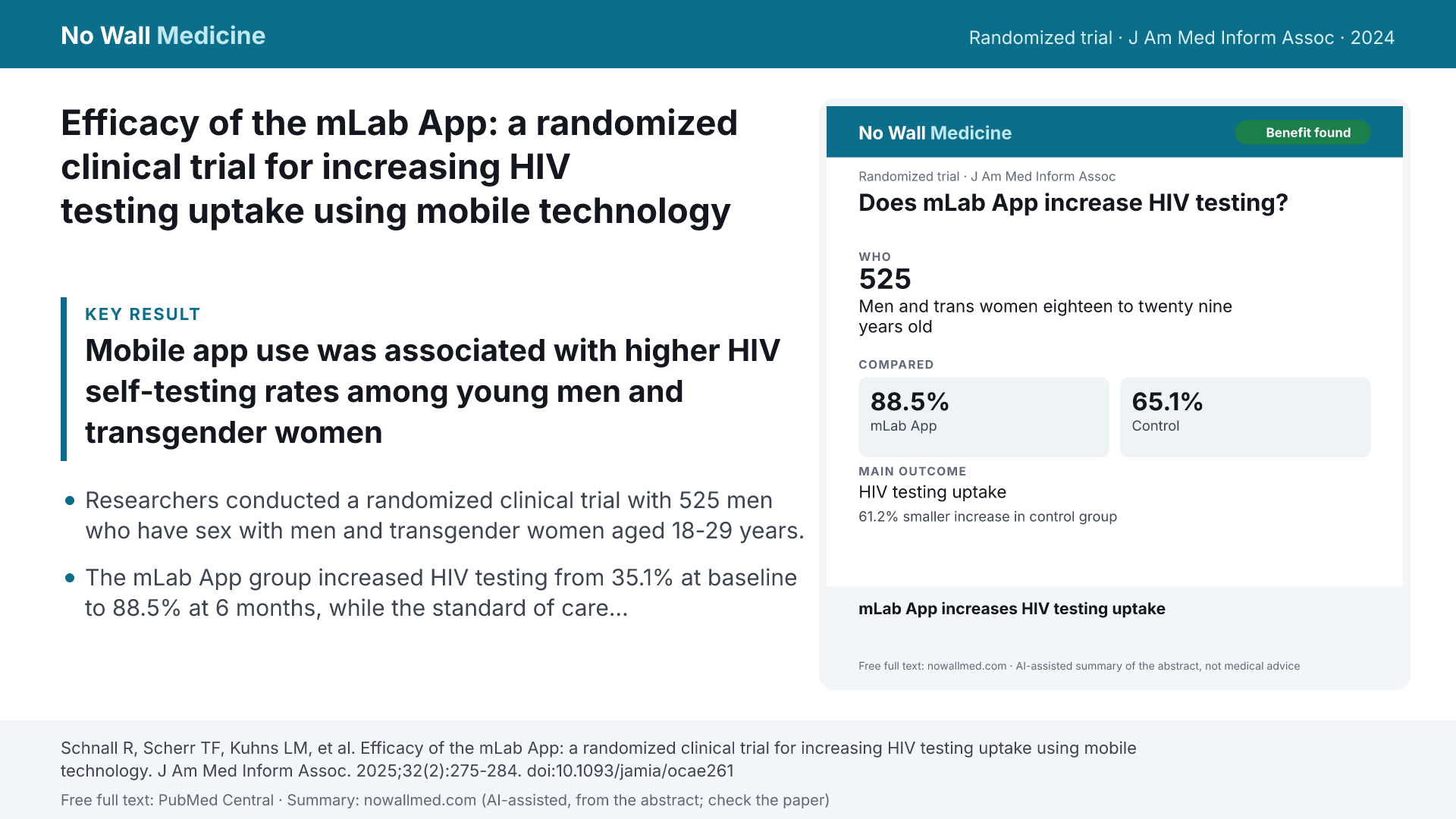
Efficacy of the mLab App: a randomized clinical trial for increasing HIV testing uptake using mobile technology
Key result: Mobile app use was associated with higher HIV self-testing rates among young men and transgender women
mLab App
Control
About 5 people would need the treatment for 1 more to benefit over the trial’s follow-up (number needed to treat).
Key points
- Researchers conducted a randomized clinical trial with 525 men who have sex with men and transgender women aged 18-29 years.
- The mLab App group increased HIV testing from 35.1% at baseline to 88.5% at 6 months, while the standard of care group increased from 28.8% to 65.1%.
- At 12 months, the control group showed an 82.6% smaller increase in HIV testing compared to the mLab App group.
In absolute numbers: mLab App 88.5% vs Control 65.1%, a difference of 23.4 percentage points (about 5 people treated for one more to benefit).
Discussion prompts
- Would these patients look like yours? Who was left out?
- Is the main outcome one that matters to patients?
- Is the difference large enough to change what you do?
Cite: Schnall R, Scherr TF, Kuhns LM, et al. Efficacy of the mLab App: a randomized clinical trial for increasing HIV testing uptake using mobile technology. J Am Med Inform Assoc. 2025;32(2):275-284. doi:10.1093/jamia/ocae261
Free full text: PubMed Central · Summary and visual abstract: nowallmed.com/a/efficacy-of-the-mlab-app-a-randomized-clinical-trial-for-increasing-14vek3i/ (AI-assisted from the abstract; check the paper before relying on it).