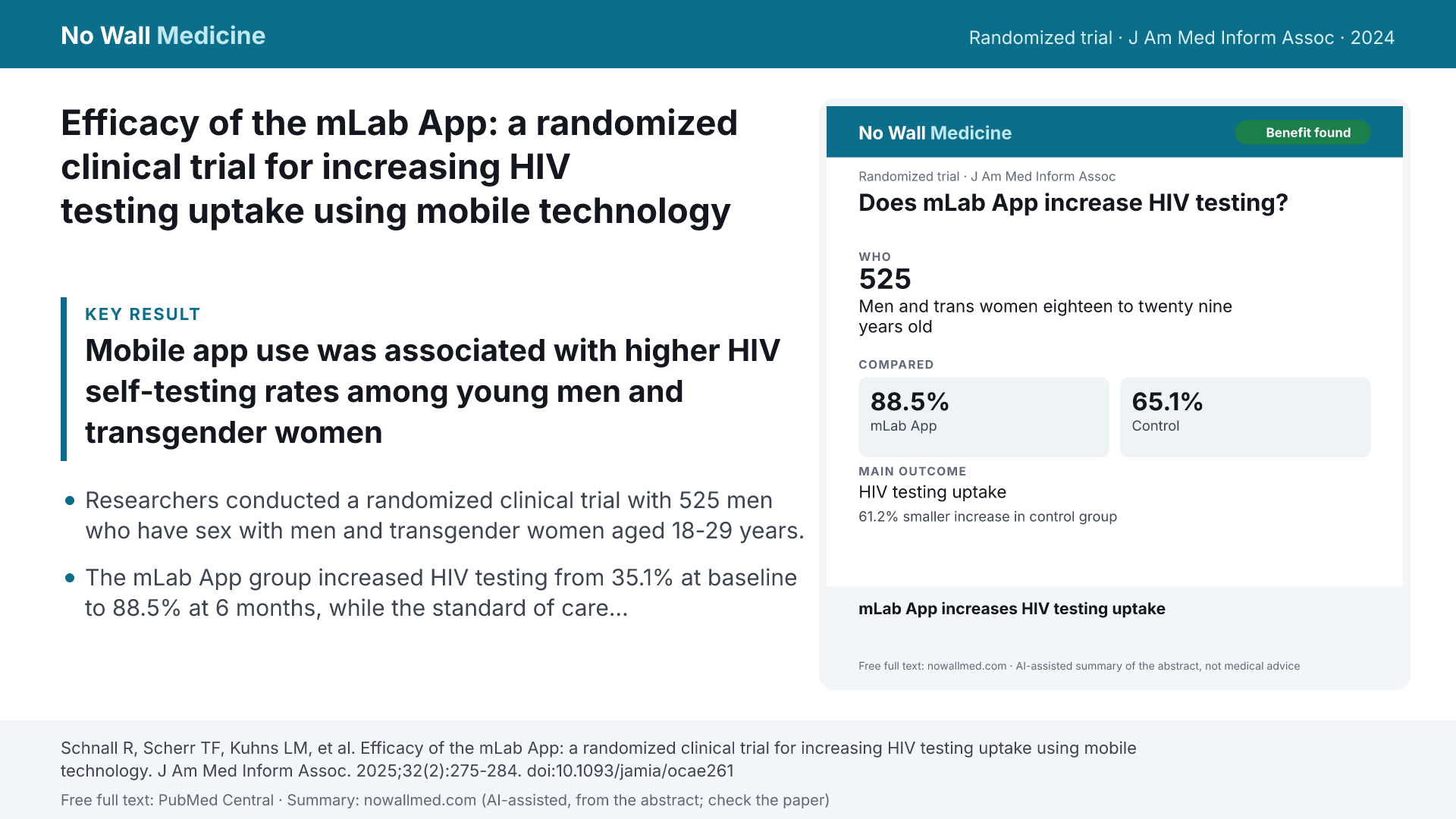
Mobile app use was associated with higher HIV self-testing rates among young men and transgender women
Efficacy of the mLab App: a randomized clinical trial for increasing HIV testing uptake using mobile technology
Randomized trialBenefit found
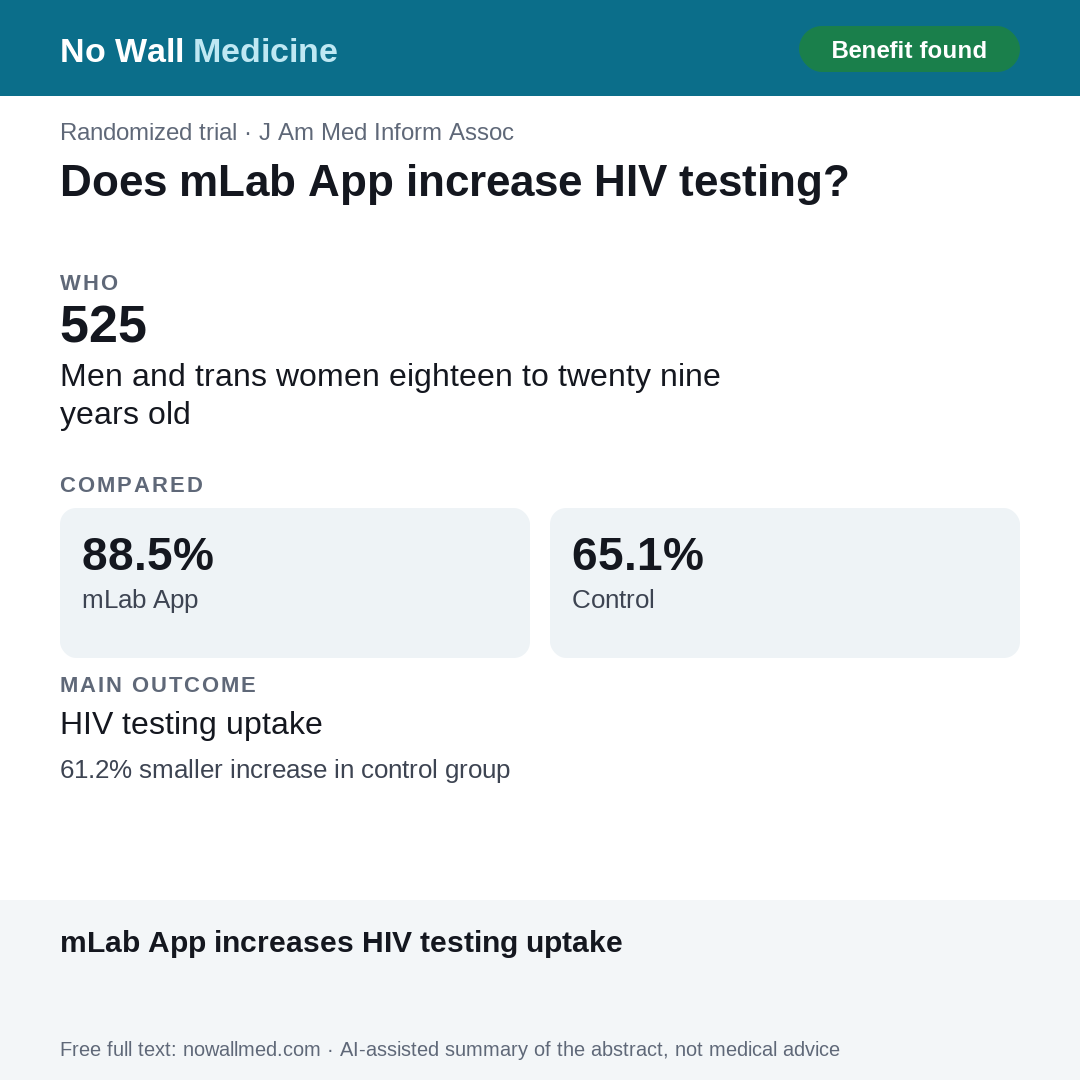
Does mLab App increase HIV testing?
Who
525
Men and trans women eighteen to twenty nine years old
Compared
88.5%mLab App
65.1%Control
Main outcome
HIV testing uptake
Result: 61.2% smaller increase in control group
Bottom line: mLab App increases HIV testing uptake
J Am Med Inform Assoc · 2024-11-19Download image
Clinical question: Does mLab App increase HIV testing?
Why it matters: It was unknown if a mobile-delivered intervention could increase HIV self-testing rates among young men who have sex with men and transgender women.
In absolute numbers
mLab App: 88.5% · Control: 65.1% → a difference of 23.4 percentage points, so about 5 people would need the treatment for 1 more to benefit (number needed to treat) over the trial’s follow-up.
Worked out by us from the two group results above, not reported by the authors. Check the paper for the exact outcome and timing.
Key points
- Researchers conducted a randomized clinical trial with 525 men who have sex with men and transgender women aged 18-29 years.
- The mLab App group increased HIV testing from 35.1% at baseline to 88.5% at 6 months, while the standard of care group increased from 28.8% to 65.1%.
- At 12 months, the control group showed an 82.6% smaller increase in HIV testing compared to the mLab App group.
Headline and key points written with AI from the paper’s abstract, with every number checked against it. Read the paper before relying on them.
Was this summary helpful?
Subject terms
Cite this article
Schnall R, Scherr TF, Kuhns LM, et al. Efficacy of the mLab App: a randomized clinical trial for increasing HIV testing uptake using mobile technology. J Am Med Inform Assoc. 2024. doi:10.1093/jamia/ocae261
Spotted a mistake? Suggest a correction