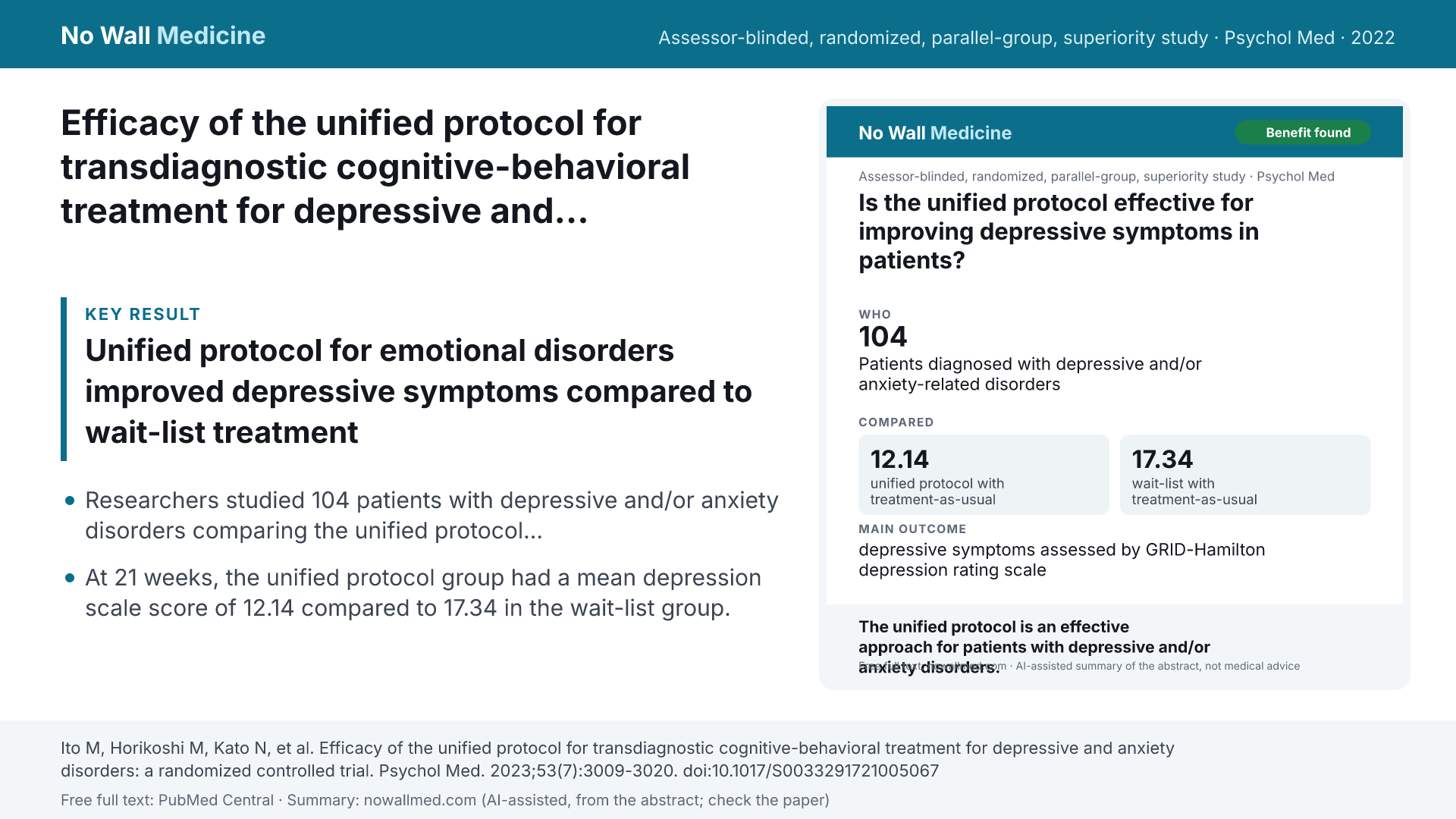
Efficacy of the unified protocol for transdiagnostic cognitive-behavioral treatment for depressive and anxiety disorders: a randomized controlled trial
Key result: Unified protocol for emotional disorders improved depressive symptoms compared to wait-list treatment
Key points
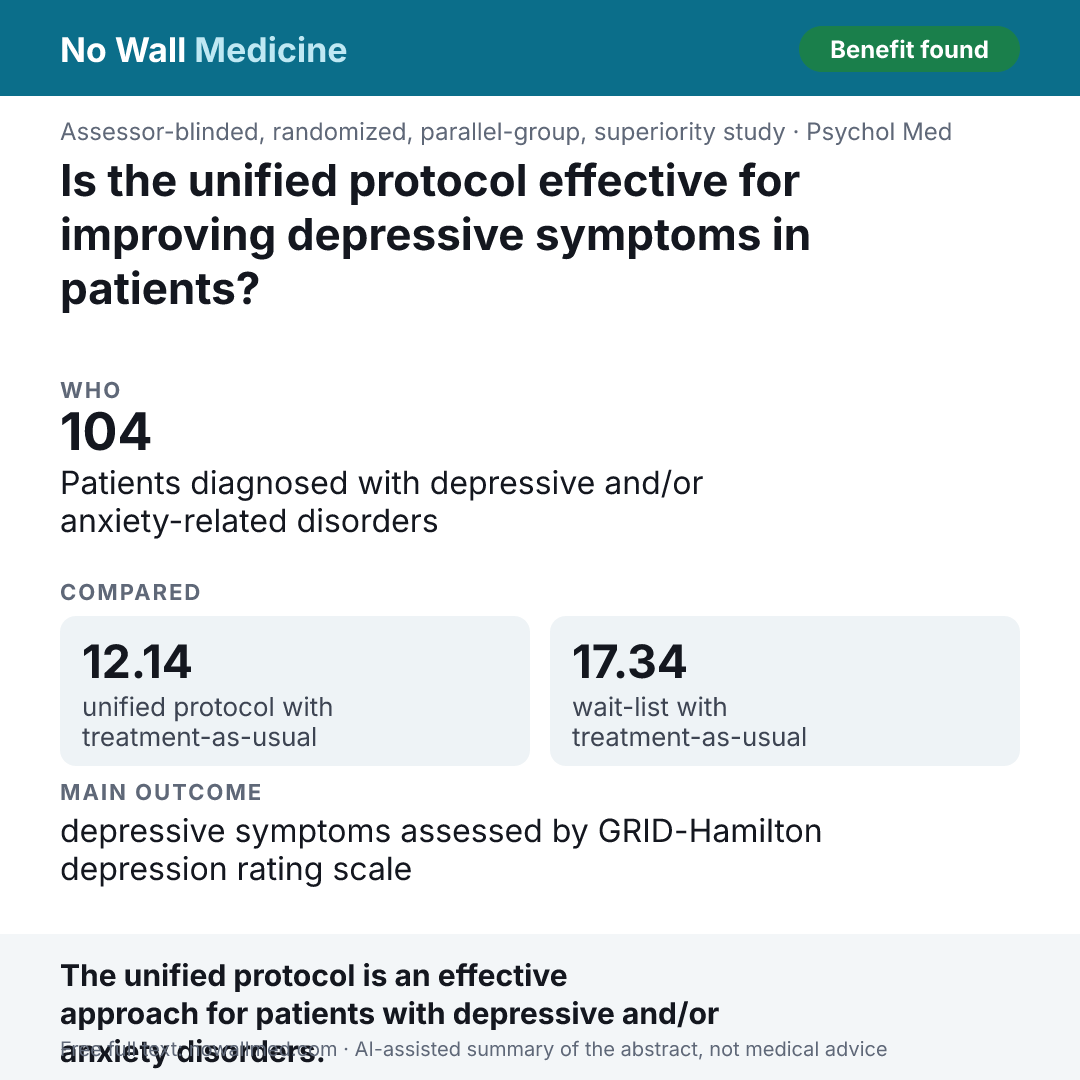
- Researchers studied 104 patients with depressive and/or anxiety disorders comparing the unified protocol with treatment-as-usual to a wait-list group.
- At 21 weeks, the unified protocol group had a mean depression scale score of 12.14 compared to 17.34 in the wait-list group.
- The unified protocol group also showed significant superiority in anxiety symptoms and clinical global impressions, with improvements maintained at 43 weeks.
Why it matters: The efficacy of the unified protocol for transdiagnostic treatment of emotional disorders has been poorly studied in patients with depressive disorders.
Discussion prompts
- Would these patients look like yours? Who was left out?
- Is the main outcome one that matters to patients?
- Is the difference large enough to change what you do?
Cite: Ito M, Horikoshi M, Kato N, et al. Efficacy of the unified protocol for transdiagnostic cognitive-behavioral treatment for depressive and anxiety disorders: a randomized controlled trial. Psychol Med. 2023;53(7):3009-3020. doi:10.1017/S0033291721005067
Free full text: PubMed Central · Summary and visual abstract: nowallmed.com/a/efficacy-of-the-unified-protocol-for-transdiagnostic-cognitive-8nist9/ (AI-assisted from the abstract; check the paper before relying on it).