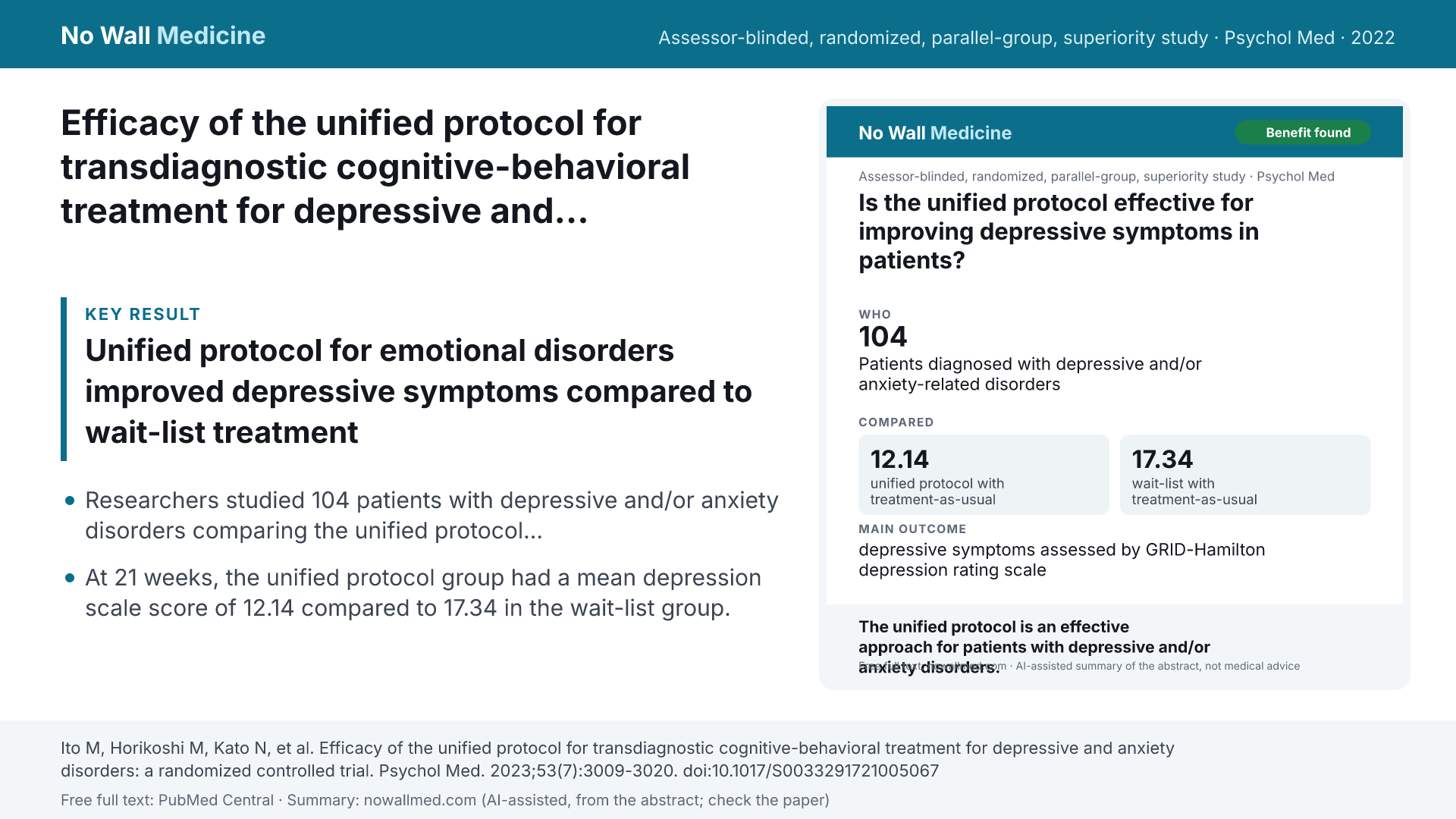
Unified protocol for emotional disorders improved depressive symptoms compared to wait-list treatment
Efficacy of the unified protocol for transdiagnostic cognitive-behavioral treatment for depressive and anxiety disorders: a randomized controlled trial
Assessor-blinded, randomized, parallel-group, superiority studyBenefit found
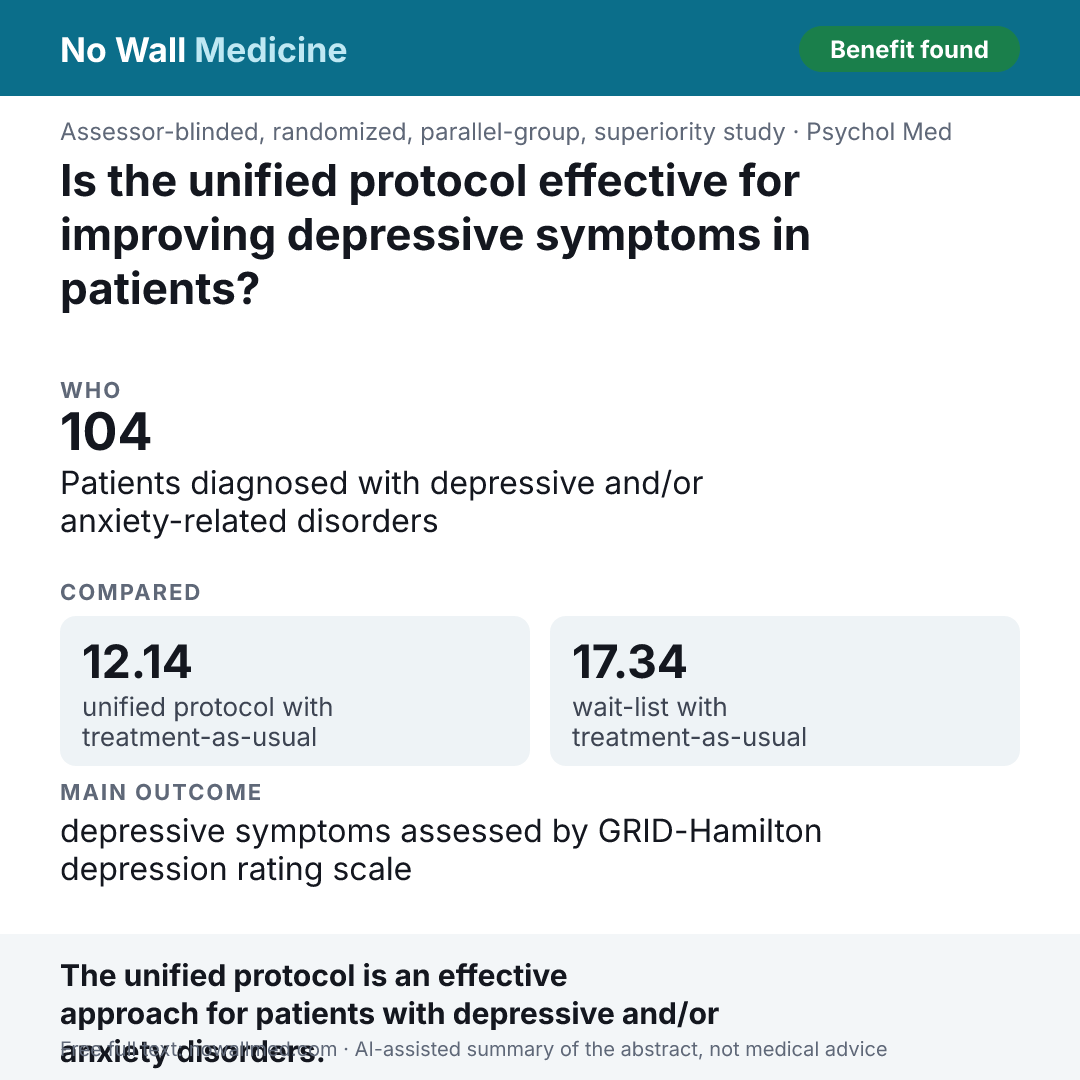
Is the unified protocol effective for improving depressive symptoms in patients?
Who
104
Patients diagnosed with depressive and/or anxiety-related disorders
Compared
12.14unified protocol with treatment-as-usual (s.d. = 5.47)
17.34wait-list with treatment-as-usual (s.d. = 5.78)
Main outcome
depressive symptoms assessed by GRID-Hamilton depression rating scale
Result: -3.99 (95% CI -6.10 to -1.87)
Bottom line: The unified protocol is an effective approach for patients with depressive and/or anxiety disorders.
Psychol Med · 2022-01-10 · Save PNG
Clinical question: Is the unified protocol effective for improving depressive symptoms in patients?
Why it matters: The efficacy of the unified protocol for transdiagnostic treatment of emotional disorders has been poorly studied in patients with depressive disorders.
Key points
- Researchers studied 104 patients with depressive and/or anxiety disorders comparing the unified protocol with treatment-as-usual to a wait-list group.
- At 21 weeks, the unified protocol group had a mean depression scale score of 12.14 compared to 17.34 in the wait-list group.
- The unified protocol group also showed significant superiority in anxiety symptoms and clinical global impressions, with improvements maintained at 43 weeks.
Headline and key points written with AI from the paper’s abstract, with every number checked against it. Read the paper before relying on them.
Was this summary helpful?
Subject terms
Headline, design, result, key points, caveat and citation as plain text.
Cite this article
Ito M, Horikoshi M, Kato N, et al. Efficacy of the unified protocol for transdiagnostic cognitive-behavioral treatment for depressive and anxiety disorders: a randomized controlled trial. Psychol Med. 2022. doi:10.1017/S0033291721005067
Spotted a mistake? Suggest a correction