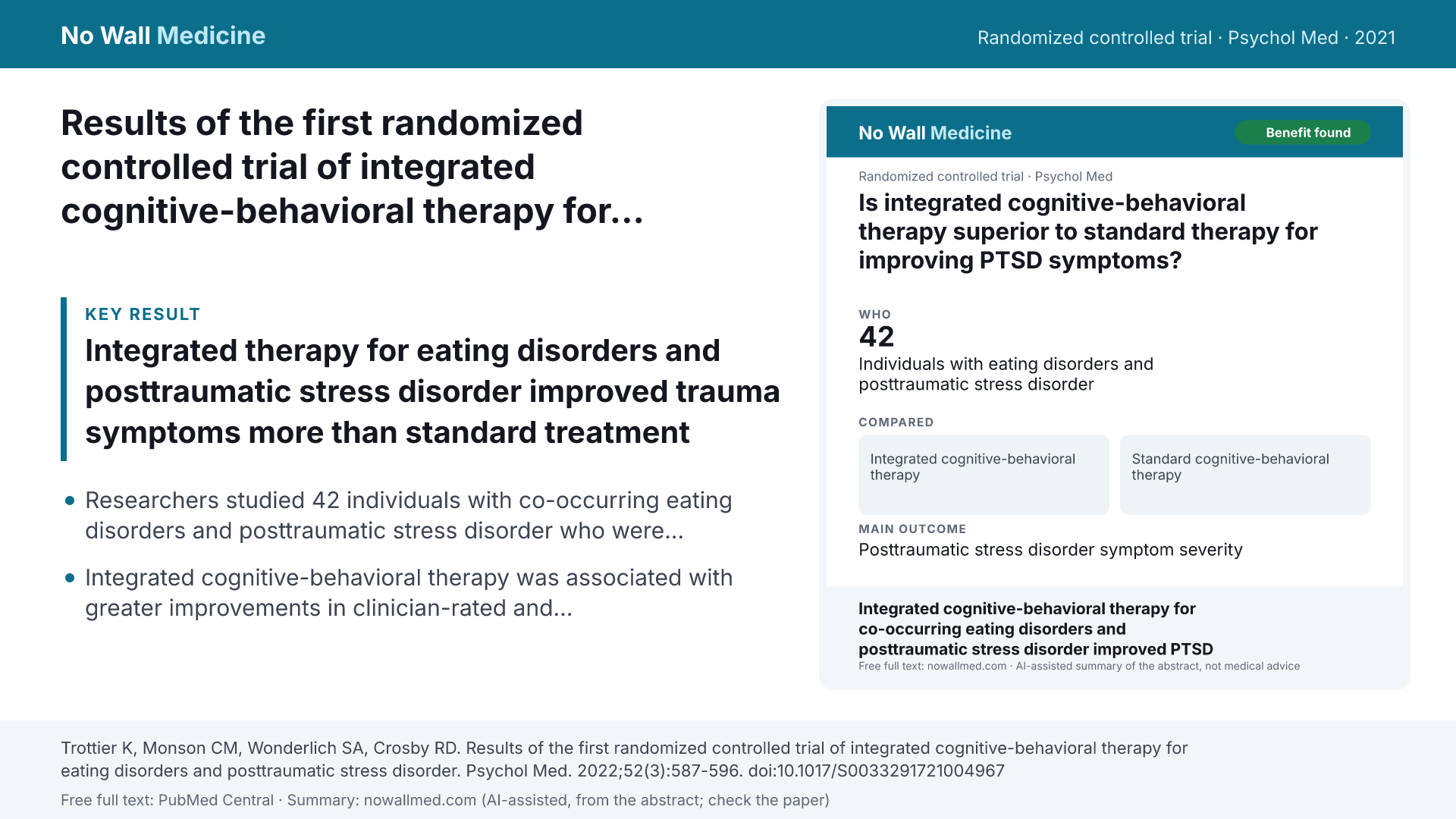
Integrated therapy for eating disorders and posttraumatic stress disorder improved trauma symptoms more than standard treatment
Results of the first randomized controlled trial of integrated cognitive-behavioral therapy for eating disorders and posttraumatic stress disorder
Randomized controlled trialBenefit found
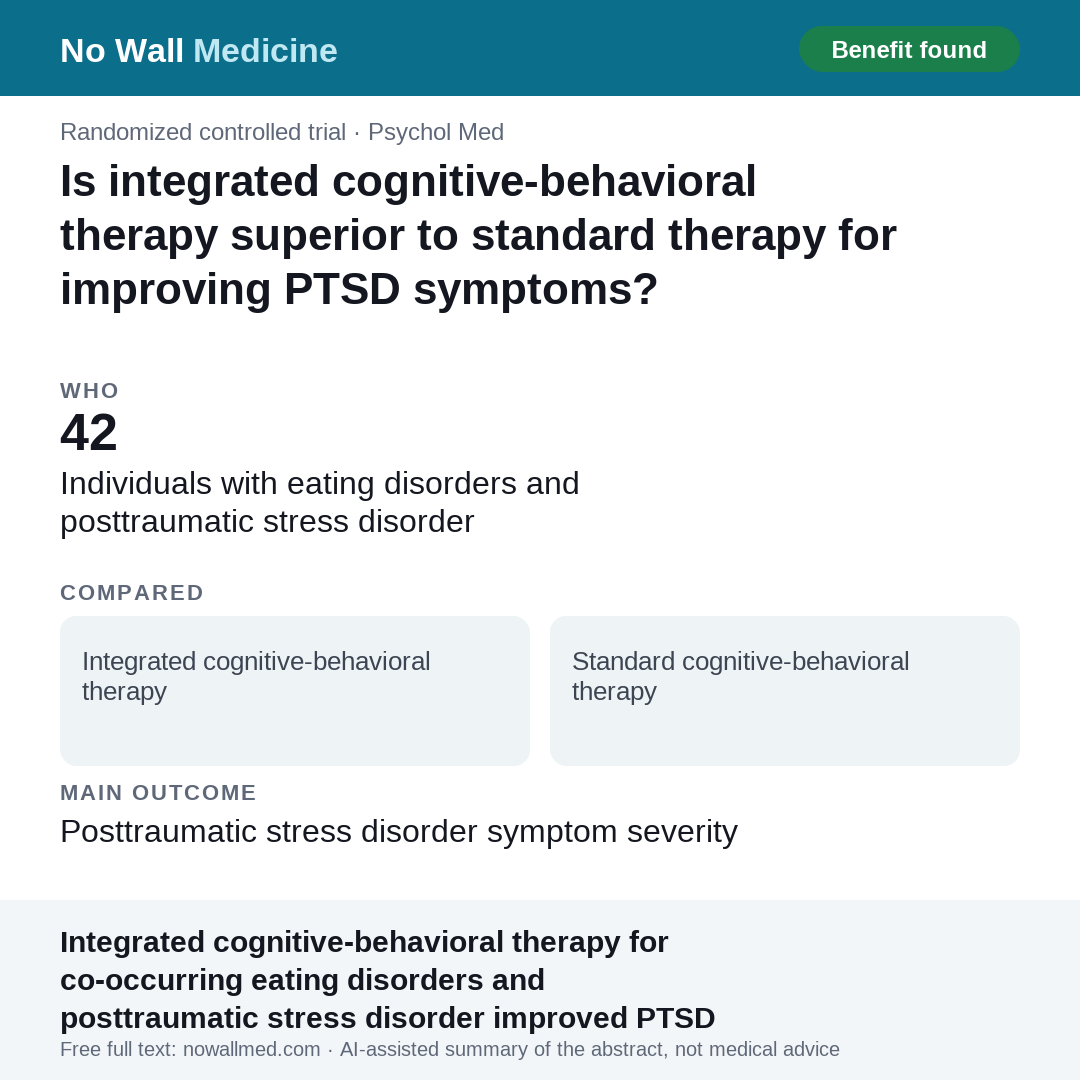
Is integrated cognitive-behavioral therapy superior to standard therapy for improving PTSD symptoms?
Who
42
Individuals with eating disorders and posttraumatic stress disorder
Compared
Integrated cognitive-behavioral therapy
Standard cognitive-behavioral therapy
Main outcome
Posttraumatic stress disorder symptom severity
Bottom line: Integrated cognitive-behavioral therapy for co-occurring eating disorders and posttraumatic stress disorder improved PTSD symptoms.
Limitation: Future studies with larger sample sizes are needed to determine benefits for eating disorder outcomes.
Psychol Med · 2021-12-07Download image
Clinical question: Is integrated cognitive-behavioral therapy superior to standard therapy for improving PTSD symptoms?
Why it matters: It was unknown whether combining cognitive-behavioral therapy for eating disorders and posttraumatic stress disorder is more effective for trauma symptoms than treating the eating disorder alone.
Key points
- Researchers studied 42 individuals with co-occurring eating disorders and posttraumatic stress disorder who were randomized to receive either integrated cognitive-behavioral therapy or standard cognitive-behavioral therapy for eating disorders.
- Integrated cognitive-behavioral therapy was associated with greater improvements in clinician-rated and self-reported posttraumatic stress disorder symptom severity compared to standard treatment.
- Both treatment types were associated with significant improvements in anxiety, depression, and posttraumatic stress disorder symptoms that were maintained at 3- and 6-month follow-up.
Limitation the authors note: Future studies with larger sample sizes are needed to determine if integrated treatment provides benefits for eating disorder outcomes.
Headline and key points written with AI from the paper’s abstract, with every number checked against it. Read the paper before relying on them.
Was this summary helpful?
Subject terms
Cite this article
Trottier K, Monson CM, Wonderlich SA, Crosby RD. Results of the first randomized controlled trial of integrated cognitive-behavioral therapy for eating disorders and posttraumatic stress disorder. Psychol Med. 2021. doi:10.1017/S0033291721004967
Spotted a mistake? Suggest a correction