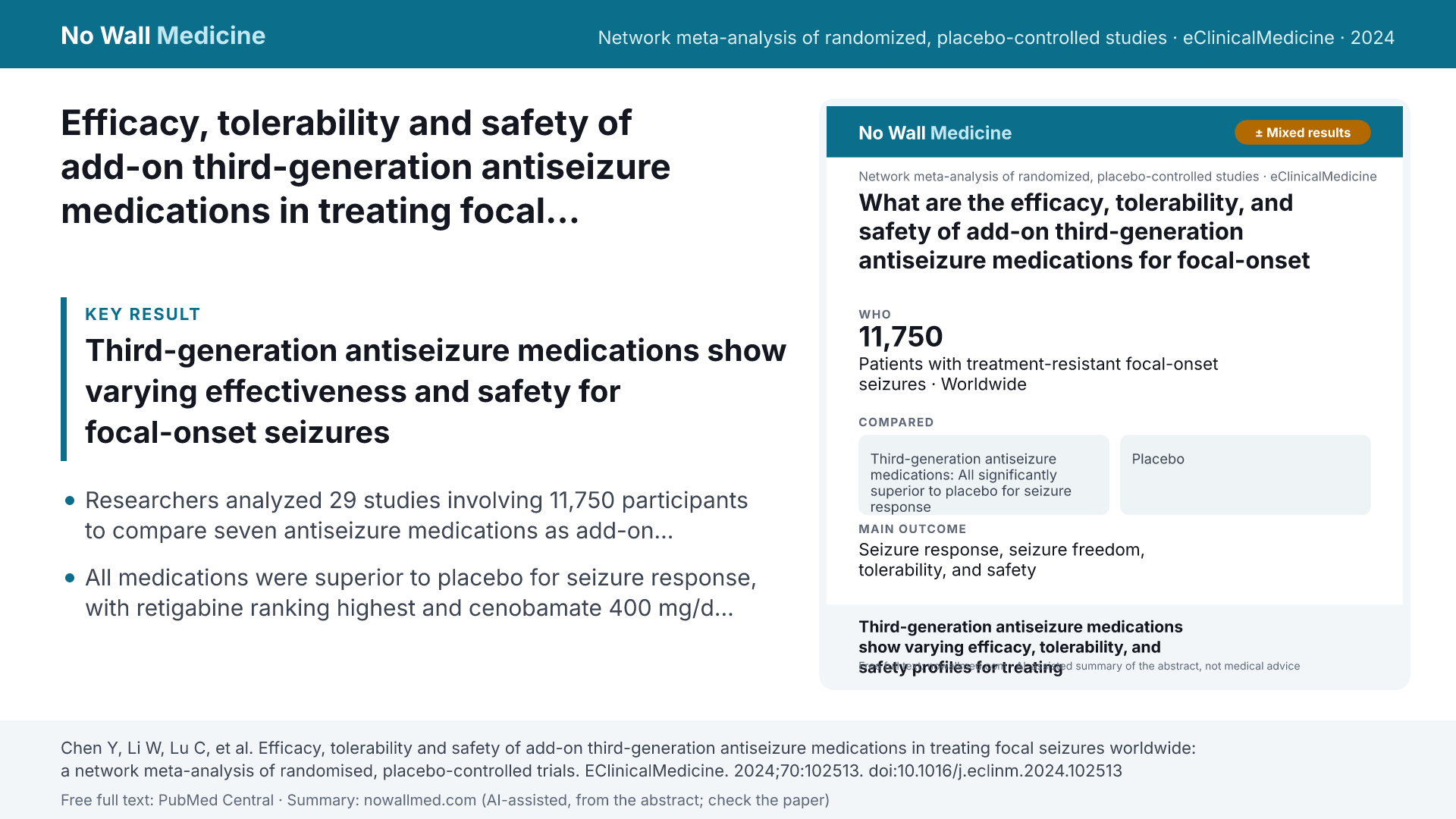
Third-generation antiseizure medications show varying effectiveness and safety for focal-onset seizures
Efficacy, tolerability and safety of add-on third-generation antiseizure medications in treating focal seizures worldwide: a network meta-analysis of randomised, placebo-controlled trials
Network meta-analysis of randomized, placebo-controlled trialsMixed results
What are the efficacy, tolerability, and safety of add-on third-generation antiseizure medications for focal-onset seizures?
Who
11,750
Patients with treatment-resistant focal-onset seizures · Worldwide
Compared
Third-generation antiseizure medications: All significantly superior to placebo for seizure response
Placebo
Main outcome
Seizure response, seizure freedom, tolerability, and safety
Bottom line: Third-generation antiseizure medications show varying efficacy, tolerability, and safety profiles for treating treatment-resistant focal-onset seizures.
eClinicalMedicine · 2024-02-28Download image
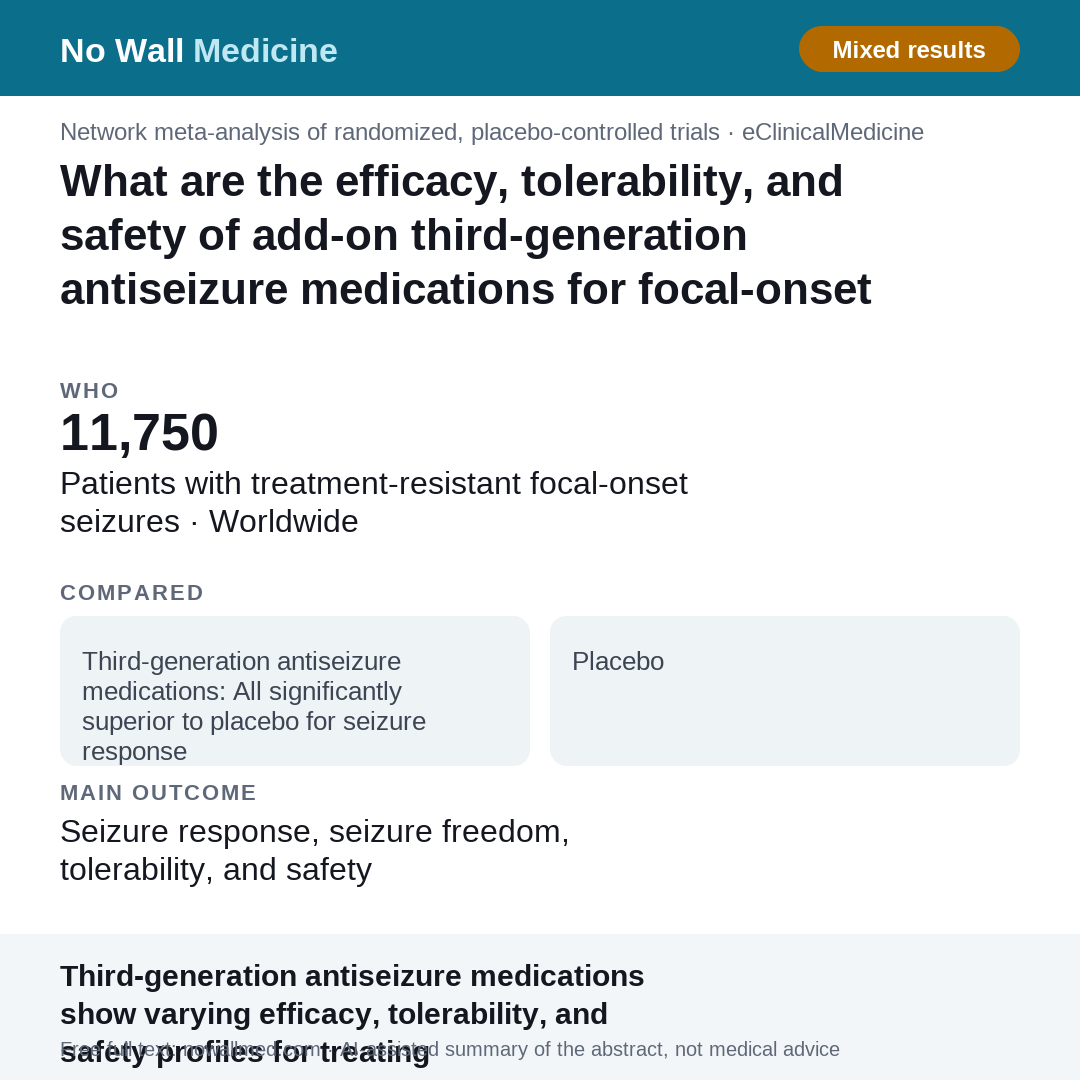
Clinical question: What are the efficacy, tolerability, and safety of add-on third-generation antiseizure medications for focal-onset seizures?
Why it matters: Evidence was needed to compile data on the efficacy, tolerability, and safety of newer antiseizure medications used for treatment-resistant focal-onset seizures.
Key points
- Researchers analyzed 29 studies involving 11,750 participants to compare seven antiseizure medications as add-on treatments for focal-onset seizures.
- All medications were superior to placebo for seizure response, with retigabine ranking highest and cenobamate 400 mg/d ranking second.
- Brivaracetam 100 mg/d ranked highest for seizure freedom, while lacosamide 600 mg/d had the lowest ranking for tolerability.
Headline and key points written with AI from the paper’s abstract, with every number checked against it. Read the paper before relying on them.
Was this summary helpful?
Cite this article
Chen Y, Li W, Lu C, Gao X, Song H, Zhang Y. Efficacy, tolerability and safety of add-on third-generation antiseizure medications in treating focal seizures worldwide: a network meta-analysis of randomised, placebo-controlled trials. eClinicalMedicine. 2024. doi:10.1016/j.eclinm.2024.102513
Spotted a mistake? Suggest a correction
Top studies every Monday
The week’s key trials and guidelines in your specialties, plus any topics you follow. By email, free.
Get the weekly digest