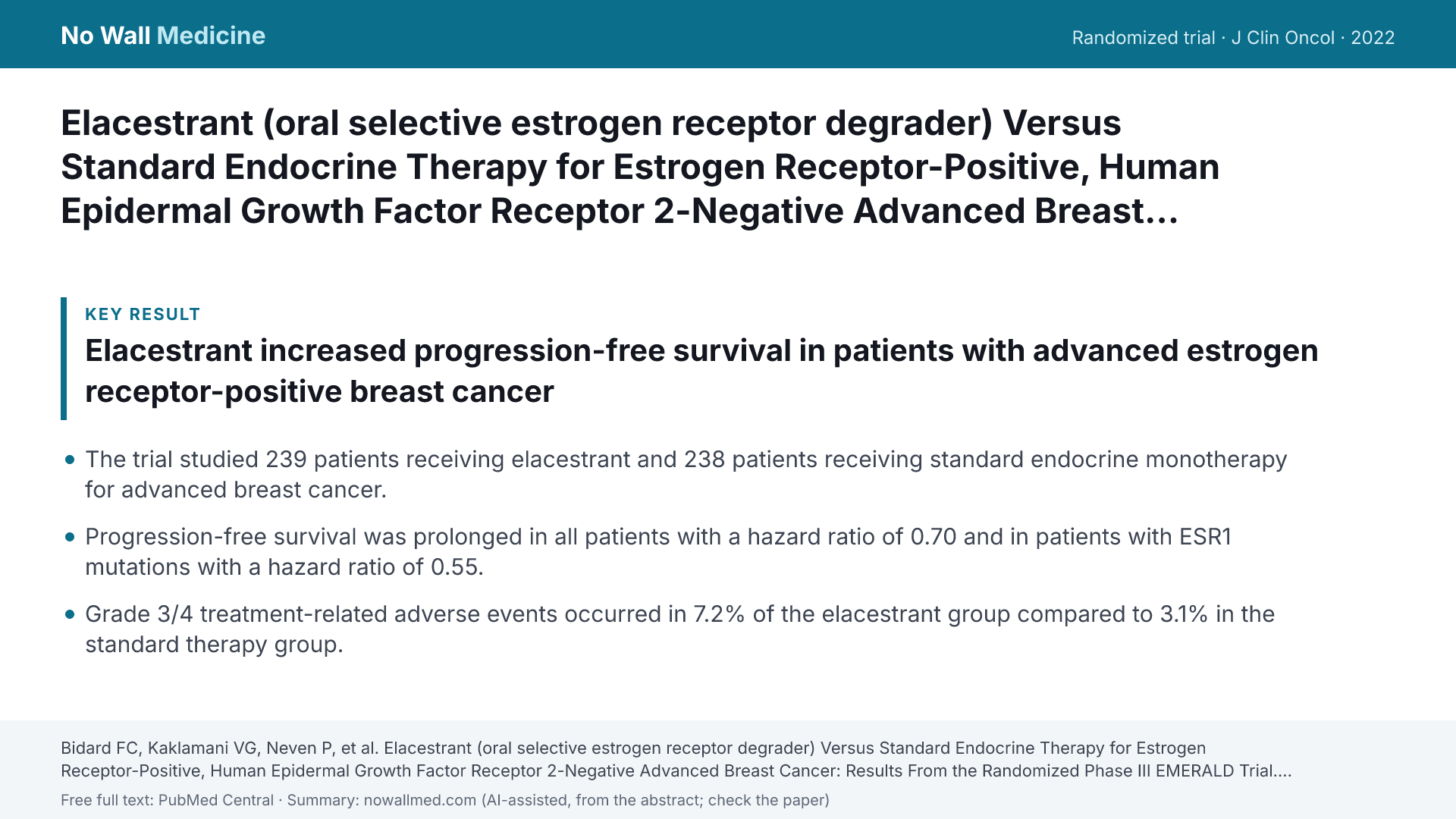
Elacestrant increased progression-free survival in patients with advanced estrogen receptor-positive breast cancer
Elacestrant (oral selective estrogen receptor degrader) Versus Standard Endocrine Therapy for Estrogen Receptor-Positive, Human Epidermal Growth Factor Receptor 2-Negative Advanced Breast Cancer: Results From the Randomized Phase III EMERALD Trial
Why it matters: Patients with advanced estrogen receptor-positive, human epidermal growth factor receptor 2-negative breast cancer who have received prior endocrine therapy and kinase inhibitors have a poor prognosis.
Key points
- The trial studied 239 patients receiving elacestrant and 238 patients receiving standard endocrine monotherapy for advanced breast cancer.
- Progression-free survival was prolonged in all patients with a hazard ratio of 0.70 and in patients with ESR1 mutations with a hazard ratio of 0.55.
- Grade 3/4 treatment-related adverse events occurred in 7.2% of the elacestrant group compared to 3.1% in the standard therapy group.
Headline and key points written with AI from the paper’s abstract, with every number checked against it. Read the paper before relying on them.
Was this summary helpful?
Subject terms
Cite this article
Bidard FC, Kaklamani VG, Neven P, et al. Elacestrant (oral selective estrogen receptor degrader) Versus Standard Endocrine Therapy for Estrogen Receptor-Positive, Human Epidermal Growth Factor Receptor 2-Negative Advanced Breast Cancer: Results From the Randomized Phase III EMERALD Trial. J Clin Oncol. 2022. doi:10.1200/JCO.22.00338
Spotted a mistake? Suggest a correction