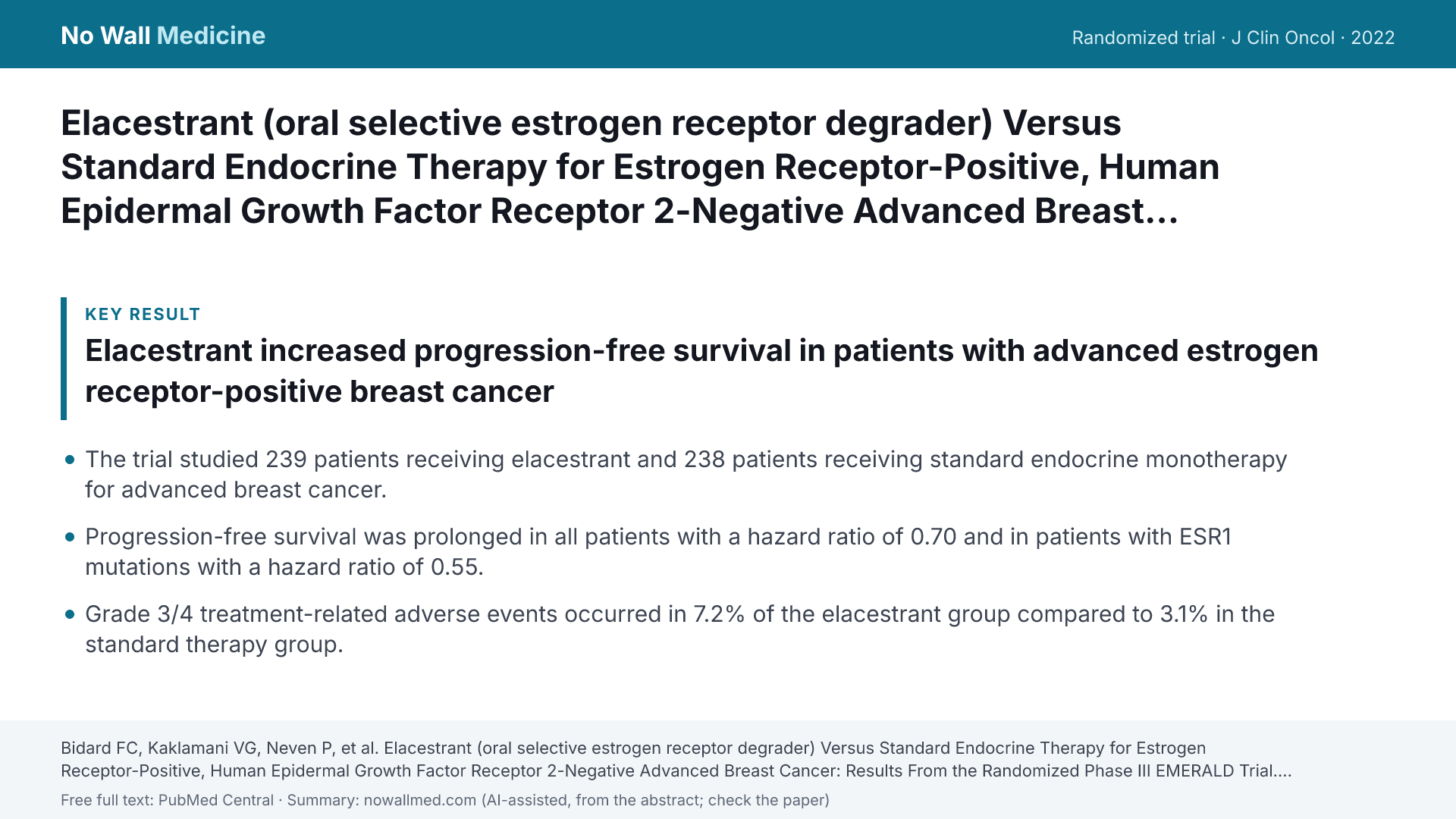
Elacestrant (oral selective estrogen receptor degrader) Versus Standard Endocrine Therapy for Estrogen Receptor-Positive, Human Epidermal Growth Factor Receptor 2-Negative Advanced Breast Cancer: Results From the Randomized Phase III EMERALD Trial
Key result: Elacestrant increased progression-free survival in patients with advanced estrogen receptor-positive breast cancer
Key points
- The trial studied 239 patients receiving elacestrant and 238 patients receiving standard endocrine monotherapy for advanced breast cancer.
- Progression-free survival was prolonged in all patients with a hazard ratio of 0.70 and in patients with ESR1 mutations with a hazard ratio of 0.55.
- Grade 3/4 treatment-related adverse events occurred in 7.2% of the elacestrant group compared to 3.1% in the standard therapy group.
Why it matters: Patients with advanced estrogen receptor-positive, human epidermal growth factor receptor 2-negative breast cancer who have received prior endocrine therapy and kinase inhibitors have a poor prognosis.
Discussion prompts
- Would these patients look like yours? Who was left out?
- Is the main outcome one that matters to patients?
- Is the difference large enough to change what you do?
Cite: Bidard FC, Kaklamani VG, Neven P, et al. Elacestrant (oral selective estrogen receptor degrader) Versus Standard Endocrine Therapy for Estrogen Receptor-Positive, Human Epidermal Growth Factor Receptor 2-Negative Advanced Breast Cancer: Results From the Randomized Phase III EMERALD Trial. J Clin Oncol. 2022. doi:10.1200/JCO.22.00338
Free full text: PubMed Central · Summary and visual abstract: nowallmed.com/a/elacestrant-oral-selective-estrogen-receptor-degrader-versus-standard-16tfab0/ (AI-assisted from the abstract; check the paper before relying on it).