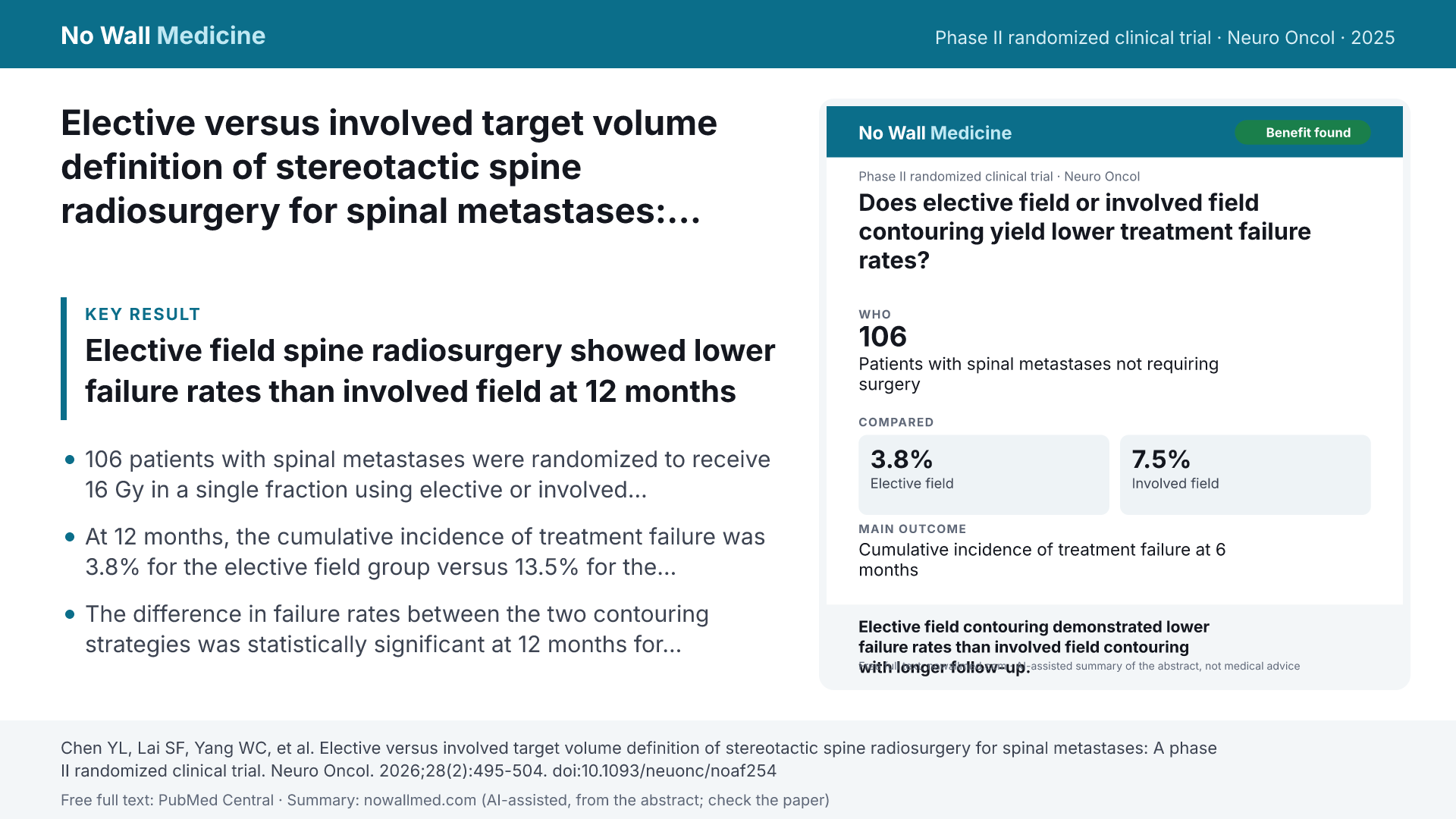
Elective field contouring showed lower failure rates than involved field contouring for spinal metastases
Elective versus involved target volume definition of stereotactic spine radiosurgery for spinal metastases: A phase II randomized clinical trial
Phase II randomized clinical trialBenefit found
Does elective field or involved field contouring yield lower treatment failure rates?
Who
106
Patients with spinal metastases not requiring surgery
Compared
3.8%Elective field
7.5%Involved field
Main outcome
Cumulative incidence of treatment failure at 6 months
Bottom line: Elective field contouring demonstrated lower failure rates than involved field contouring with longer follow-up.
Neuro Oncol · 2025-10-27Download image
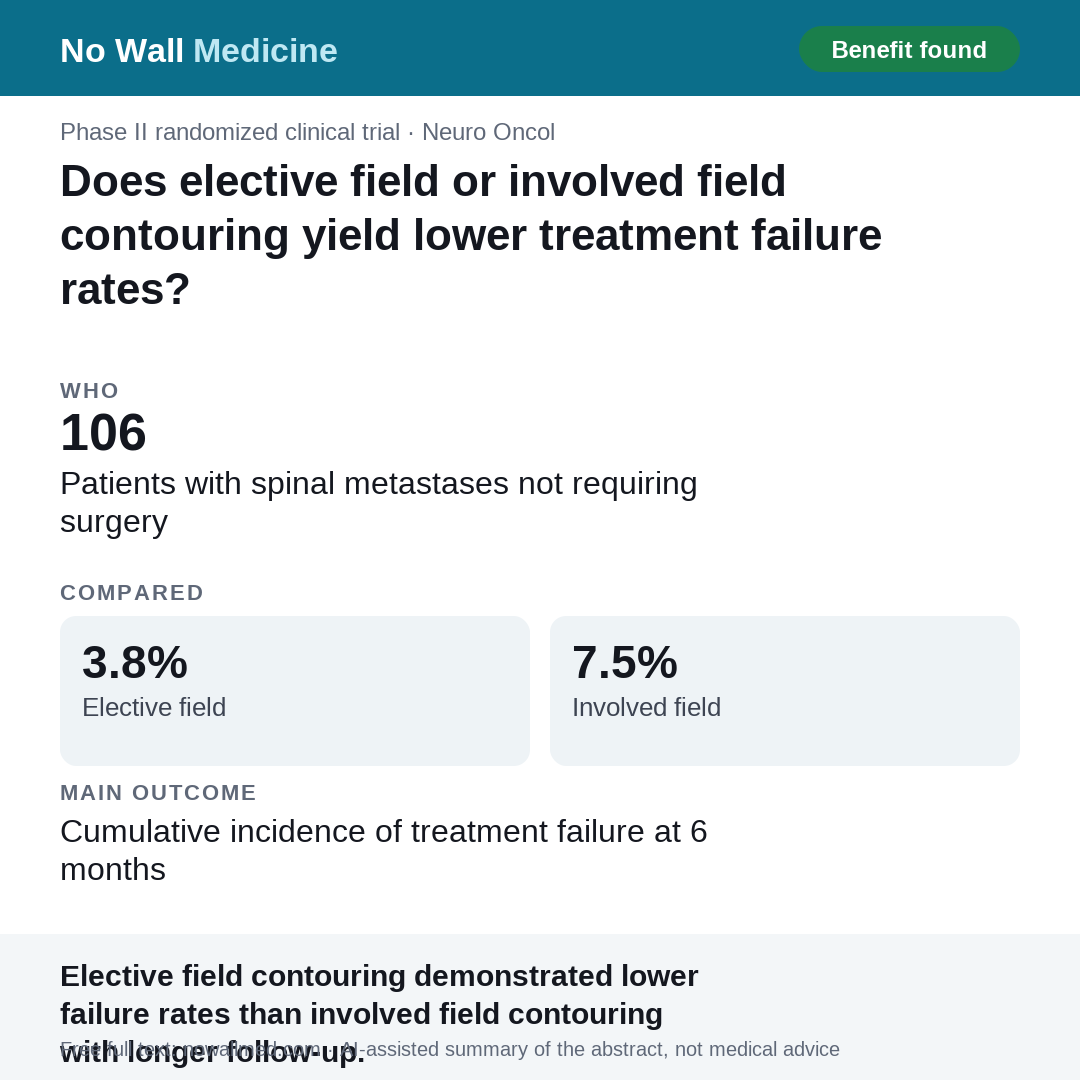
Clinical question: Does elective field or involved field contouring yield lower treatment failure rates?
Why it matters: It is unclear whether using an elective field or an involved field strategy for defining the radiation target provides better outcomes for spinal metastases.
Key points
- Researchers randomized 106 patients with spinal metastases to receive either elective field or involved field stereotactic spine radiosurgery.
- At 6 months, the cumulative incidence of treatment failure was 3.8% for the elective field group and 7.5% for the involved field group.
- By 12 months, the elective field group had a per-patient failure rate of 3.8% compared to 13.5% in the involved field group.
Headline and key points written with AI from the paper’s abstract, with every number checked against it. Read the paper before relying on them.
Was this summary helpful?
Subject terms
Cite this article
Chen YL, Lai SF, Yang WC, Lu SL, Tsuang FY, Xiao FR. Elective versus involved target volume definition of stereotactic spine radiosurgery for spinal metastases: A phase II randomized clinical trial. Neuro Oncol. 2025. doi:10.1093/neuonc/noaf254
Spotted a mistake? Suggest a correction