Elective versus involved target volume definition of stereotactic spine radiosurgery for spinal metastases: A phase II randomized clinical trial
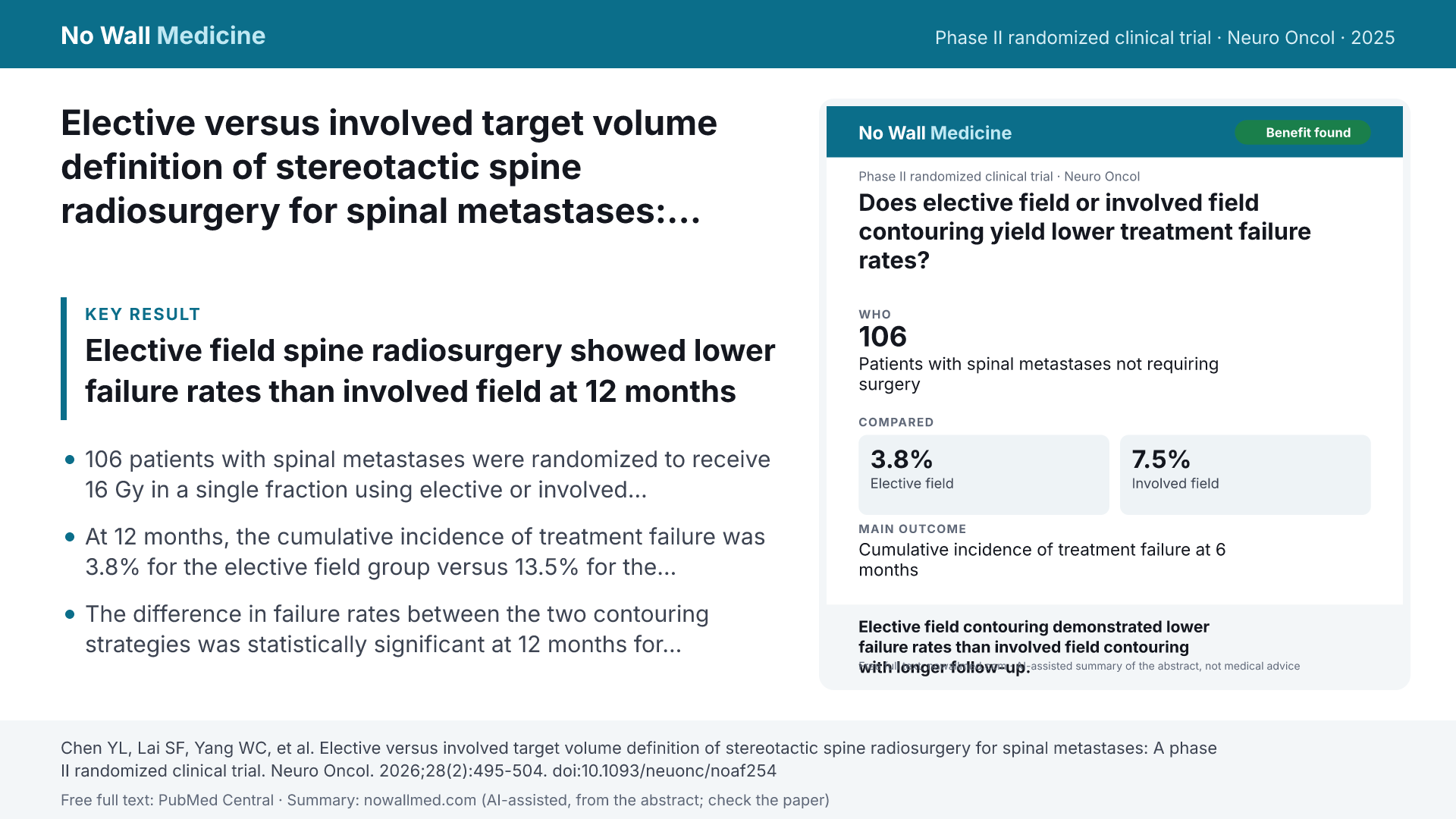
Key result: Elective field spine radiosurgery showed lower failure rates than involved field at 12 months
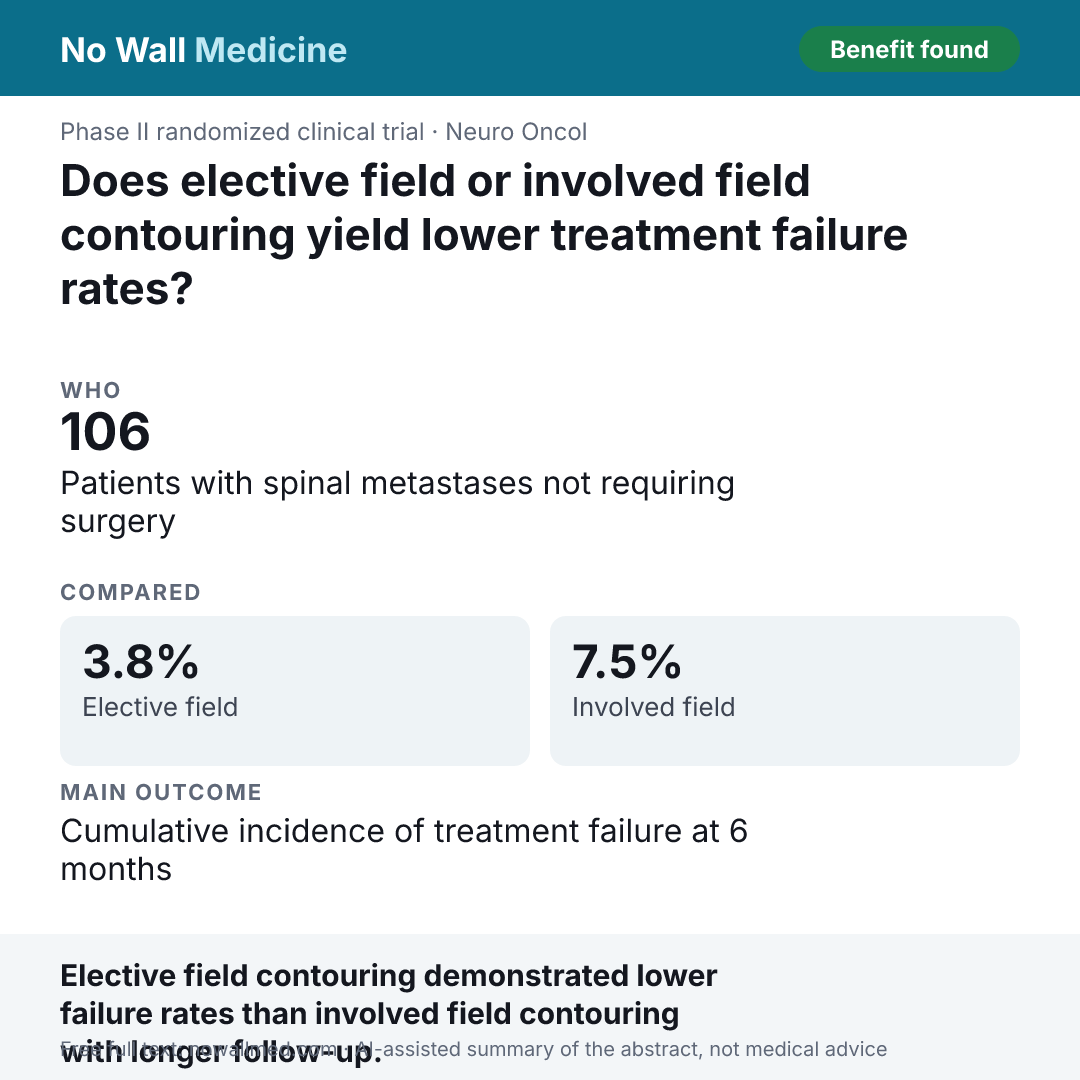
Phase II randomized clinical trialBenefit found
Does elective field or involved field contouring yield lower treatment failure rates?
Who
106
Patients with spinal metastases not requiring surgery
Compared
3.8%Elective field
7.5%Involved field
Main outcome
Cumulative incidence of treatment failure at 6 months
Bottom line: Elective field contouring demonstrated lower failure rates than involved field contouring with longer follow-up.
Neuro Oncol · 2025-10-27 · Save PNG
Key points
- 106 patients with spinal metastases were randomized to receive 16 Gy in a single fraction using elective or involved field contouring.
- At 12 months, the cumulative incidence of treatment failure was 3.8% for the elective field group versus 13.5% for the involved field group.
- The difference in failure rates between the two contouring strategies was statistically significant at 12 months for both per-patient and per-segment analyses.
Discussion prompts
- Would these patients look like yours? Who was left out?
- Is the main outcome one that matters to patients?
- Is the difference large enough to change what you do?
Cite: Chen YL, Lai SF, Yang WC, et al. Elective versus involved target volume definition of stereotactic spine radiosurgery for spinal metastases: A phase II randomized clinical trial. Neuro Oncol. 2026;28(2):495-504. doi:10.1093/neuonc/noaf254
Free full text: PubMed Central · Summary and visual abstract: nowallmed.com/a/elective-versus-involved-target-volume-definition-of-stereotactic-nqprui/ (AI-assisted from the abstract; check the paper before relying on it).