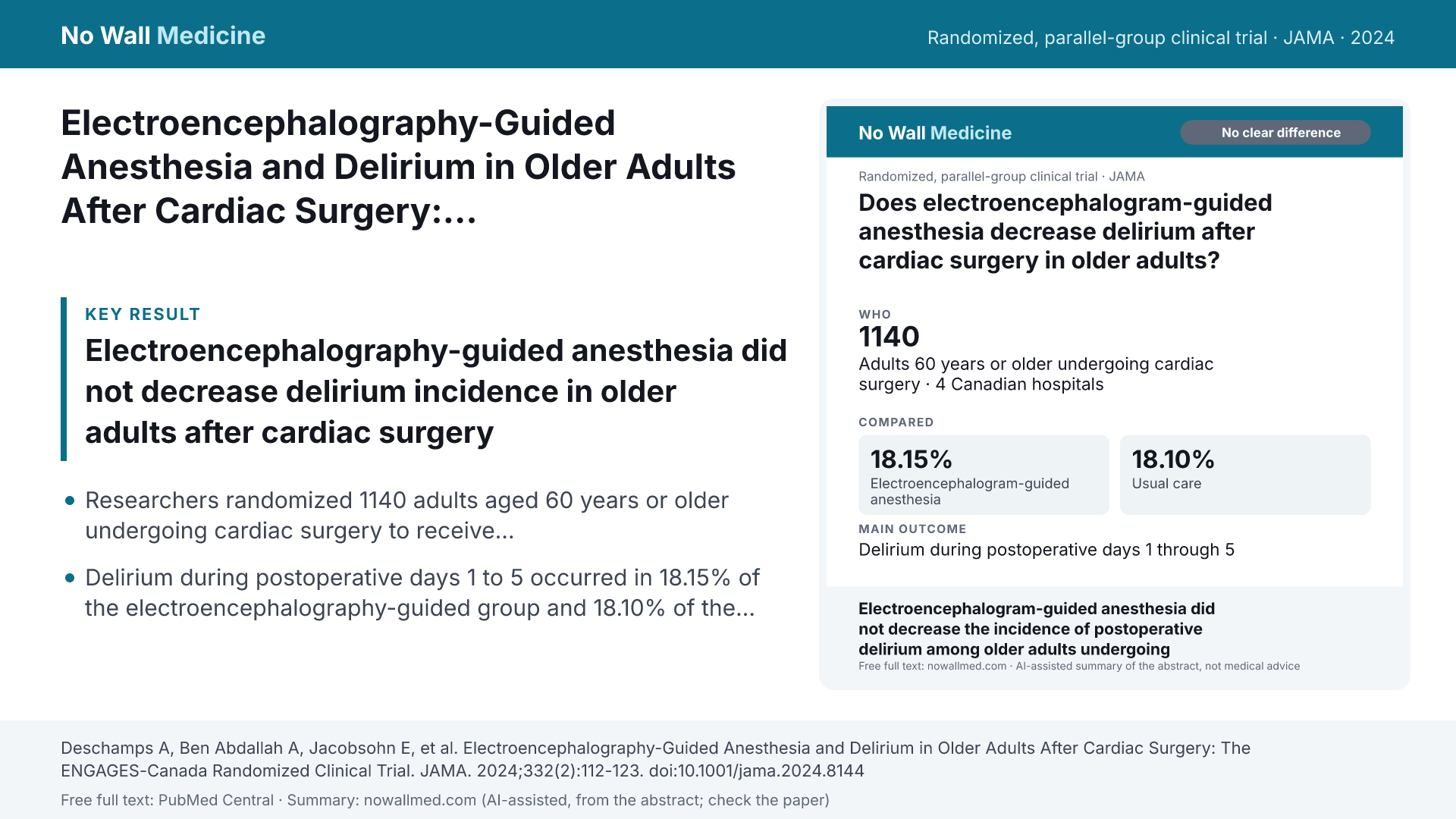
Electroencephalography-guided anesthesia did not decrease delirium incidence in older adults after cardiac surgery
Electroencephalography-Guided Anesthesia and Delirium in Older Adults After Cardiac Surgery: The ENGAGES-Canada Randomized Clinical Trial
Randomized, parallel-group clinical trialNo clear difference
Does electroencephalogram-guided anesthesia decrease delirium after cardiac surgery in older adults?
Who
1140
Adults 60 years or older undergoing cardiac surgery · 4 Canadian hospitals
Compared
18.15%Electroencephalogram-guided anesthesia (102/562)
18.10%Usual care (103/569)
Main outcome
Delirium during postoperative days 1 through 5
Result: difference, 0.05% (95% CI, -4.57% to 4.67%)
Bottom line: Electroencephalogram-guided anesthesia did not decrease the incidence of postoperative delirium among older adults undergoing cardiac surgery.
JAMA · 2024-06-10Download image
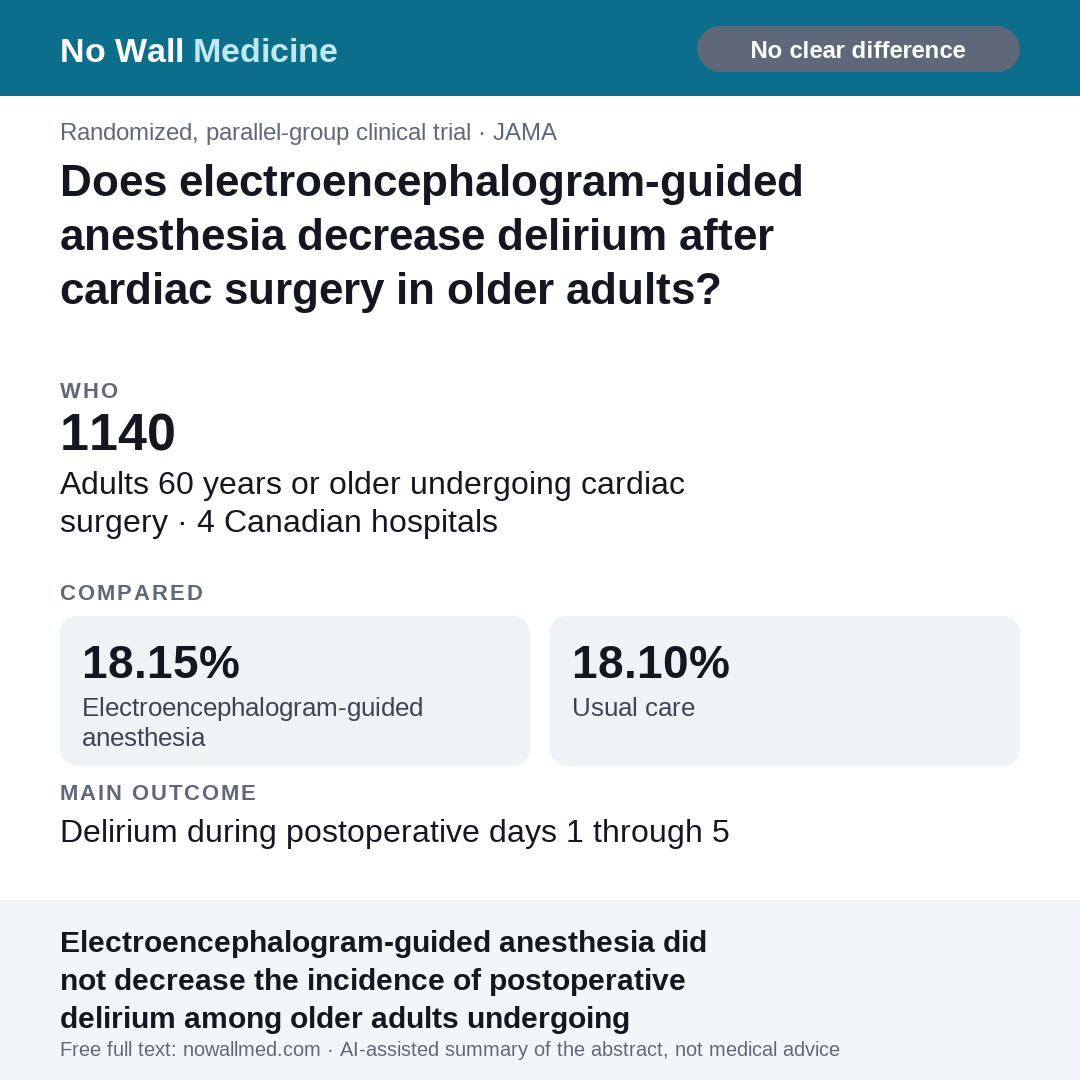
Clinical question: Does electroencephalogram-guided anesthesia decrease delirium after cardiac surgery in older adults?
Why it matters: It is unclear if using electroencephalography to guide anesthesia and minimize waveform suppression reduces the incidence of postoperative delirium in older patients after cardiac surgery.
Key points
- Researchers randomized 1140 adults aged 60 years or older undergoing cardiac surgery to receive either electroencephalography-guided anesthesia or usual care.
- Delirium during postoperative days 1 to 5 occurred in 18.15% of the electroencephalography-guided group and 18.10% of the usual care group.
- The electroencephalography-guided group had a median total time of 4.0 minutes spent with electroencephalogram waveform suppression compared to 11.7 minutes in the usual care group.
Headline and key points written with AI from the paper’s abstract, with every number checked against it. Read the paper before relying on them.
Was this summary helpful?
Subject terms
Cite this article
Deschamps A, Ben Abdallah A, Jacobsohn E, et al. Electroencephalography-Guided Anesthesia and Delirium in Older Adults After Cardiac Surgery: The ENGAGES-Canada Randomized Clinical Trial. JAMA. 2024. doi:10.1001/jama.2024.8144
Spotted a mistake? Suggest a correction