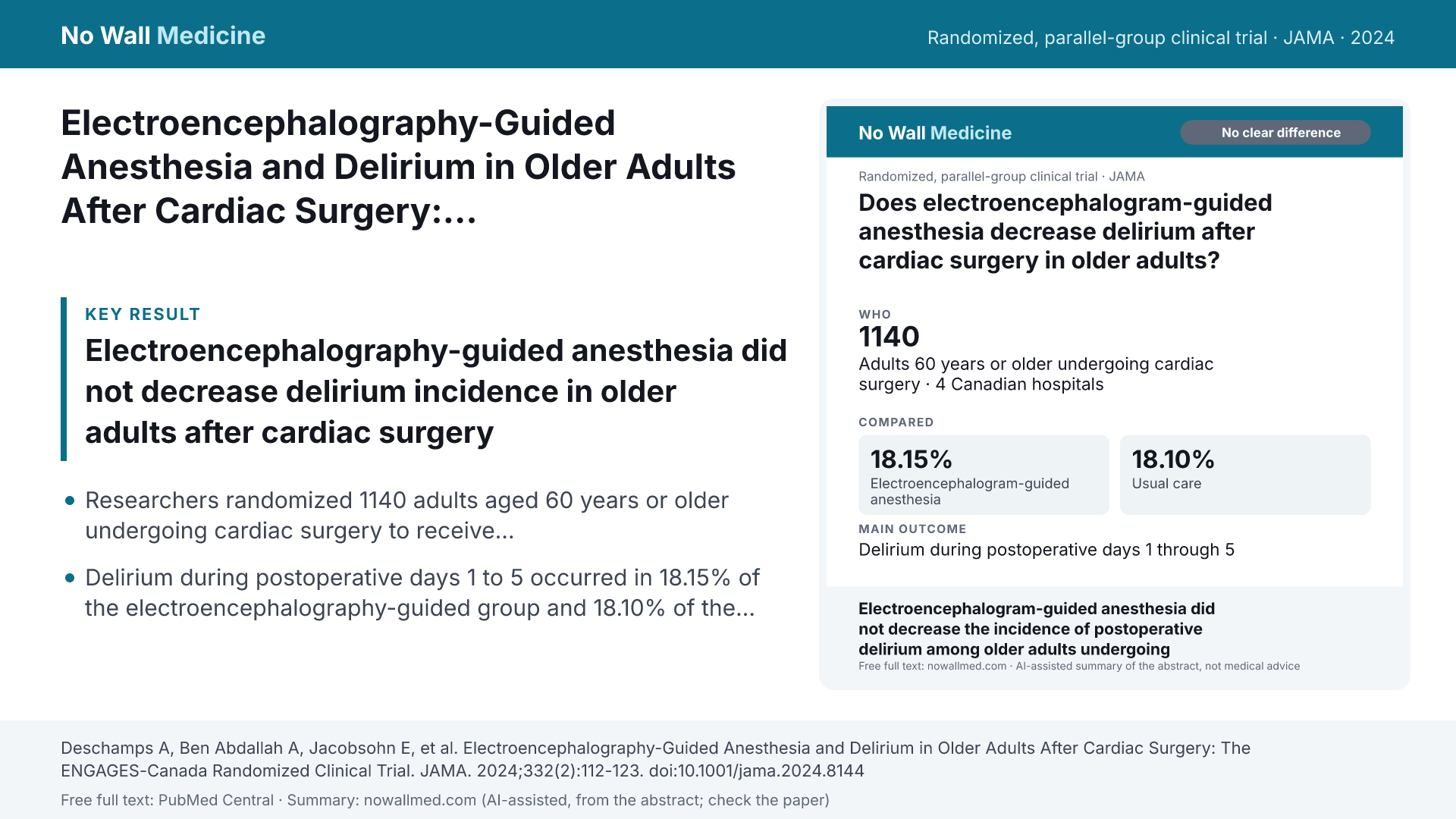
Electroencephalography-Guided Anesthesia and Delirium in Older Adults After Cardiac Surgery: The ENGAGES-Canada Randomized Clinical Trial
Key result: Electroencephalography-guided anesthesia did not decrease delirium incidence in older adults after cardiac surgery
Randomized, parallel-group clinical trialNo clear difference
Does electroencephalogram-guided anesthesia decrease delirium after cardiac surgery in older adults?
Who
1140
Adults 60 years or older undergoing cardiac surgery · 4 Canadian hospitals
Compared
18.15%Electroencephalogram-guided anesthesia (102/562)
18.10%Usual care (103/569)
Main outcome
Delirium during postoperative days 1 through 5
Result: difference, 0.05% (95% CI, -4.57% to 4.67%)
Bottom line: Electroencephalogram-guided anesthesia did not decrease the incidence of postoperative delirium among older adults undergoing cardiac surgery.
JAMA · 2024-06-10 · Save PNG

Key points
- Researchers randomized 1140 adults aged 60 years or older undergoing cardiac surgery to receive either electroencephalography-guided anesthesia or usual care.
- Delirium during postoperative days 1 to 5 occurred in 18.15% of the electroencephalography-guided group and 18.10% of the usual care group.
- The electroencephalography-guided group had a median total time of 4.0 minutes spent with electroencephalogram waveform suppression compared to 11.7 minutes in the usual care group.
Discussion prompts
- Would these patients look like yours? Who was left out?
- Is the main outcome one that matters to patients?
- Is the difference large enough to change what you do?
Cite: Deschamps A, Ben Abdallah A, Jacobsohn E, et al. Electroencephalography-Guided Anesthesia and Delirium in Older Adults After Cardiac Surgery: The ENGAGES-Canada Randomized Clinical Trial. JAMA. 2024;332(2):112-123. doi:10.1001/jama.2024.8144
Free full text: PubMed Central · Summary and visual abstract: nowallmed.com/a/electroencephalography-guided-anesthesia-and-delirium-in-older-adults-1gms4ol/ (AI-assisted from the abstract; check the paper before relying on it).