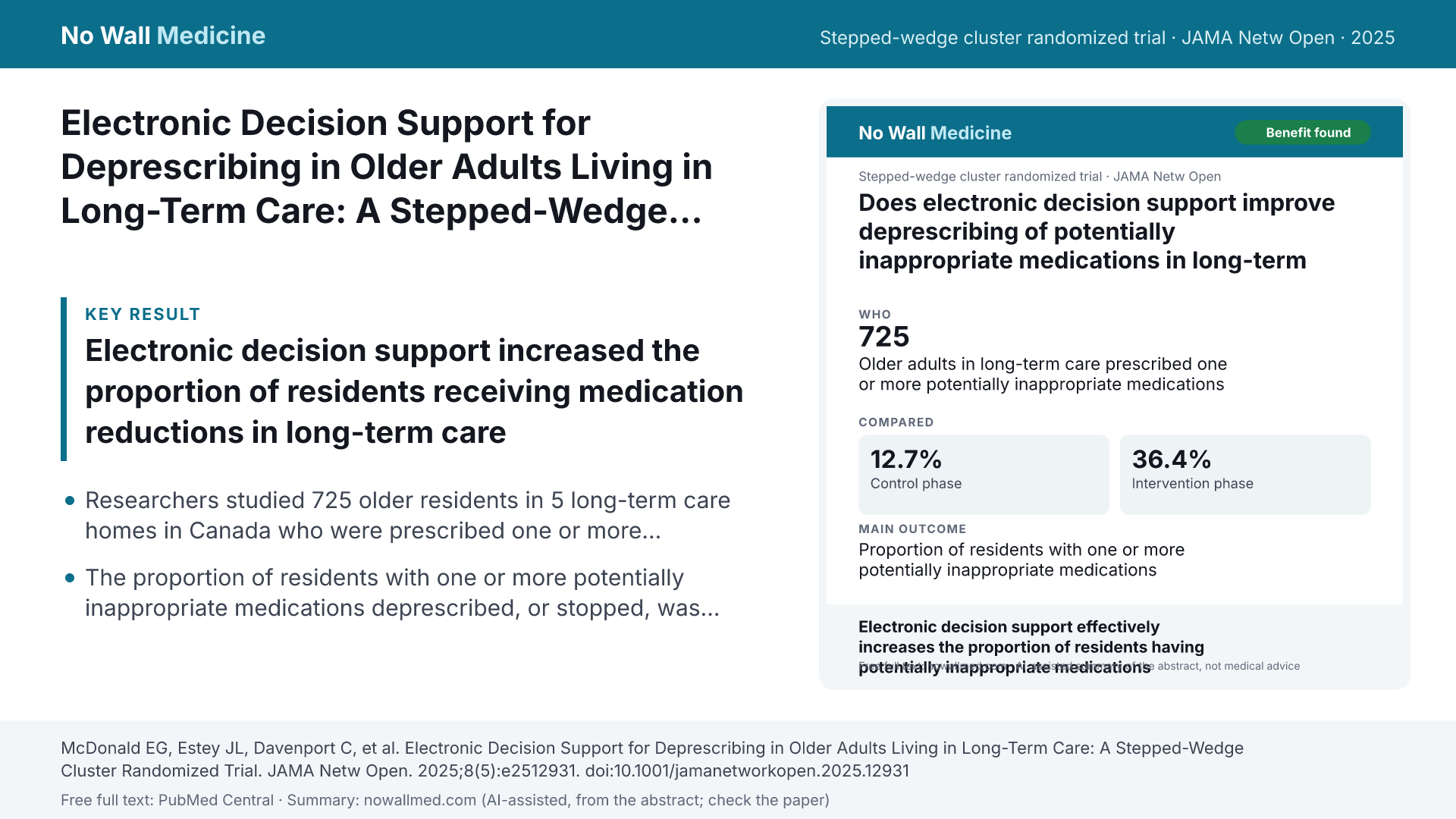
Electronic Decision Support for Deprescribing in Older Adults Living in Long-Term Care: A Stepped-Wedge Cluster Randomized Trial
Key result: Electronic decision support increased the proportion of residents receiving medication reductions in long-term care
Key points
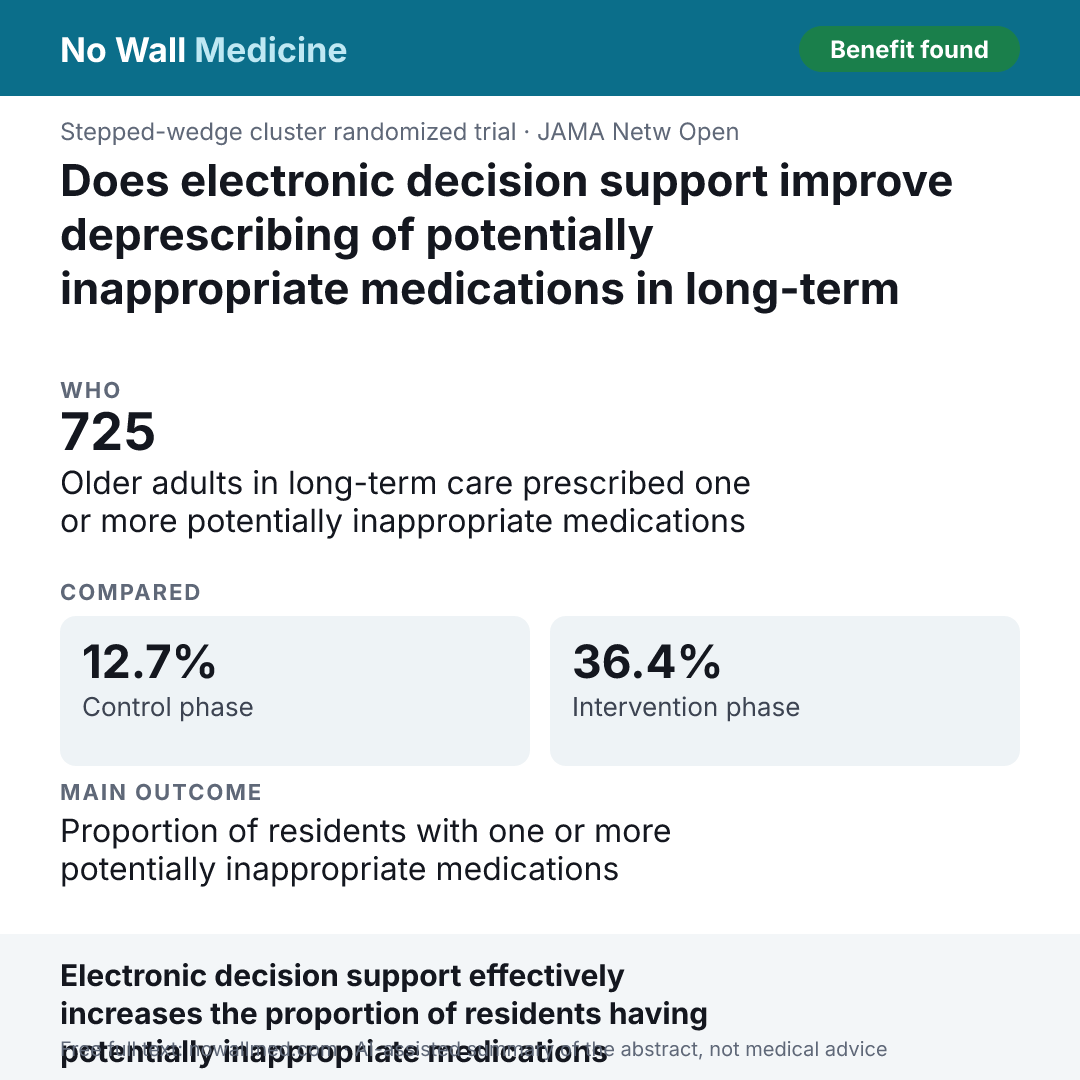
- Researchers studied 725 older residents in 5 long-term care homes in Canada who were prescribed one or more potentially inappropriate medications.
- The proportion of residents with one or more potentially inappropriate medications deprescribed, or stopped, was 12.7% in the control phase compared to 36.4% during the intervention.
- Participants had a median age of 84 years and a median of 3 potentially inappropriate medications.
In absolute numbers: Control phase 12.7% vs Intervention phase 36.4%, a difference of 23.7 percentage points (about 5 people treated for one more to benefit).
Why it matters: Potentially inappropriate prescribing affects up to 88% of long-term care residents, making the deprescribing of these medications a priority for health outcomes.
Discussion prompts
- Would these patients look like yours? Who was left out?
- Is the main outcome one that matters to patients?
- Is the difference large enough to change what you do?
Cite: McDonald EG, Estey JL, Davenport C, et al. Electronic Decision Support for Deprescribing in Older Adults Living in Long-Term Care: A Stepped-Wedge Cluster Randomized Trial. JAMA Netw Open. 2025;8(5):e2512931. doi:10.1001/jamanetworkopen.2025.12931
Free full text: PubMed Central · Summary and visual abstract: nowallmed.com/a/electronic-decision-support-for-deprescribing-in-older-adults-living-edwfqd/ (AI-assisted from the abstract; check the paper before relying on it).