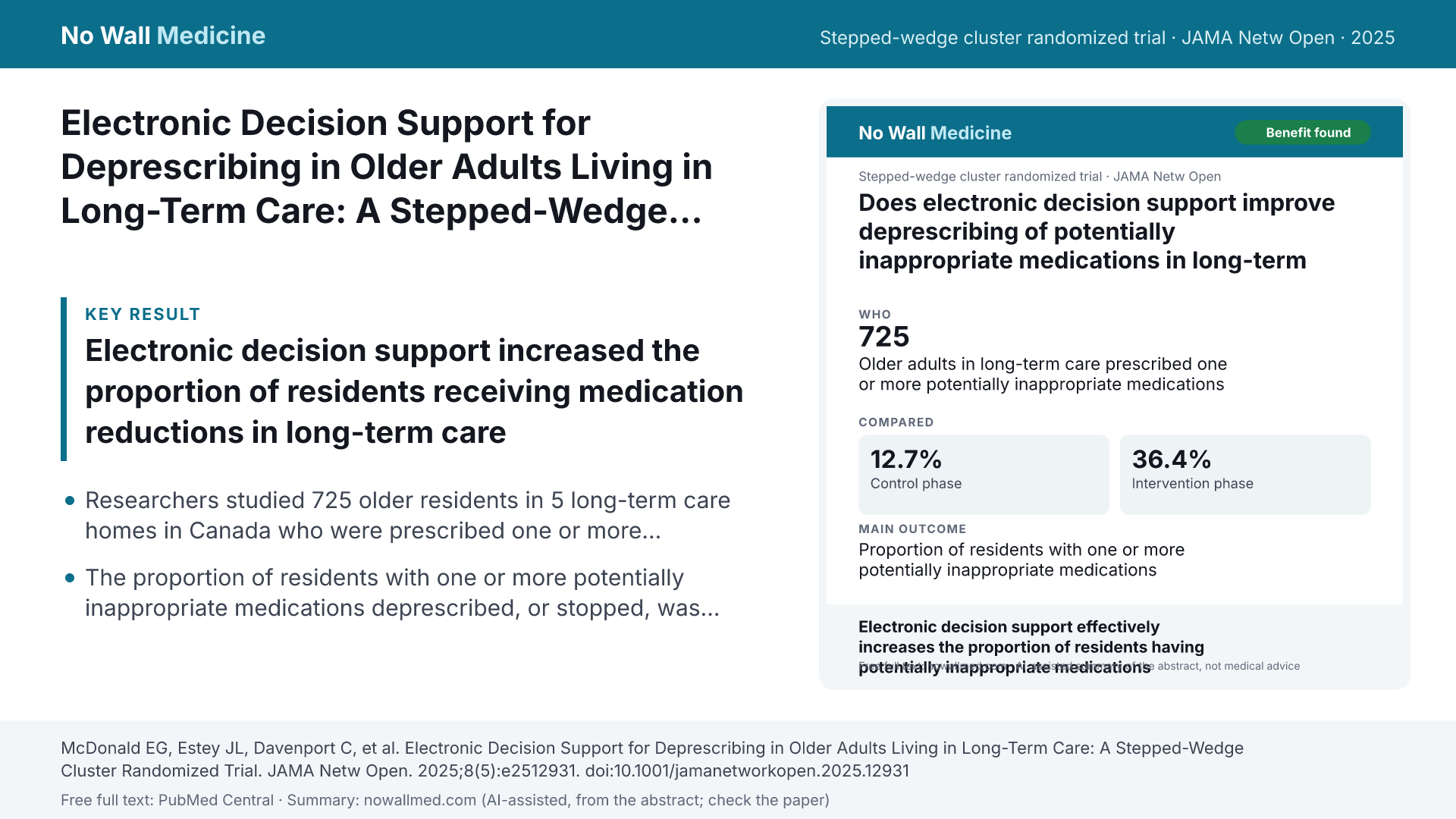
Electronic decision support increased the proportion of residents receiving medication reductions in long-term care
Electronic Decision Support for Deprescribing in Older Adults Living in Long-Term Care: A Stepped-Wedge Cluster Randomized Trial
Stepped-wedge cluster randomized trialBenefit found
Does electronic decision support improve deprescribing of potentially inappropriate medications in long-term care?
Who
725
Older adults in long-term care prescribed one or more potentially inappropriate medications · 5 long-term care homes in New Brunswick, Canada
Compared
12.7%Control phase
36.4%Intervention phase
Main outcome
Proportion of residents with one or more potentially inappropriate medications deprescribed
Result: adjusted odds ratio 1.58 (95% CI 1.07-2.34)
Bottom line: Electronic decision support effectively increases the proportion of residents having potentially inappropriate medications deprescribed in long-term care.
Limitation: The study took place during the COVID-19 pandemic.
JAMA Netw Open · 2025-05-01Download image
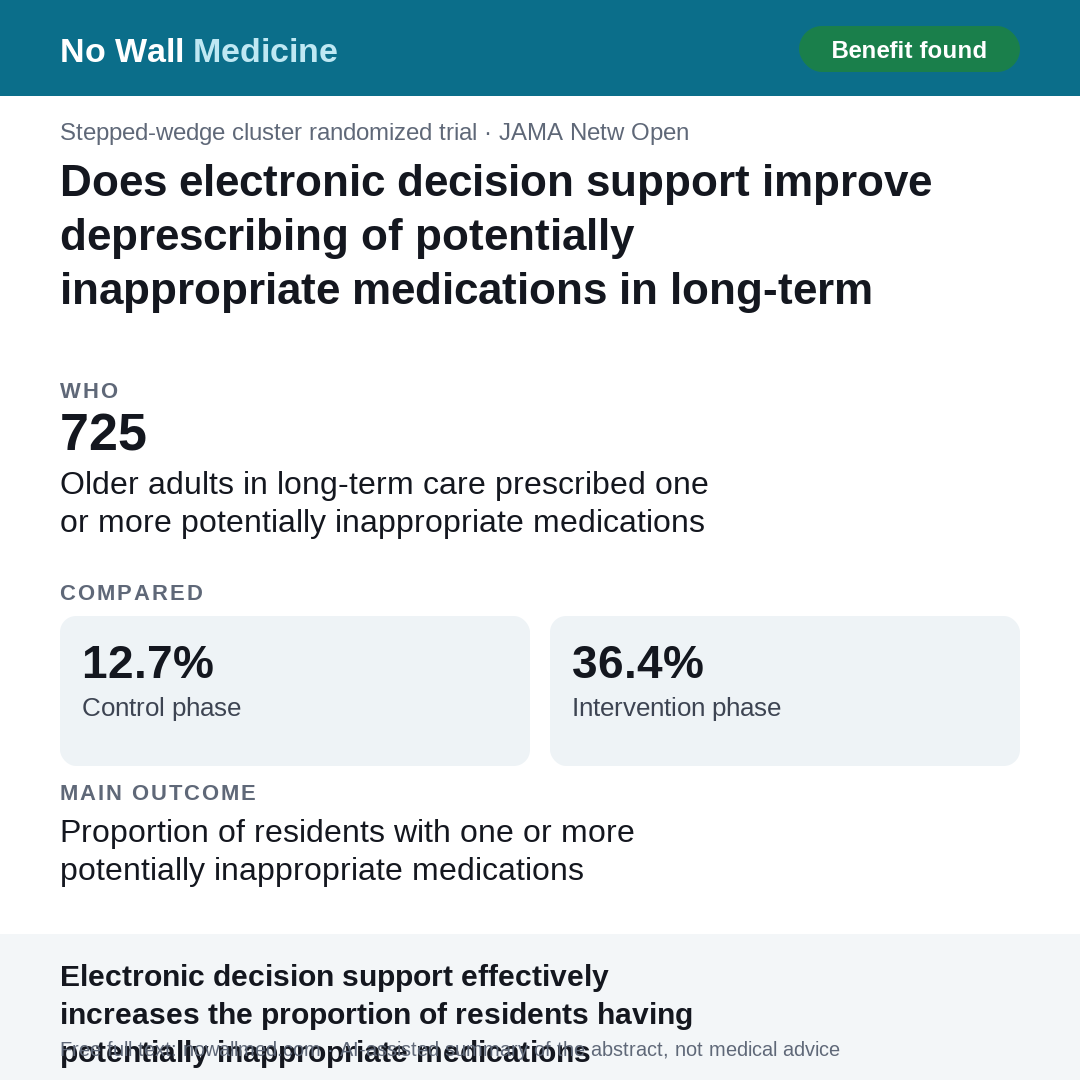
Clinical question: Does electronic decision support improve deprescribing of potentially inappropriate medications in long-term care?
Why it matters: Potentially inappropriate prescribing affects up to 88% of long-term care residents, making the deprescribing of these medications a priority for health outcomes.
In absolute numbers
Control phase: 12.7% · Intervention phase: 36.4% → a difference of 23.7 percentage points, so about 5 people would need the treatment for 1 more to benefit (number needed to treat) over the trial’s follow-up.
Worked out by us from the two group results above, not reported by the authors. Check the paper for the exact outcome and timing.
Key points
- Researchers studied 725 older residents in 5 long-term care homes in Canada who were prescribed one or more potentially inappropriate medications.
- The proportion of residents with one or more potentially inappropriate medications deprescribed, or stopped, was 12.7% in the control phase compared to 36.4% during the intervention.
- Participants had a median age of 84 years and a median of 3 potentially inappropriate medications.
Headline and key points written with AI from the paper’s abstract, with every number checked against it. Read the paper before relying on them.
Was this summary helpful?
Subject terms
Cite this article
McDonald EG, Estey JL, Davenport C, Bortolussi-Courval É, Gaudet J, Wilson Registe PP. Electronic Decision Support for Deprescribing in Older Adults Living in Long-Term Care: A Stepped-Wedge Cluster Randomized Trial. JAMA Netw Open. 2025. doi:10.1001/jamanetworkopen.2025.12931
Spotted a mistake? Suggest a correction