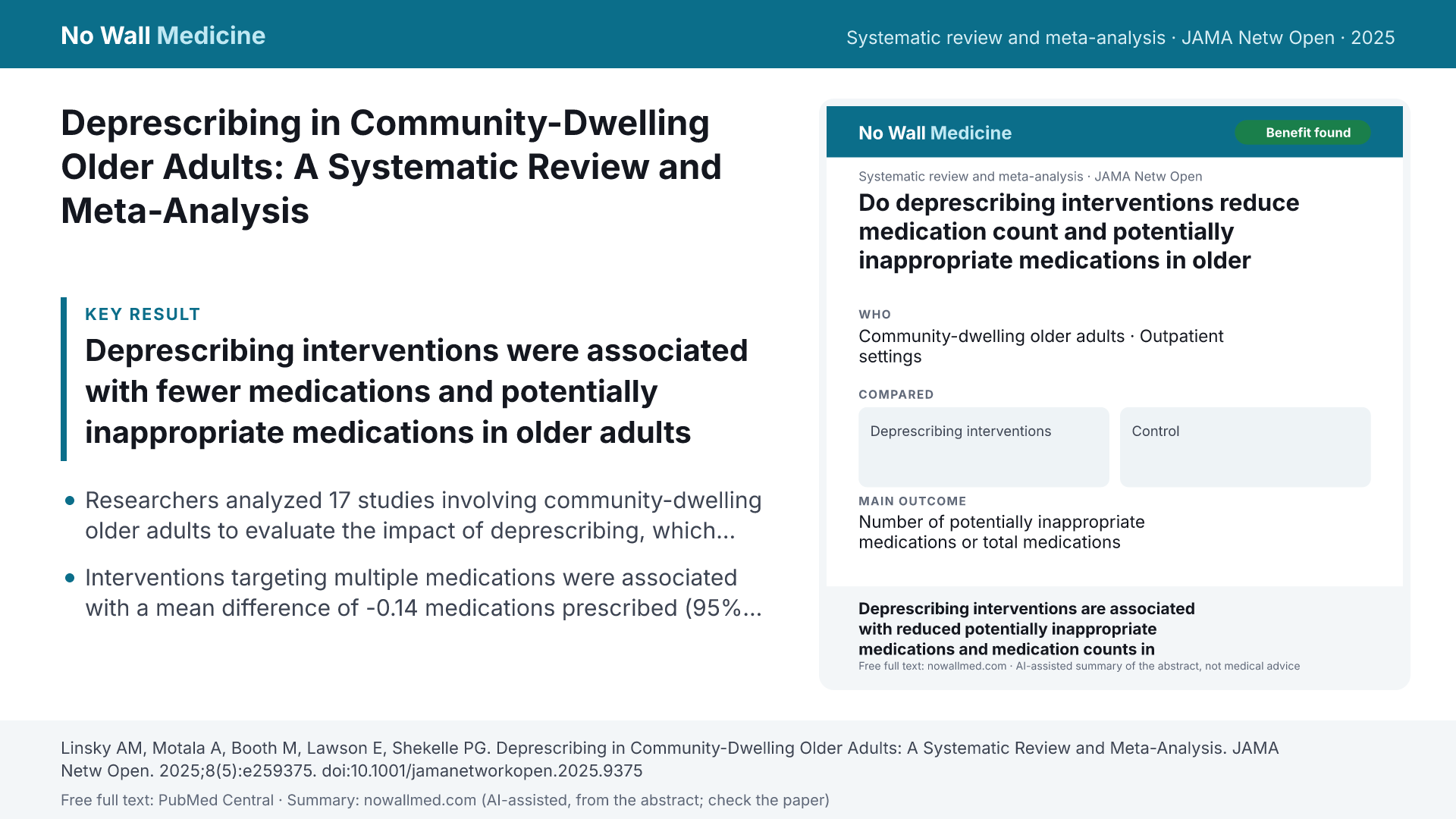
Deprescribing interventions were associated with fewer medications and potentially inappropriate medications in older adults
Deprescribing in Community-Dwelling Older Adults: A Systematic Review and Meta-Analysis
Systematic review and meta-analysisBenefit found
Do deprescribing interventions reduce medication count and potentially inappropriate medications in older adults?
Who
Community-dwelling older adults · Outpatient settings
Compared
Deprescribing interventions
Control
Main outcome
Number of potentially inappropriate medications or total medications
Result: mean difference -0.14 (95% CI, -0.27 to -0.01) medications prescribed
Bottom line: Deprescribing interventions are associated with reduced potentially inappropriate medications and medication counts in community-dwelling older adults.
JAMA Netw Open · 2025-05-01 · Save PNG
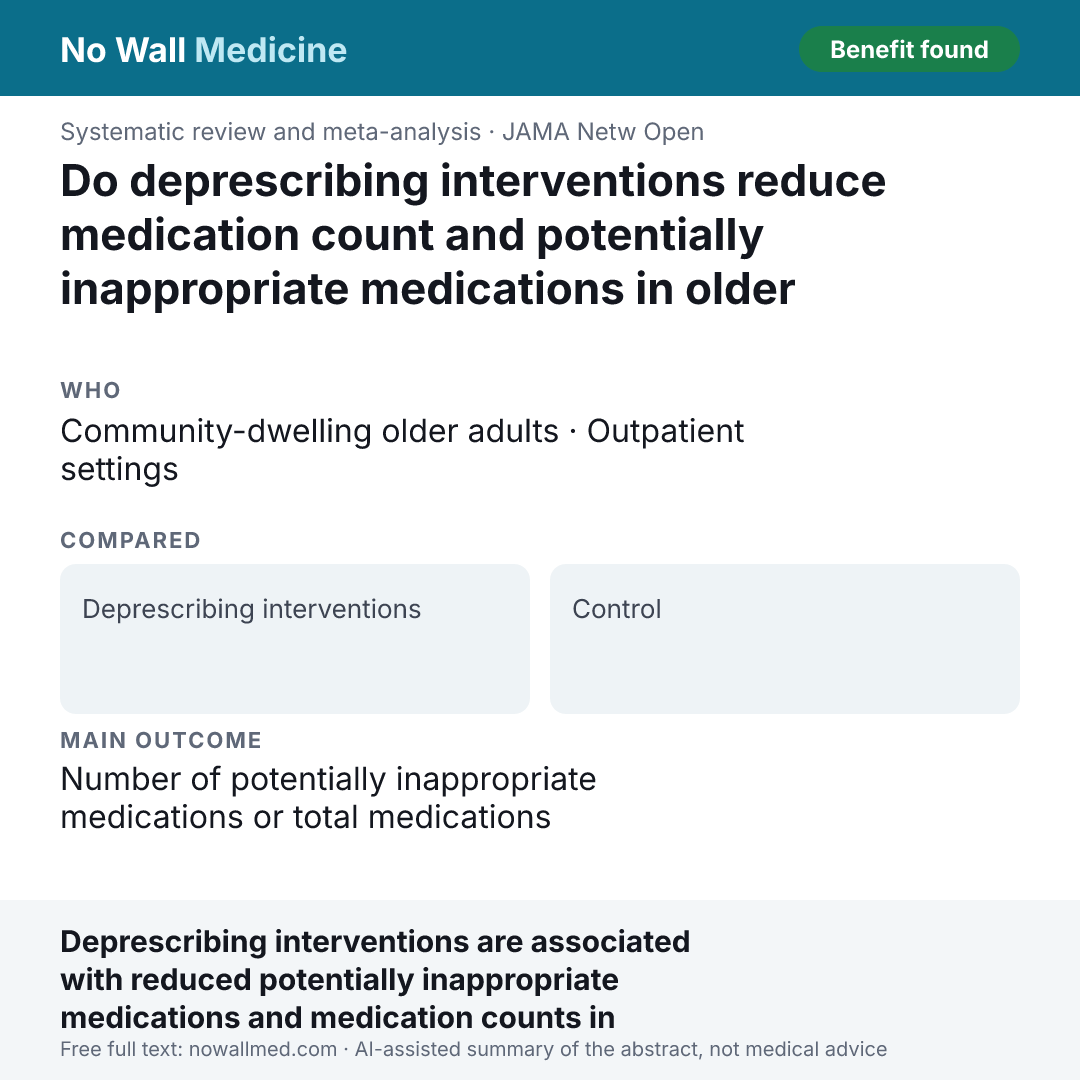
Clinical question: Do deprescribing interventions reduce medication count and potentially inappropriate medications in older adults?
Why it matters: Questions remain regarding how effective deprescribing interventions are at reducing medication counts and potentially inappropriate medications in outpatient settings.
Key points
- Researchers analyzed 17 studies involving community-dwelling older adults to evaluate the impact of deprescribing, which is the planned process of reducing or stopping medications.
- Interventions targeting multiple medications were associated with a mean difference of -0.14 medications prescribed (95% CI, -0.27 to -0.01).
- The interventions were not linked to a significant change in the proportion of people prescribed at least 1 potentially inappropriate medication (odds ratio, 0.92 [95% CI, 0.74 to 1.14]).
Headline and key points written with AI from the paper’s abstract, with every number checked against it. Read the paper before relying on them.
Was this summary helpful?
Subject terms
Headline, design, result, key points, caveat and citation as plain text.
Cite this article
Linsky AM, Motala A, Booth M, Lawson E, Shekelle PG. Deprescribing in Community-Dwelling Older Adults: A Systematic Review and Meta-Analysis. JAMA Netw Open. 2025;8(5):e259375. doi:10.1001/jamanetworkopen.2025.9375
Spotted a mistake? Suggest a correction