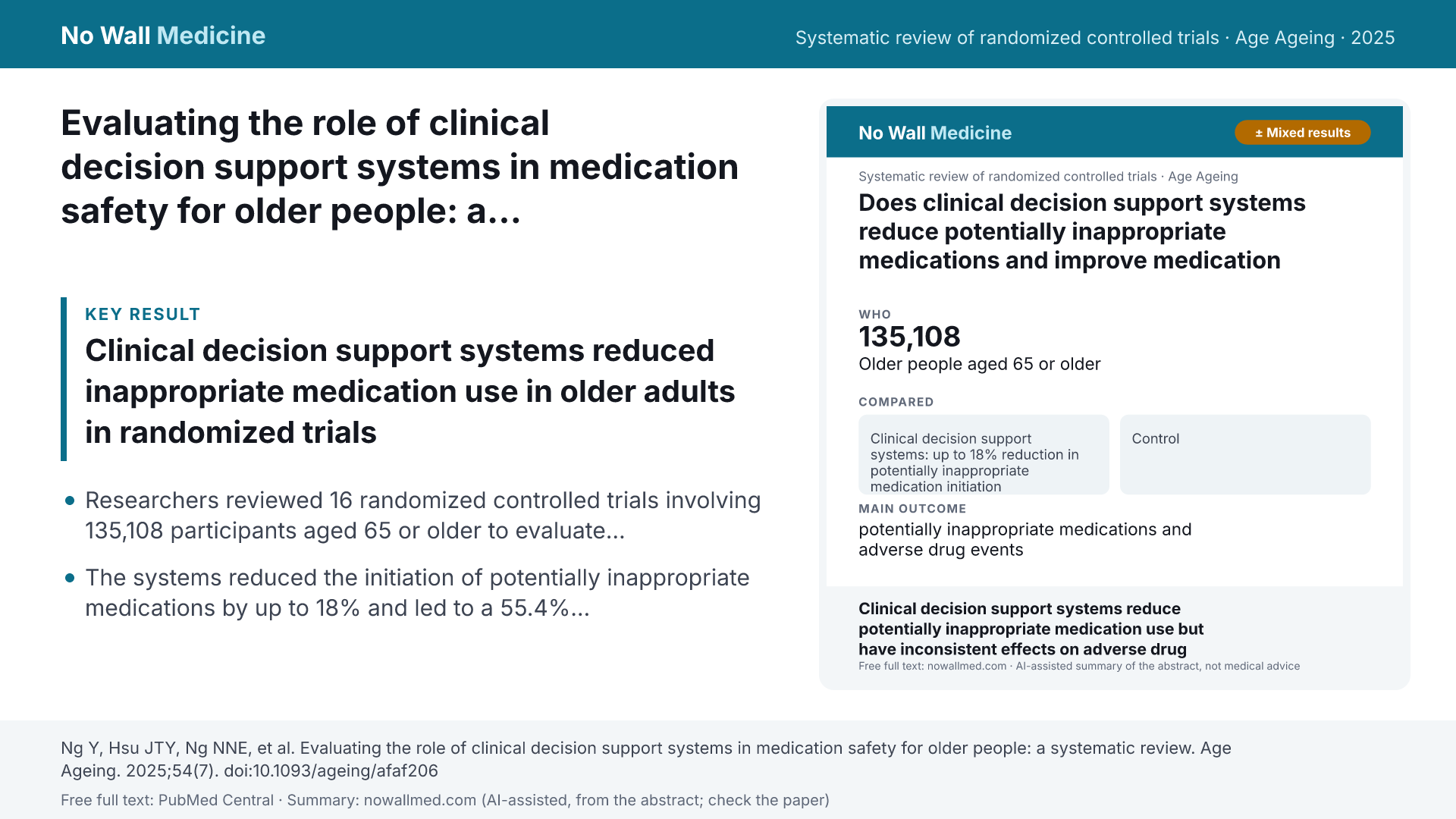
Clinical decision support systems reduced inappropriate medication use in older adults in randomized trials
Evaluating the role of clinical decision support systems in medication safety for older people: a systematic review
Systematic review of randomized controlled trialsMixed results
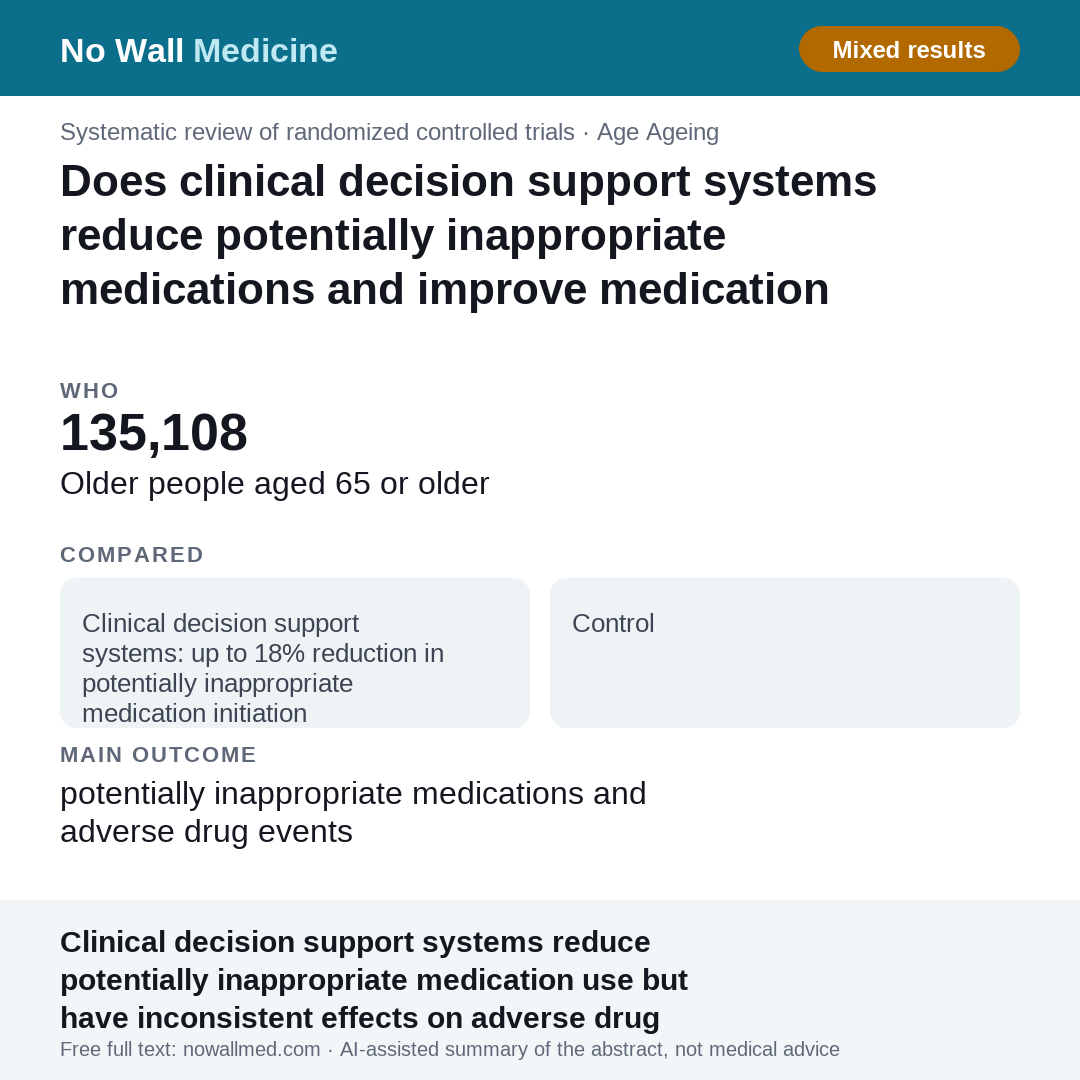
Does clinical decision support systems reduce potentially inappropriate medications and improve medication safety?
Who
135,108
Older people aged 65 or older
Compared
Clinical decision support systems: up to 18% reduction in potentially inappropriate medication initiation
Control
Main outcome
potentially inappropriate medications and adverse drug events
Bottom line: Clinical decision support systems reduce potentially inappropriate medication use but have inconsistent effects on adverse drug events.
Limitation: Inconsistent effects on adverse drug events and implementation challenges like alert fatigue.
Age Ageing · 2025-07-29Download image
Clinical question: Does clinical decision support systems reduce potentially inappropriate medications and improve medication safety?
Why it matters: The effectiveness of clinical decision support systems in reducing potentially inappropriate medications and improving medication safety for older people remains uncertain.
Key points
- Researchers reviewed 16 randomized controlled trials involving 135,108 participants aged 65 or older to evaluate clinical decision support systems, which are digital tools that provide clinicians with automated guidance.
- The systems reduced the initiation of potentially inappropriate medications by up to 18% and led to a 55.4% discontinuation rate of such medications.
- The impact of these digital tools on adverse drug events, which are harmful reactions to medicines, was inconsistent across the studies.
Limitation the authors note: The authors noted that implementation challenges such as clinician adherence, alert fatigue, and system usability must be addressed to optimize effectiveness.
Headline and key points written with AI from the paper’s abstract, with every number checked against it. Read the paper before relying on them.
Was this summary helpful?
Subject terms
Cite this article
Ng Y, Hsu JTY, Ng NNE, et al. Evaluating the role of clinical decision support systems in medication safety for older people: a systematic review. Age Ageing. 2025. doi:10.1093/ageing/afaf206
Spotted a mistake? Suggest a correction