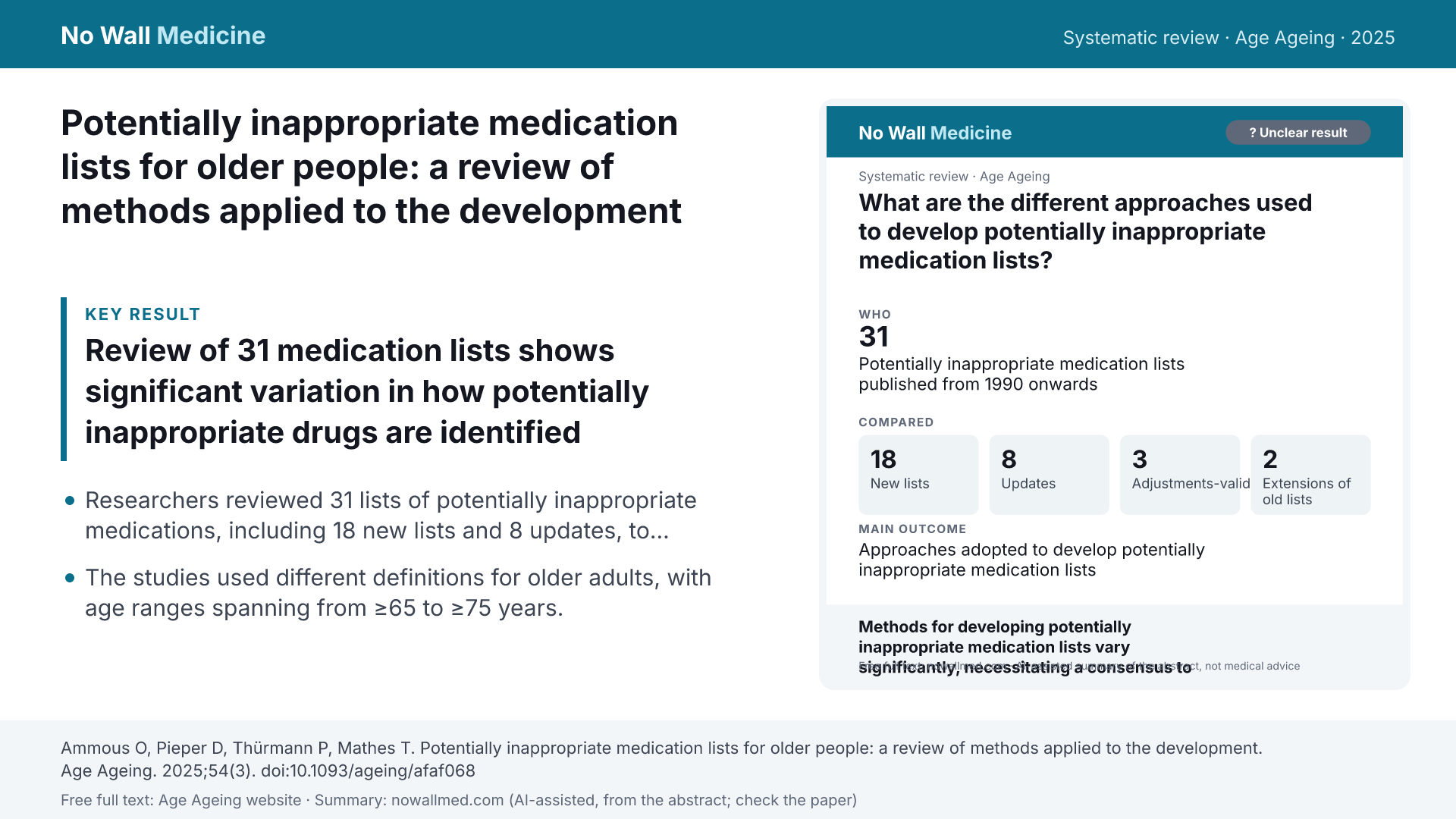
Review of 31 medication lists shows significant variation in how potentially inappropriate drugs are identified
Potentially inappropriate medication lists for older people: a review of methods applied to the development
Systematic reviewUnclear result
What are the different approaches used to develop potentially inappropriate medication lists?
Who
31
Potentially inappropriate medication lists published from 1990 onwards
Compared
18New lists
8Updates
3Adjustments-validation
2Extensions of old lists
Main outcome
Approaches adopted to develop potentially inappropriate medication lists
Bottom line: Methods for developing potentially inappropriate medication lists vary significantly, necessitating a consensus to standardise development.
Limitation: Extensive variations in organization, panellist selection, and consensus thresholds were observed.
Age Ageing · 2025-03-28Download image
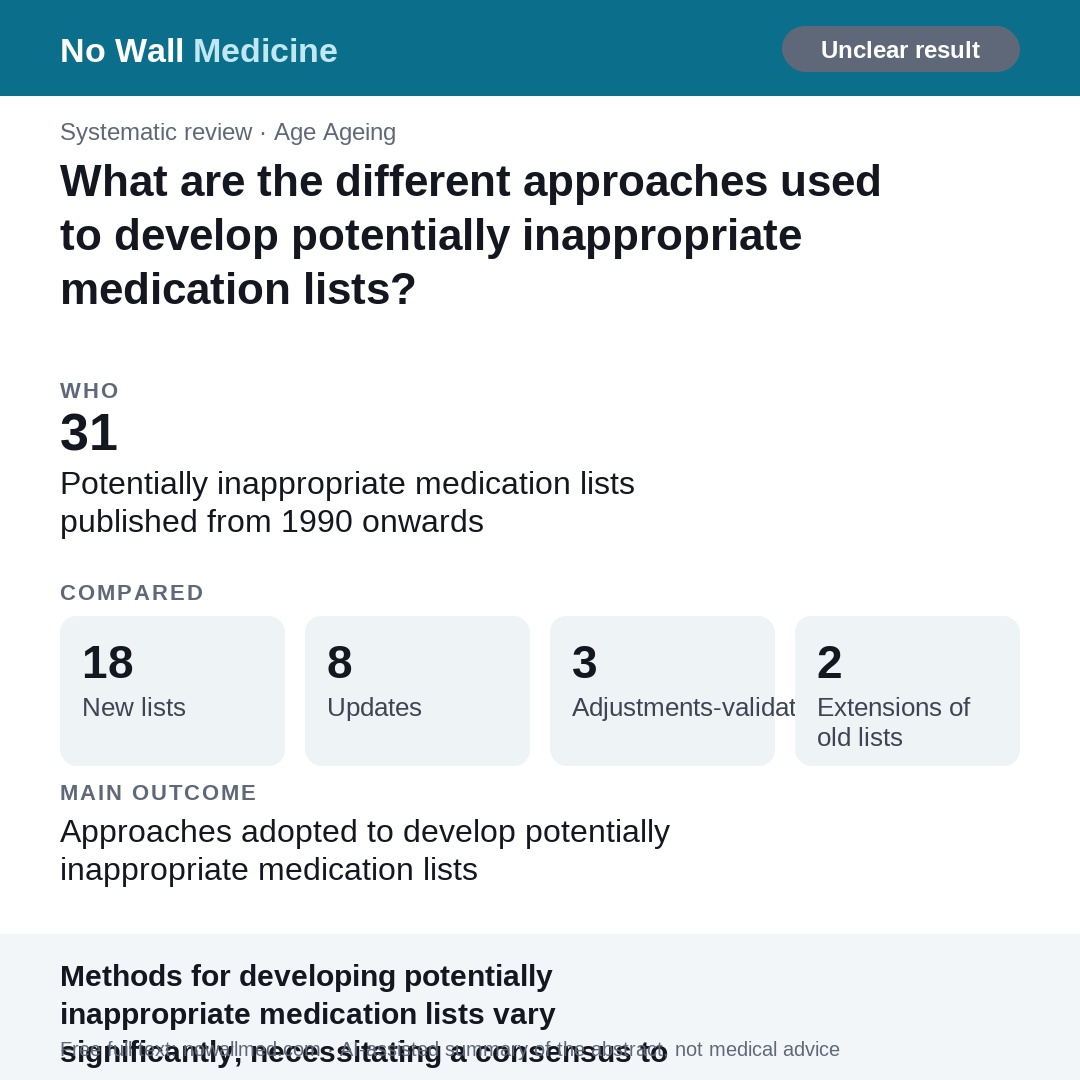
Clinical question: What are the different approaches used to develop potentially inappropriate medication lists?
Why it matters: Methods for creating lists of potentially inappropriate medications for older adults vary significantly, making it difficult to standardize how these drugs are identified.
Key points
- Researchers reviewed 31 lists of potentially inappropriate medications, including 18 new lists and 8 updates, to compare different development methods.
- The studies used different definitions for older adults, with age ranges spanning from ≥65 to ≥75 years.
- While the Delphi consensus technique was widely used, there were extensive variations in panelist selection and consensus thresholds.
Headline and key points written with AI from the paper’s abstract, with every number checked against it. Read the paper before relying on them.
Was this summary helpful?
Subject terms
Cite this article
Ammous O, Pieper D, Thürmann P, Mathes T. Potentially inappropriate medication lists for older people: a review of methods applied to the development. Age Ageing. 2025. doi:10.1093/ageing/afaf068
Spotted a mistake? Suggest a correction