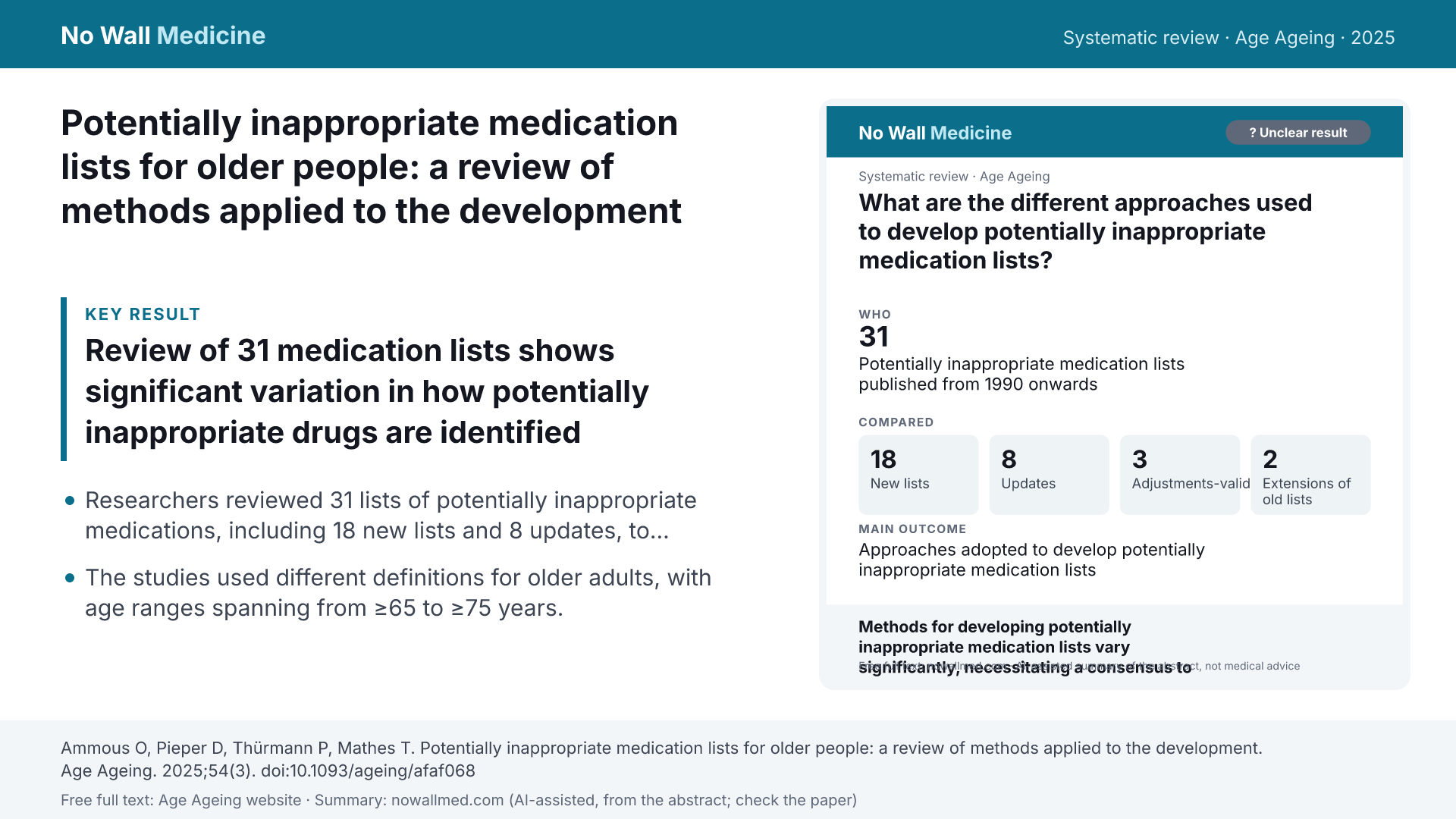
Potentially inappropriate medication lists for older people: a review of methods applied to the development
Key result: Review of 31 medication lists shows significant variation in how potentially inappropriate drugs are identified
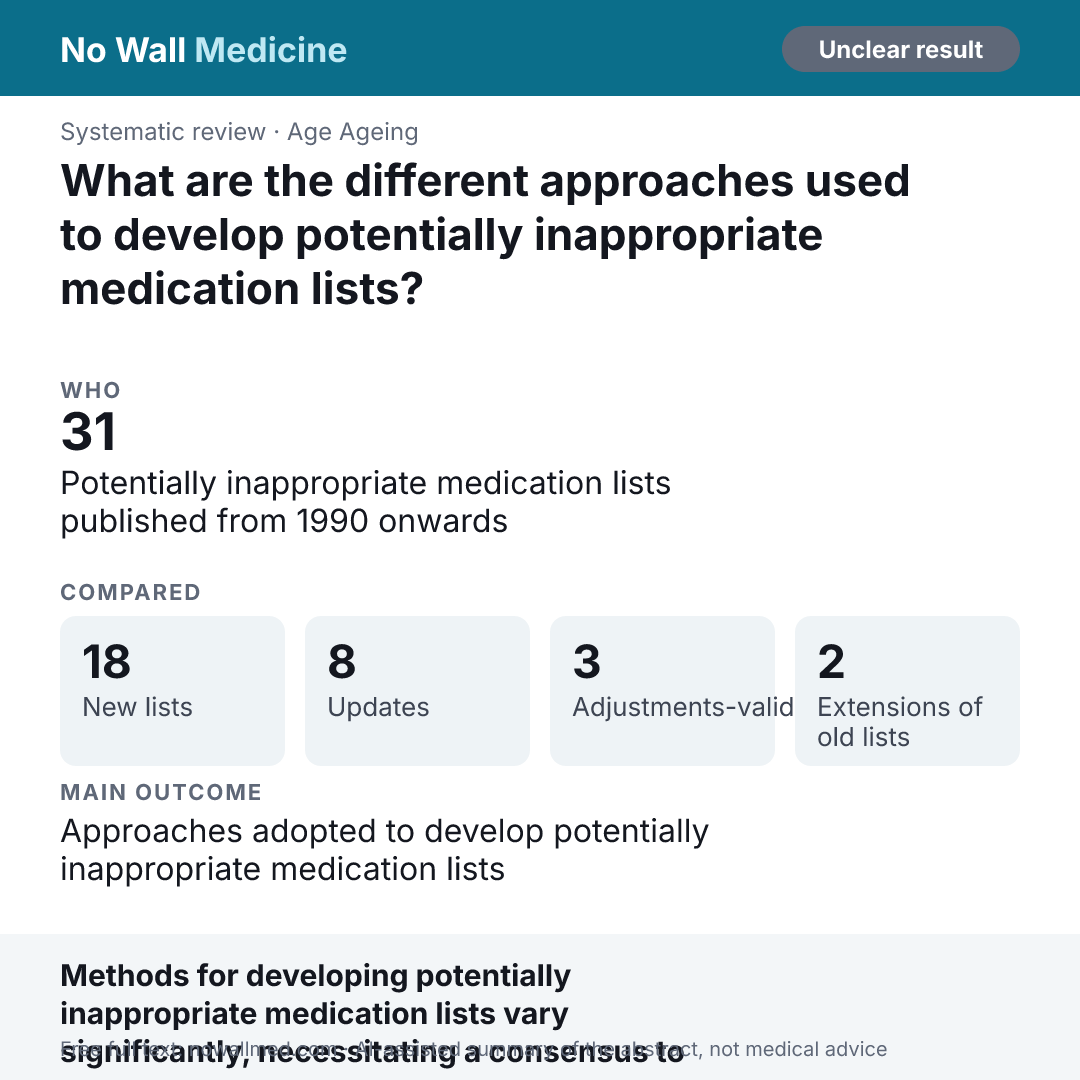
Systematic reviewUnclear result
What are the different approaches used to develop potentially inappropriate medication lists?
Who
31
Potentially inappropriate medication lists published from 1990 onwards
Compared
18New lists
8Updates
3Adjustments-validation
2Extensions of old lists
Main outcome
Approaches adopted to develop potentially inappropriate medication lists
Bottom line: Methods for developing potentially inappropriate medication lists vary significantly, necessitating a consensus to standardise development.
Limitation: Extensive variations in organization, panellist selection, and consensus thresholds were observed.
Age Ageing · 2025-03-28 · Save PNG
Key points
- Researchers reviewed 31 lists of potentially inappropriate medications, including 18 new lists and 8 updates, to compare different development methods.
- The studies used different definitions for older adults, with age ranges spanning from ≥65 to ≥75 years.
- While the Delphi consensus technique was widely used, there were extensive variations in panelist selection and consensus thresholds.
Why it matters: Methods for creating lists of potentially inappropriate medications for older adults vary significantly, making it difficult to standardize how these drugs are identified.
Discussion prompts
- Would these patients look like yours? Who was left out?
- Is the main outcome one that matters to patients?
- Is the difference large enough to change what you do?
Cite: Ammous O, Pieper D, Thürmann P, Mathes T. Potentially inappropriate medication lists for older people: a review of methods applied to the development. Age Ageing. 2025;54(3). doi:10.1093/ageing/afaf068
Free full text: Age Ageing website · Summary and visual abstract: nowallmed.com/a/potentially-inappropriate-medication-lists-for-older-people-a-review-1sc4wx8/ (AI-assisted from the abstract; check the paper before relying on it).