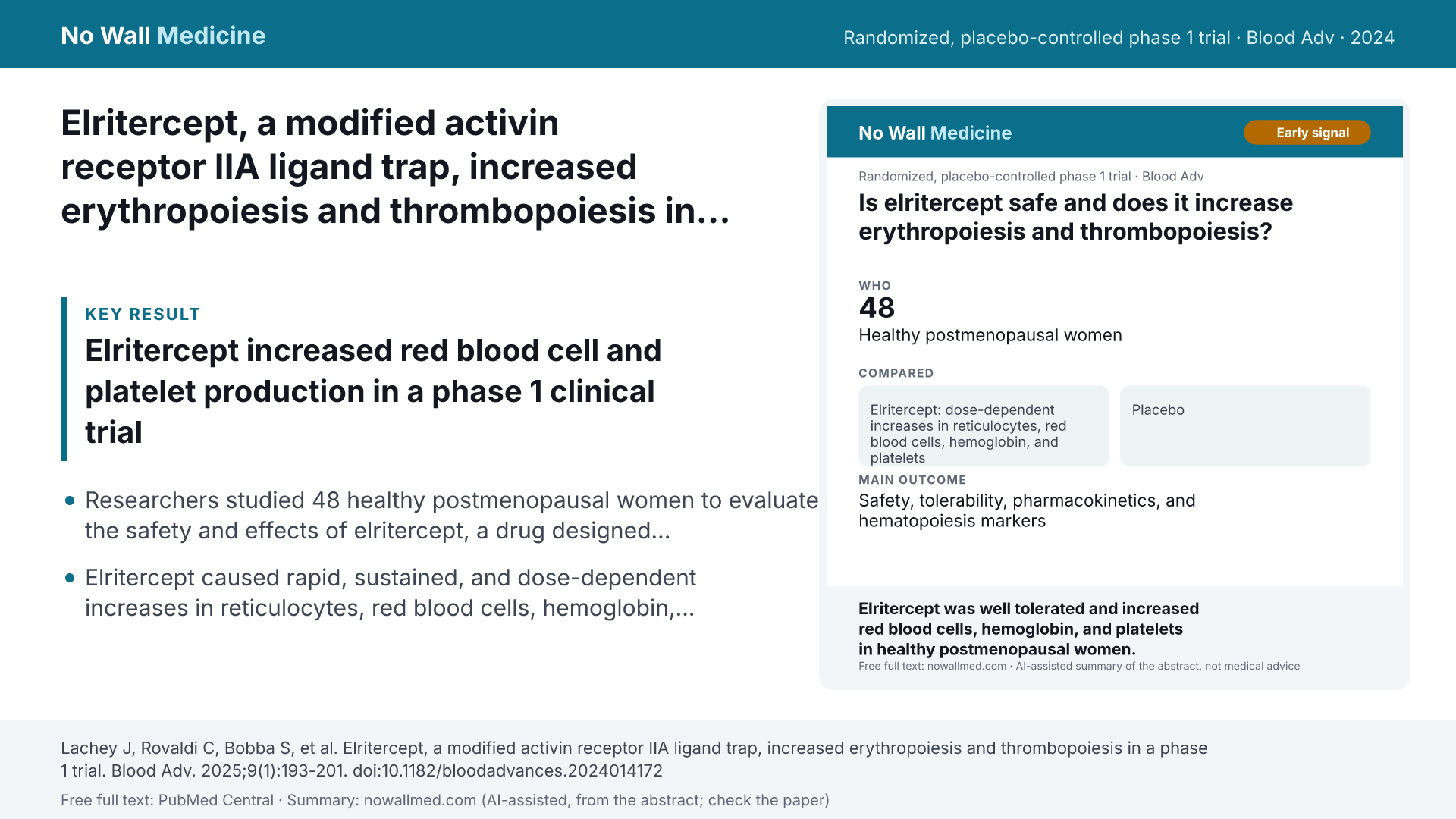
Elritercept, a modified activin receptor IIA ligand trap, increased erythropoiesis and thrombopoiesis in a phase 1 trial
Key result: Elritercept increased red blood cell and platelet production in a phase 1 clinical trial
Randomized, placebo-controlled phase 1 trialEarly signal
Is elritercept safe and does it increase erythropoiesis and thrombopoiesis?
Who
48
Healthy postmenopausal women
Compared
Elritercept: dose-dependent increases in reticulocytes, red blood cells, hemoglobin, and platelets
Placebo
Main outcome
Safety, tolerability, pharmacokinetics, and hematopoiesis markers
Bottom line: Elritercept was well tolerated and increased red blood cells, hemoglobin, and platelets in healthy postmenopausal women.
Blood Adv · 2024-10-23 · Save PNG

Key points
- Researchers studied 48 healthy postmenopausal women to evaluate the safety and effects of elritercept, a drug designed to inhibit certain proteins.
- Elritercept caused rapid, sustained, and dose-dependent increases in reticulocytes, red blood cells, hemoglobin, and platelets.
- The drug was generally well tolerated with no dose-limiting toxicities or serious adverse events observed across all dose levels.
Discussion prompts
- Would these patients look like yours? Who was left out?
- Is the main outcome one that matters to patients?
- Is the difference large enough to change what you do?
Cite: Lachey J, Rovaldi C, Bobba S, et al. Elritercept, a modified activin receptor IIA ligand trap, increased erythropoiesis and thrombopoiesis in a phase 1 trial. Blood Adv. 2025;9(1):193-201. doi:10.1182/bloodadvances.2024014172
Free full text: PubMed Central · Summary and visual abstract: nowallmed.com/a/elritercept-a-modified-activin-receptor-iia-ligand-trap-increased-cu6x51/ (AI-assisted from the abstract; check the paper before relying on it).