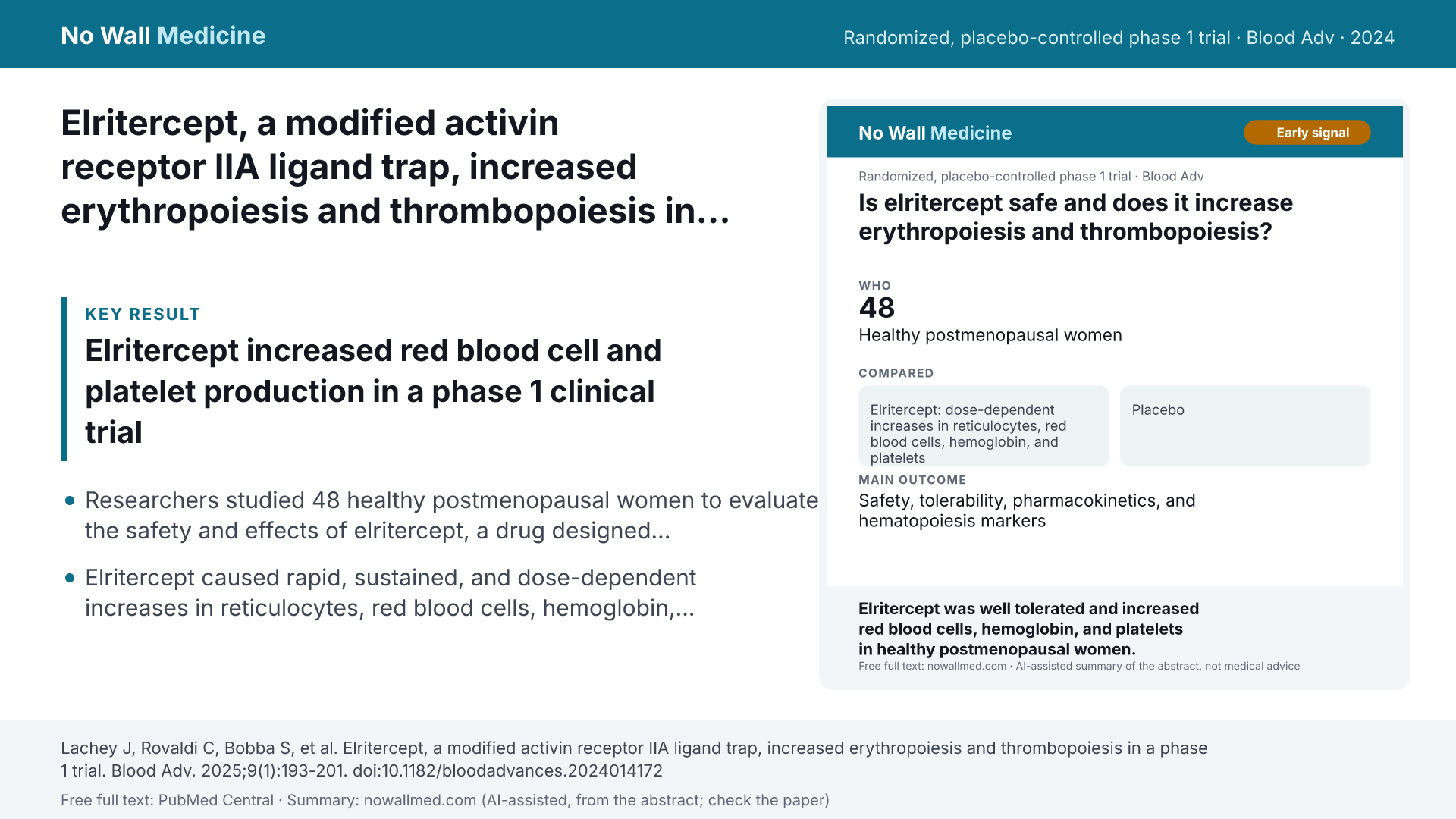
Elritercept increased red blood cell and platelet production in a phase 1 clinical trial
Elritercept, a modified activin receptor IIA ligand trap, increased erythropoiesis and thrombopoiesis in a phase 1 trial
Randomized, placebo-controlled phase 1 trialBenefit found
Is elritercept safe and does it increase erythropoiesis and thrombopoiesis?
Who
48
Healthy postmenopausal women
Compared
Elritercept: dose-dependent increases in reticulocytes, red blood cells, hemoglobin, and platelets
Placebo
Main outcome
Safety, tolerability, pharmacokinetics, and hematopoiesis markers
Bottom line: Elritercept was well tolerated and increased red blood cells, hemoglobin, and platelets in healthy postmenopausal women.
Blood Adv · 2024-10-23Download image

Clinical question: Is elritercept safe and does it increase erythropoiesis and thrombopoiesis?
Why it matters: It was unknown how elritercept affects the safety, movement through the body, and production of blood cells in humans.
Key points
- Researchers studied 48 healthy postmenopausal women to evaluate the safety and effects of elritercept, a drug designed to inhibit certain proteins.
- Elritercept caused rapid, sustained, and dose-dependent increases in reticulocytes, red blood cells, hemoglobin, and platelets.
- The drug was generally well tolerated with no dose-limiting toxicities or serious adverse events observed across all dose levels.
Headline and key points written with AI from the paper’s abstract, with every number checked against it. Read the paper before relying on them.
Was this summary helpful?
Abstract
The transforming growth factor β (TGF-β) superfamily plays a crucial role in regulating biological processes of virtually every tissue and system in the body, including hemostasis and hematopoiesis. Elritercept (KER-050) is an investigational, modified activin receptor type IIA ligand trap designed to bind and inhibit activin A and other select TGF-β superfamily ligands, including activin B, growth differentiation factor 8 (GDF-8), and GDF-11. The objectives of this phase 1 randomized, placebo-controlled study of elritercept were to evaluate the safety, tolerability, pharmacokinetics, and pharmacodynamic markers of activin inhibition and hematopoiesis in healthy postmenopausal women (N = 48). This study comprised 2 parts: single ascending doses ranging from 0.05 to 4.5 mg/kg; and multiple (up to 2 doses) ascending doses of 0.75 mg/kg administered subcutaneously (SC) every 4 weeks. Elritercept was generally well tolerated at all dose levels, with no dose-limiting toxicities observed. There were no severe or serious adverse events or clinically significant changes in safety laboratory measures. Serum concentrations increased in a dose-proportional manner after single SC doses, with peak concentrations achieved in 4.5 to 6 days and a mean elimination half-life of 12 days. These parameters were comparable after multiple doses. Elritercept elicited rapid, sustained, and dose-dependent increases in reticulocytes, red blood cells, hemoglobin, and platelets without eliciting detrimental changes in white blood cells such as neutrophils and lymphocytes. The time course and duration of changes in these cell populations supported a differentiated pharmacologic profile that is consistent with the stimulation of both early- and late-stage hematologic pathways. The trial was registered at www.anzctr.org.au/ as #ACTRN12619000318189.
Abstract reproduced under the article’s CC BY NC ND licence.
Subject terms
Cite this article
Lachey J, Rovaldi C, Bobba S, Tur J, Natarajan H, Snyder B. Elritercept, a modified activin receptor IIA ligand trap, increased erythropoiesis and thrombopoiesis in a phase 1 trial. Blood Adv. 2024. doi:10.1182/bloodadvances.2024014172
Spotted a mistake? Suggest a correction