Emotional and psychosocial function after dorsal column spinal cord stimulator implantation: a systematic review and meta-analysis
Systematic review and meta-analysisBenefit found
How does spinal cord stimulation affect emotional and psychosocial functioning in chronic pain patients?
Who
Patients who underwent spinal cord stimulator implantation for chronic pain
Compared
Post spinal cord stimulation
Pre spinal cord stimulation
Main outcome
Emotional and psychosocial functioning
Result: MD anxiety -2.16 (95% CI -2.84 to -1.49); MD depression -4.66 (95% CI -6.26 to -3.06); MD global functioning 20.30 (95% CI 14.69 to 25.90); MD mental well-being 4.95 (95% CI 3.60 to 6.31); MD pain catastrophizing -12.09 (95% CI -14.94 to -9.23)
Bottom line: Spinal cord stimulation leads to significant improvements in emotional and psychosocial outcomes for patients with chronic pain.
Limitation: Results should be interpreted with caution due to very low certainty of evidence.
Reg Anesth Pain Med · 2025-10-06Download image
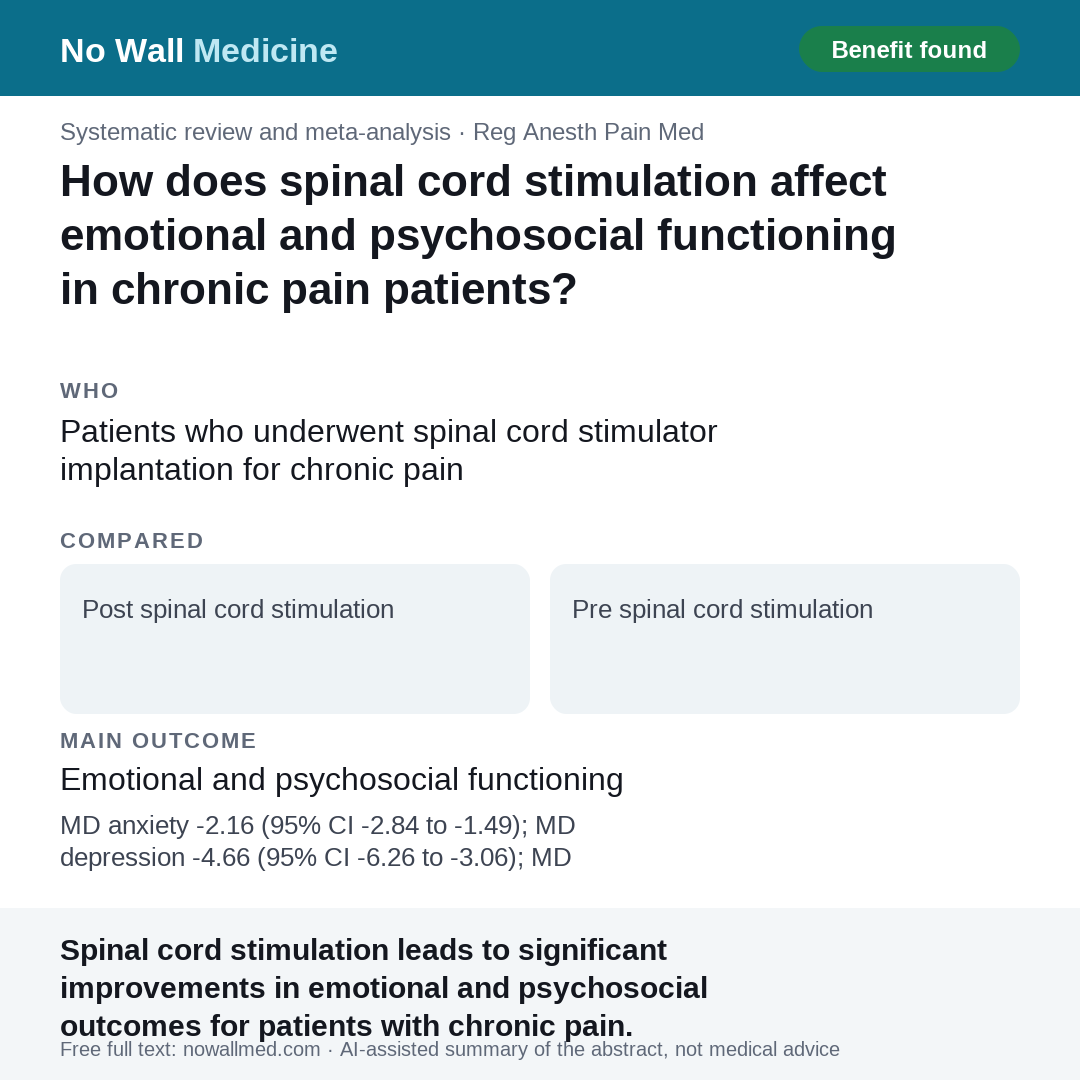
Clinical question: How does spinal cord stimulation affect emotional and psychosocial functioning in chronic pain patients?
Abstract
Background
The efficacy of spinal cord stimulation (SCS) in chronic pain studies is traditionally assessed by pain scores, which do not reflect the multidimensional nature of pain perception. Despite the evidence of SCS's influence on emotional functioning comprehensive assessments of its effect remain lacking. Objective
To assess changes in emotional and psychosocial functioning in patients who underwent SCS implantation for chronic pain. Evidence review
Ovid MEDLINE, EMBASE, PsychINFO, Cochrane CENTRAL and Scopus databases were searched for original peer-reviewed publications reporting emotional functioning after SCS. The primary outcomes were a pooled mean difference (MD) in anxiety, depression, global functioning, mental well-being and pain catastrophizing at 12 months. The Grading of Recommendation, Assessment, Development, and Evaluation (GRADE) was used to determine the quality of evidence. Findings
Thirty-two studies were included in the primary analysis. Statistically significant improvements were observed in anxiety (MD -2.16; 95% CI -2.84 to -1.49; p<0.001), depression (MD -4.66; 95% CI -6.26 to -3.06; p<0.001), global functioning (MD 20.30; 95% CI 14.69 to 25.90; p<0.001), mental well-being (MD 4.95; 95% CI 3.60 to 6.31; p<0.001), and pain catastrophizing (MD -12.09; 95% CI -14.94 to -9.23; p<0.001). Subgroup analyses revealed differences in Global Assessment of Functioning and mental well-being based on study design and in depression based on waveform paradigm. Conclusion
The results highlight the statistically and clinically significant improvements in emotional and psychosocial outcomes in patients with chronic pain undergoing SCS therapy. However, these results need to be interpreted with caution due to the very low certainty of evidence per the GRADE criteria. Prospero registration
CRD42023446326.
Abstract reproduced under the article’s CC BY NC licence.
Topics
Cite this article
Klasova J, Hussain N, Umer I, Al-Hindawi A, ElSaban M, Lahori S. Emotional and psychosocial function after dorsal column spinal cord stimulator implantation: a systematic review and meta-analysis. Reg Anesth Pain Med. 2025. doi:10.1136/rapm-2024-105523
Spotted a mistake? Suggest a correction