Closed-loop spinal cord stimulation provided more sustained pain relief than open-loop stimulation at 36 months
ECAP-controlled closed-loop versus open-loop SCS for the treatment of chronic pain: 36-month results of the EVOKE blinded randomized clinical trial
Randomized, controlled, parallel-arm clinical trialBenefit found
Is closed-loop spinal cord stimulation better than open-loop stimulation for chronic pain?
Who
Participants with chronic, intractable back and leg pain · Multicenter
Compared
77.6%closed-loop spinal cord stimulation
49.3%open-loop spinal cord stimulation
Main outcome
Reduction of at least 50% in overall back and leg pain
Result: difference: 28.4%, 95% CI 12.8% to 43.9%
Bottom line: Closed-loop spinal cord stimulation provided superior and durable pain relief and holistic treatment response compared to open-loop stimulation.
Reg Anesth Pain Med · 2024-05-07Download image
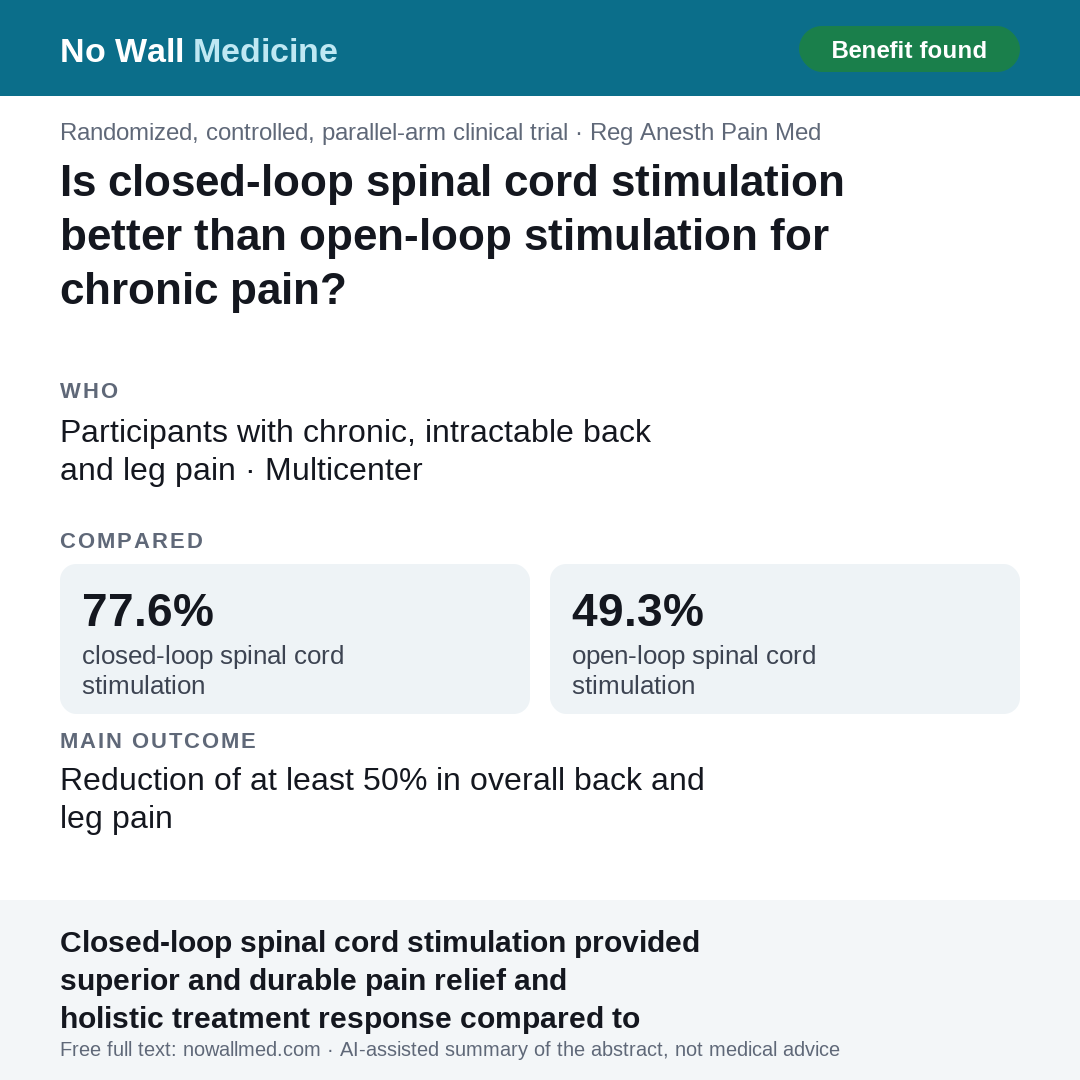
Clinical question: Is closed-loop spinal cord stimulation better than open-loop stimulation for chronic pain?
Why it matters: It was unknown if closed-loop spinal cord stimulation provides better long-term outcomes and more durable pain relief than traditional open-loop stimulation.
Key points
- Researchers conducted a randomized trial comparing closed-loop spinal cord stimulation, which uses electrical feedback, to open-loop stimulation, which uses fixed output, in patients with chronic back and leg pain.
- At 36 months, 77.6% of the closed-loop group reported at least 50% pain reduction compared to 49.3% in the open-loop group.
- The closed-loop group also showed higher rates of 80% pain reduction at 49.3% versus 31.3% for the open-loop group.
Headline and key points written with AI from the paper’s abstract, with every number checked against it. Read the paper before relying on them.
Abstract
Introduction
The evidence for spinal cord stimulation (SCS) has been criticized for the absence of blinded, parallel randomized controlled trials (RCTs) and limited evaluations of the long-term effects of SCS in RCTs. The aim of this study was to determine whether evoked compound action potential (ECAP)-controlled, closed-loop SCS (CL-SCS) is associated with better outcomes when compared with fixed-output, open-loop SCS (OL-SCS) 36 months following implant. Methods
The EVOKE study was a multicenter, participant-blinded, investigator-blinded, and outcome assessor-blinded, randomized, controlled, parallel-arm clinical trial that compared ECAP-controlled CL-SCS with fixed-output OL-SCS. Participants with chronic, intractable back and leg pain refractory to conservative therapy were enrolled between January 2017 and February 2018, with follow-up through 36 months. The primary outcome was a reduction of at least 50% in overall back and leg pain. Holistic treatment response, a composite outcome including pain intensity, physical and emotional functioning, sleep, and health-related quality of life, and objective neural activation was also assessed. Results
At 36 months, more CL-SCS than OL-SCS participants reported ≥50% reduction (CL-SCS=77.6%, OL-SCS=49.3%; difference: 28.4%, 95% CI 12.8% to 43.9%, p<0.001) and ≥80% reduction (CL-SCS=49.3%, OL-SCS=31.3%; difference: 17.9, 95% CI 1.6% to 34.2%, p=0.032) in overall back and leg pain intensity. Clinically meaningful improvements from baseline were observed at 36 months in both CL-SCS and OL-SCS groups in all other patient-reported outcomes with greater levels of improvement with CL-SCS. A greater proportion of patients with CL-SCS were holistic treatment responders at 36-month follow-up (44.8% vs 28.4%), with a greater cumulative responder score for CL-SCS patients. Greater neural activation and accuracy were observed with CL-SCS. There were no differences between CL-SCS and OL-SCS groups in adverse events. No explants due to loss of efficacy were observed in the CL-SCS group. Conclusion
This long-term evaluation with objective measurement of SCS therapy demonstrated that ECAP-controlled CL-SCS resulted in sustained, durable pain relief and superior holistic treatment response through 36 months. Greater neural activation and increased accuracy of therapy delivery were observed with ECAP-controlled CL-SCS than OL-SCS. Trial registration number
NCT02924129.
Abstract reproduced under the article’s CC BY NC licence.
Topics
Cite this article
Mekhail NA, Levy RM, Deer TR, Kapural L, Li S, Amirdelfan K. ECAP-controlled closed-loop versus open-loop SCS for the treatment of chronic pain: 36-month results of the EVOKE blinded randomized clinical trial. Reg Anesth Pain Med. 2024. doi:10.1136/rapm-2023-104751
Spotted a mistake? Suggest a correction
Top studies every Monday
The week’s key trials and guidelines in your specialties, plus any topics you follow. By email, free.
Get the weekly digest